You�re probably here because your golf cart stopped feeling simple.
Maybe you use it for quick rides to the clubhouse, the pool, a neighbor�s house, or the corner market in your community. Then someone tells you your teenager can�t drive it anymore. A neighbor says you need a tag if the cart goes too fast. Another person insists local rules matter more than state law. Suddenly, a vehicle that seemed easier than a car comes with its own legal maze.
That confusion is normal. Florida�s rules changed, local ordinances still matter, and the line between a regular golf cart and a street-legal low-speed vehicle can be thinner than most owners realize. The good news is that the rules make more sense once you sort them into a few practical questions: What exactly are you driving? Where are you driving it? Who is driving it? And if you�ve modified it, what did that change legally?
Why Understanding Florida Golf Cart Laws Matters Now
A lot of Florida families treat a golf cart like a neighborhood tool. It�s casual, open-air, and feels low-risk. That�s exactly why people get caught off guard when a stop by local law enforcement turns into a citation, or when an accident brings up questions about age, equipment, and whether the vehicle was even legal for that road.
The stakes are bigger than many drivers assume. Florida golf cart crashes lead to an estimated 15,604 emergency room visits annually, and 70.3% occur away from golf courses on public streets or property, according to Florida golf cart accident statistics. In plain terms, the biggest risk often isn�t on the fairway. It�s in the places people treat as familiar and harmless.
Why the rules changed
Florida tightened golf cart rules in 2023 after lawmakers focused on injury risks and underage operation on public roads. That change caught many residents by surprise because older habits linger. In many communities, people still repeat rules that were common before the law changed.
If you haven�t checked the law recently, you may be relying on outdated advice from a neighbor, a Facebook group, or a dealership conversation. That�s risky, especially if your household includes teens or if your cart has been upgraded over time.
Golf cart law problems usually start with one bad assumption: �I�ve always done it this way, so it must still be legal.�
Why this matters for everyday drivers
Understanding florida golf cart laws isn�t about making a simple vehicle feel complicated. It�s about staying out of preventable trouble. You want to know whether your route is allowed, whether your child can operate the cart, and whether your �slightly faster� upgrade moved you into a different legal category.
If you want a broader look at recent rule changes affecting drivers across the state, new Florida traffic laws are worth reviewing alongside golf cart rules. Many drivers only look up golf cart law after a warning or ticket. It�s much easier to learn the rules before that happens.
Is It a Golf Cart or a Low-Speed Vehicle
This is the question that controls almost everything else.
Many owners use the terms interchangeably, but Florida law doesn�t. A regular golf cart and a low-speed vehicle, often called an LSV, may look similar from the curb, yet the legal consequences are completely different. The easiest analogy is this: they�re like a bicycle and a moped. They may both be small, but the law treats them differently because their speed, equipment, and road use are different.
The speed line that changes everything
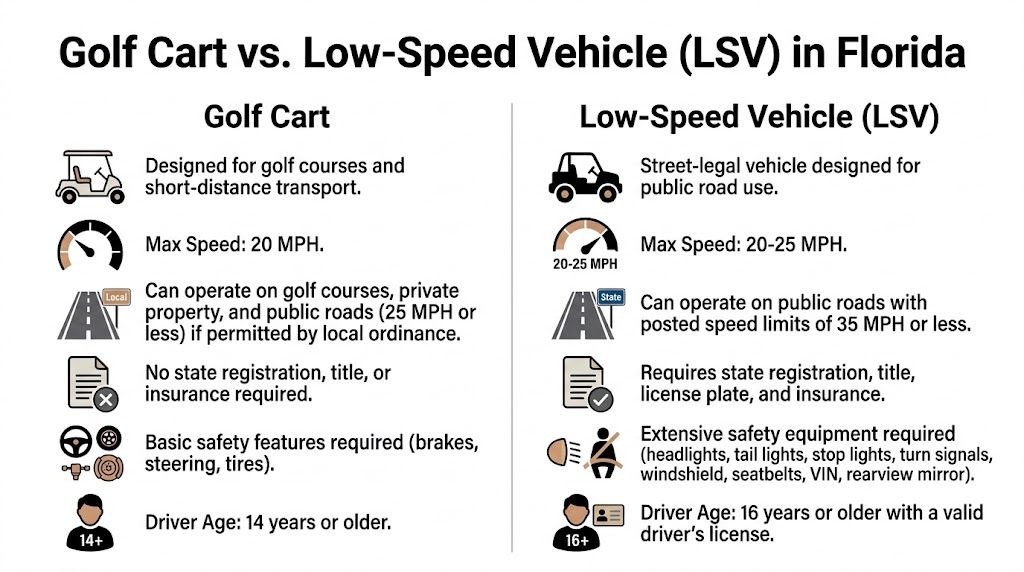
Under Florida law, a golf cart is a vehicle that can�t exceed 20 mph, while a vehicle that goes more than 20 mph but not more than 25 mph becomes a Low-Speed Vehicle. That definition appears in Florida golf cart laws under sections 320.01(22) and 320.01(42).
That means a speed upgrade isn�t just a mechanical tweak. It�s a legal reclassification.
If your cart goes even a little faster than the golf cart threshold, the law starts treating it more like a motor vehicle. That change triggers requirements for registration, insurance, and equipment that many owners don�t expect.
Quick comparison
| Vehicle type | Speed capability | Basic legal treatment |
|---|---|---|
| Golf cart | 20 mph or less | Mostly governed by state and local golf cart rules |
| LSV | More than 20 mph up to 25 mph | Treated much more like a standard motor vehicle |
That table looks simple, but the practical difference is huge.
What changes when a cart becomes an LSV
Once a cart crosses into LSV territory, owners need to think in motor vehicle terms instead of neighborhood-cart terms.
A lawful LSV generally needs the kinds of features drivers associate with road vehicles, not golf course vehicles. That includes equipment such as lighting, mirrors, a windshield, and seatbelts, along with titling, registration, and insurance obligations tied to its new status.
Here�s the practical takeaway:
- If it stays a golf cart: You�re dealing with the narrower rules that apply to golf carts.
- If it becomes an LSV: You now have to satisfy a broader set of street-legal requirements.
- If you modify first and ask questions later: You can end up driving something that feels fine mechanically but is illegal on public roads.
Practical rule: Don�t judge by appearance. Judge by top speed and legal classification.
Common owner confusion
People often get confused in three places.
- �It only goes a little faster.� Even a small bump above the golf cart speed threshold matters legally.
- �The dealer added lights, so I�m good.� Added equipment helps, but equipment alone doesn�t settle the classification issue.
- �Everyone in my community drives these.� Community habits don�t override state definitions or local ordinances.
If you want to compare these rules with Florida�s broader vehicle and licensing framework, the Florida drivers manual helps put golf cart and LSV obligations into context.
Why this distinction matters before you modify
Owners usually think about modifications in terms of performance and appearance. The law cares about classification and compliance. Those are not the same thing.
A faster motor, different controller, or other performance upgrade can create a chain reaction. Once the cart qualifies as an LSV, the owner has to think about title work, registration, insurance, lawful road access, and required safety equipment. Skip those steps, and the vehicle may be illegal the moment it leaves private property for a public roadway.
Navigating Public Roads and Neighborhood Streets
Most confusion about florida golf cart laws comes from one practical question: where can you drive?
State law gives you the framework, but your city or county may tighten the details. That�s why two nearby Florida communities can feel very different in practice. One neighborhood may allow carts on certain streets with signs and local approval, while the next community may restrict the same type of driving.
The basic road rule
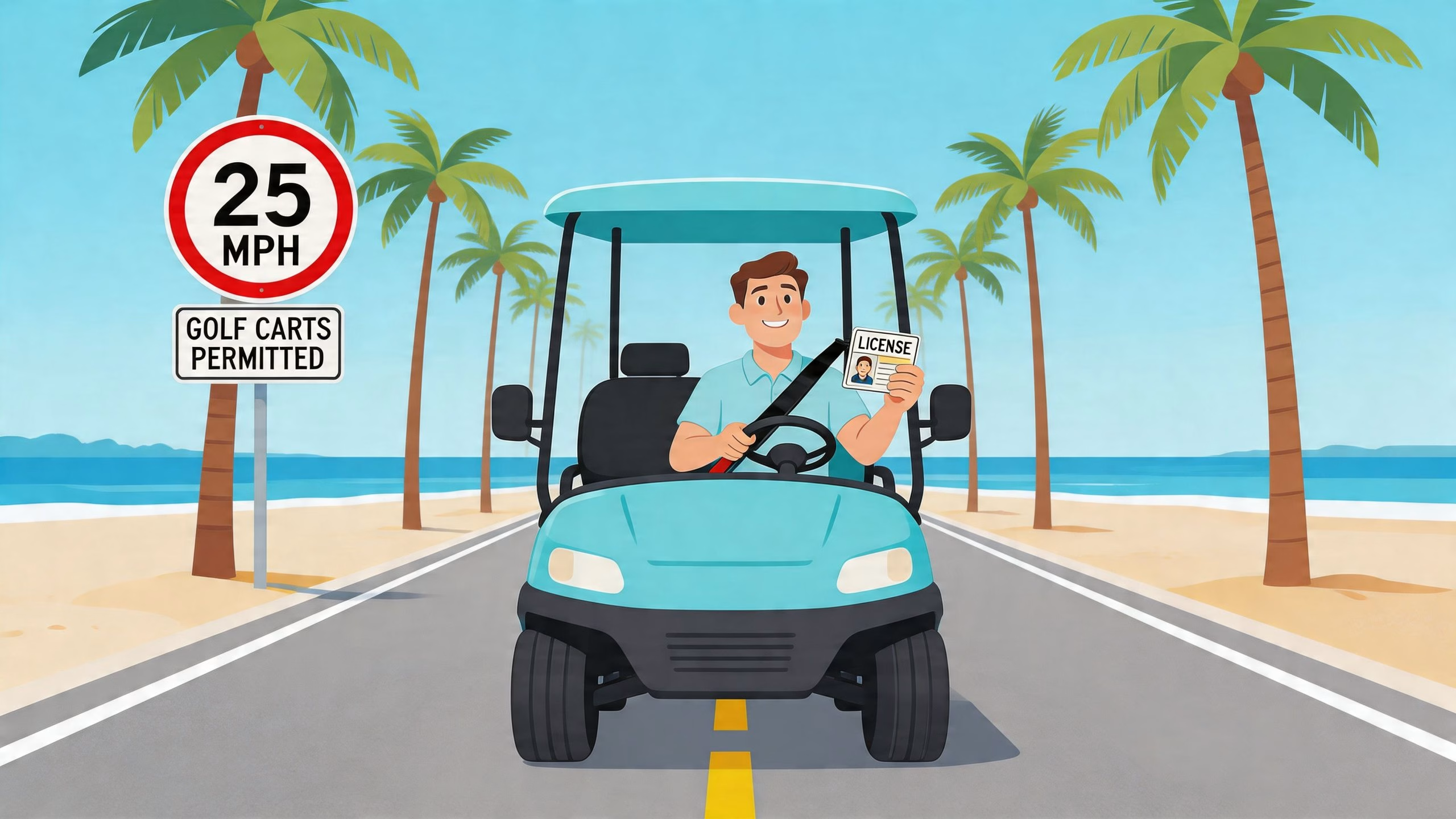
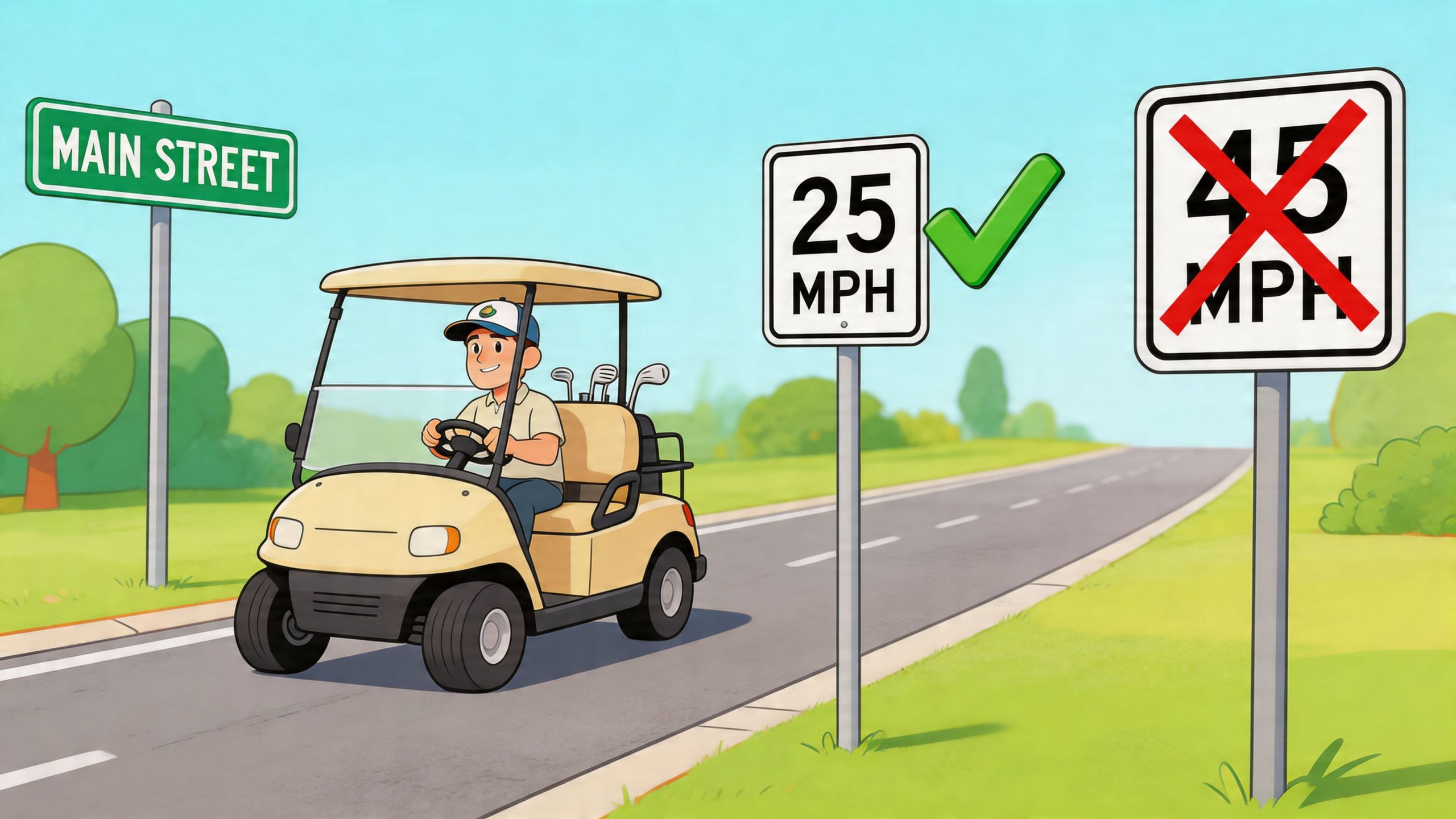
Under Florida Statute 316.212, golf carts are generally limited to local roads with speed limits of 30 mph or less, while LSVs can operate on roads up to 35 mph, as explained in this summary of Florida golf cart and low-speed vehicle laws. That distinction matters because crash force rises sharply as speed increases.
The safety logic is straightforward. A small, lightly protected vehicle is more vulnerable in faster traffic. Even when drivers feel comfortable, the road environment may not be appropriate for the vehicle they�re using.
Think in zones, not in miles
A useful way to stay legal is to stop thinking, �Can my cart handle this road?� and start thinking, �Is this road legally matched to my vehicle type?�
Use this mental map:
- Neighborhood streets and community roads: Often the most likely place where a golf cart may be allowed, if local rules permit it.
- Collector roads with heavier traffic: These may be legal only for LSVs, or not appropriate at all.
- Main roads that feel only slightly busier: They often create trouble because drivers assume �close enough� is safe enough.
- State and higher-speed roads: Usually where drivers make the most expensive mistakes.
A simple example
Suppose you live in a planned community and want to drive from your home to a nearby shopping area.
If your vehicle is a standard golf cart, the question isn�t just distance. It�s whether every public segment of that route is on roads your local government has approved for golf cart use. If one stretch falls outside that limit, your trip may be illegal even if most of the route is fine.
If your vehicle is an LSV, you may have more flexibility, but only if the vehicle is fully legal as an LSV. That means properly equipped, registered, and insured.
On golf cart routes, one short illegal segment can create the whole problem.
Crossing a busier road
Crossing can confuse people because �crossing� and �driving along� are not the same thing. In some cases, a cart may lawfully cross a road under conditions allowed by law and local regulation, even when it can�t travel down that road for any distance.
That�s why route planning matters. Before you leave home, check not just your destination but the exact path. A legal crossing point may save you from using a prohibited stretch of roadway.
A short visual overview can help if you�re comparing common road situations and local-use examples:
Local ordinances matter more than many drivers realize
State law sets the outer boundaries. Local governments decide a lot of the day-to-day details, including which roads are designated for golf cart use and what added conditions may apply.
That means you shouldn�t rely on these weak forms of advice:
- �People always drive there.�
- �I saw another cart on that road.�
- �The community used to allow it.�
Instead, check your city, county, or community transportation rules directly. Signage matters. So do local maps and posted restrictions.
The safest habit
When in doubt, treat your golf cart route like a school-zone route for a new teen driver. Keep it simple, familiar, and clearly legal. If a road feels borderline, it probably deserves a second look before you drive it.
That approach won�t just help you avoid tickets. It also reduces the chance of putting a small vehicle into a traffic setting it wasn�t designed to handle.
New Age Limits and Required Safety Equipment
The rule change that surprises families most is the age rule. For years, many Floridians assumed a young teen could legally drive a golf cart on community roads. That assumption is outdated.
Who can legally drive now
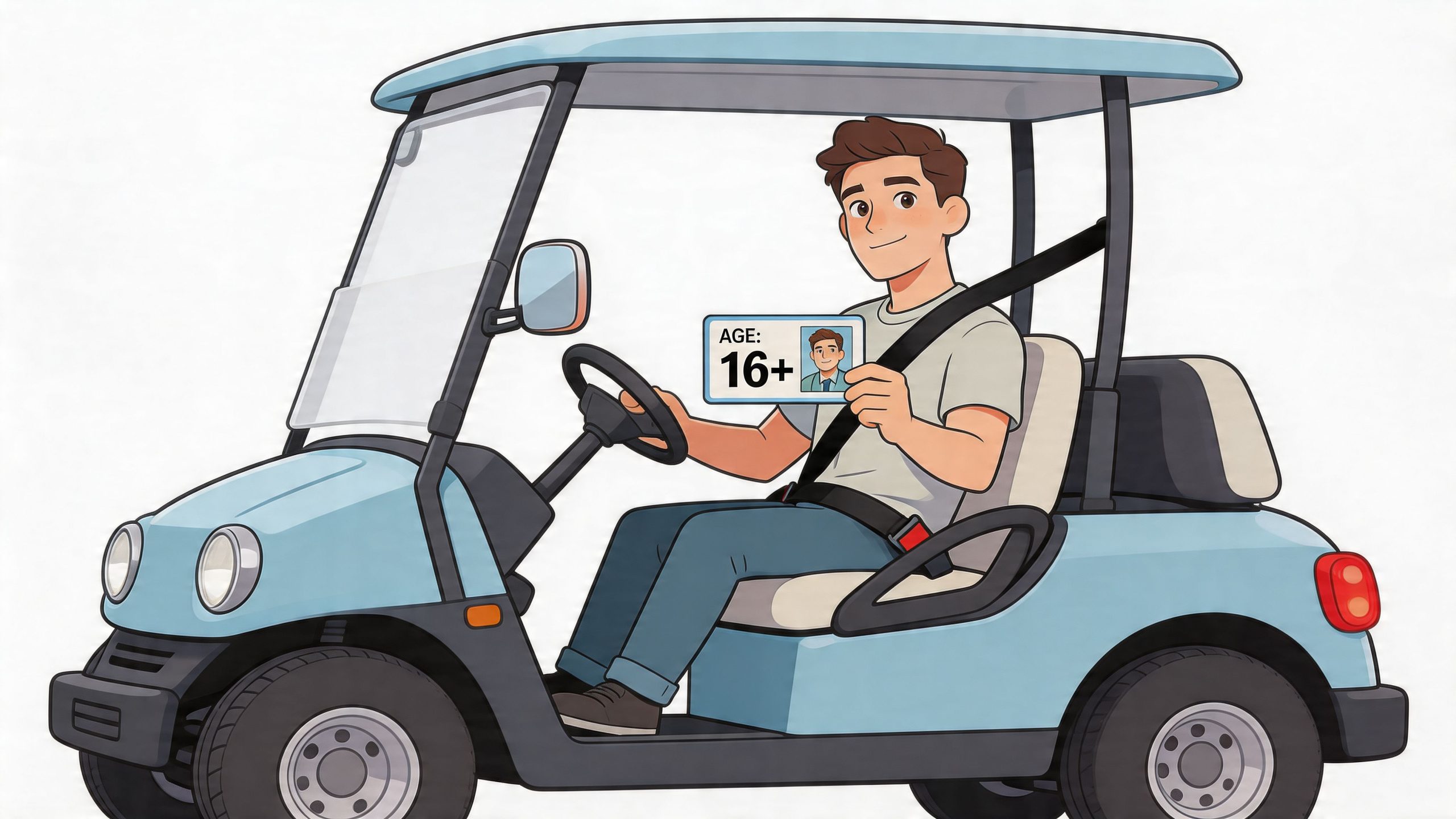
Effective October 1, 2023, House Bill 949 changed Florida law so that golf cart operators on public roads must be 18 or older with government-issued photo ID, or 16 to 17 with a valid driver�s license, or 15 with a learner�s permit, according to the Florida golf cart safety law update.
That replaced the older idea, common in many localities, that 14-year-olds could operate a golf cart without those newer conditions.
Why parents get tripped up
The confusion usually comes from mixing old community habits with new statewide rules.
A parent may think, �My child has driven around here for years,� or �It�s just inside our development.� But once the operation is on public roads covered by the statute, age and identification rules matter. An officer won�t grade on a curve because the route feels informal or familiar.
Here�s the easiest way to remember it:
- Age 15: learner�s permit required
- Age 16 to 17: valid driver�s license required
- Age 18 and older: government-issued photo ID required
Student IDs and community badges may be useful in daily life, but the law focuses on government-issued photo identification for adults.
If an adult drives a golf cart on a public road, carrying photo ID isn�t optional. It�s part of lawful operation.
Equipment for a standard golf cart
A regular golf cart doesn�t need the full equipment package of an LSV, but it still needs to be safe for lawful use where permitted. Think of this as the minimum �roadworthy for cart use� standard.
A practical self-check includes:
- Brakes that work smoothly: The cart should stop predictably, not pull, grab, or fade.
- Steering you can trust: Loose steering is a safety problem, even at lower speeds.
- Tires in safe condition: Worn or damaged tires matter on pavement, not just on the course.
- Rearview mirror: You need a usable view behind you.
- Reflectors: Visibility matters, especially in shared-use areas.
Equipment for an LSV
An LSV is in a different category, so the equipment list is broader and more like a small road vehicle.
Look for these kinds of street-legal features:
| Standard golf cart | LSV |
|---|---|
| Basic operational safety items | Full road-use equipment package |
| Mirror and reflectors | Headlamps, turn signals, taillamps, stop lamps |
| Safe brakes, steering, tires | Windshield, mirrors, parking brake, seatbelts |
| Limited road use when locally allowed | Registration-related equipment expectations |
If you�re familiar with other small vehicle laws, Florida laws on mopeds offer a useful comparison in how speed, equipment, and licensing can change the legal treatment of a vehicle that seems minor at first glance.
A smart household policy
Many families share one cart among adults, teens, and visiting relatives. That�s where mistakes happen.
Create one simple rule for your household: nobody drives the cart on a public road unless the family has already verified three things. First, the driver�s age and credentials. Second, the vehicle�s legal classification. Third, the route�s legality under local rules.
That short pause prevents a lot of expensive misunderstandings.
Common Violations and Their Consequences
Most violations don�t happen because someone set out to break the law. They happen because someone treated the golf cart like a casual exception to normal traffic rules.
A common example is the underage driver. A family lets a teen take the cart a short distance inside the neighborhood because �it�s only a few blocks.� But if the teen doesn�t meet the current legal requirement for operation on public roads, that ride can lead to a citation. Some law firms have reported a 25%+ increase in citations for underage golf cart operation after the law change, as discussed in this video summary of the enforcement trend.
Scenario one: the family shortcut
A parent is making dinner. Their child offers to run a quick errand in the golf cart. The route is familiar, slow, and close to home. The problem is that �short� and �safe-feeling� don�t answer the legal question of whether the child is old enough and properly credentialed to operate the cart on that public route.
When that goes wrong, the issue doesn�t always stop with the child. Parents may face civil exposure if the child causes a crash, and legal trouble can widen quickly if injuries are involved.
Scenario two: the upgraded cart with no paperwork
An owner installs performance upgrades because traffic in the community seems a little faster than before. The cart now moves beyond the legal golf cart threshold, but the owner never titles or registers it as an LSV and never brings the equipment up to the required standard.
That creates a layered problem. The vehicle may be unlawful for the road, uninsured for the actual risk being taken, and far more difficult to defend after a stop or crash.
Scenario three: using the wrong road because �everyone does it�
This is one of the most common mistakes. A driver sees golf carts on a road and assumes that makes the road legal for them too. But the legal answer depends on the vehicle type, the posted speed limit, and local designation.
That�s why a driver can get cited while convinced they were following community custom.
What penalties can follow
Florida violations involving golf cart operation can be treated as noncriminal traffic infractions, and fines can range from $60 to $500 under the verified statewide summary in the earlier-cited safety material. Depending on the situation, a driver may also face related consequences involving insurance, civil liability, or license points.
If you�re trying to understand how traffic penalties affect your record, driver license points give a useful overview of why even �small� traffic matters can carry longer consequences.
A golf cart citation may feel minor on the roadside. It can feel much less minor when it affects your record, your insurance, or a family lawsuit.
The issue drivers underestimate most
People often underestimate impairment and reckless behavior in golf carts and LSVs because the vehicle feels recreational. That�s a dangerous mindset. A smaller vehicle can still injure pedestrians, passengers, cyclists, and other drivers, especially in mixed-use neighborhoods and parking areas.
The safer mindset is simple: if you�d stop and think before doing it in a car, stop and think before doing it in a golf cart too.
Your Checklist for Safe and Legal Golf Carting
By this point, the rules usually become clearer. The challenge is putting them into action before something goes wrong. A checklist helps because it turns broad legal ideas into a routine you can follow.
Start with classification, not accessories
Before you buy upgrades, route your trips, or hand the key to a family member, identify the vehicle correctly.
Ask yourself:
- What is its actual top speed? That question determines whether you�re dealing with a golf cart or an LSV.
- Has anything been modified? Motor, controller, tires, or gearing changes may matter.
- Are you relying on appearance? A cart can look ordinary and still be legally reclassified.
This first step prevents the most common owner mistake, which is assuming a modified cart is still �just a golf cart.�
Check local rules before your route becomes a habit
Once you know the vehicle type, check your city or county rules for where it can go. Don�t build a routine around what neighbors do. Build it around posted rules and local approvals.
A good habit is to verify:
- Road eligibility: Is the route approved for your vehicle type?
- Crossing points: If you need to cross a busier road, is that crossing lawful and safe?
- Community-specific conditions: Some areas add local operating restrictions or equipment expectations.
Audit the vehicle itself
A legal route doesn�t help if the cart is missing required safety features or is in poor mechanical shape.
Use a simple walk-around before regular use:
- Look at tires and steering: Small handling issues feel bigger on pavement.
- Test braking response: Don�t assume low speed makes weak brakes acceptable.
- Confirm mirrors, reflectors, lights, and belts as required: The exact list depends on whether it�s a golf cart or LSV.
- Keep up with routine care: A practical golf cart maintenance checklist can help you catch the everyday problems that often turn into safety problems.
The legal checklist and the maintenance checklist belong together. A cart that�s lawful on paper still needs to be safe in motion.
Be careful with modifications
This is the part many owners overlook until after money has already been spent.
According to this explanation of Florida golf cart modification and legal assistance issues, converting a golf cart into an LSV can cost $1,000 to $5,000 for parts and labor, and failing to title and register it properly can lead to fines up to $500 per violation while also risking insurance problems after a crash.
That means a �budget upgrade� can become expensive in a hurry if the legal steps are skipped.
Confirm every driver in the household
The final check is personal, not mechanical.
Make sure each person who may use the cart knows:
- whether they�re old enough to drive it legally on public roads
- what identification or license they need
- which roads are off-limits
- whether the vehicle is a golf cart or an LSV
Confidence comes from clarity. The safest owners are not the ones who guess well. They�re the ones who verify first.
Frequently Asked Questions About Florida Golf Cart Laws
Some questions come up again and again because they sit in the gray area between �common sense� and �actual law.� Here are the practical answers drivers usually need most.
Can I drive a golf cart on the sidewalk
In general, treat sidewalks as pedestrian space, not golf cart space, unless a specific local rule clearly allows otherwise. Most legal questions about sidewalks should be answered by local ordinance, not by assumption. If a path is meant for golf carts, communities usually identify it clearly.
Do I need insurance for a regular golf cart
A standard golf cart isn�t treated the same way as an LSV for insurance purposes. The biggest mistake owners make is assuming that means insurance doesn�t matter. Even when a policy isn�t required in the same way it would be for an LSV, owners should still understand their exposure if they injure someone or damage property.
Can I get a DUI on a golf cart
You should assume impaired operation is a serious legal risk. Don�t treat a golf cart ride after drinking as a harmless loophole. If the vehicle is being operated in a traffic setting, the consequences can become very real very fast.
What happens if I modify my cart to go faster
That�s one of the most important questions in all of florida golf cart laws. A speed increase can move the vehicle out of golf cart status and into LSV status, which changes equipment, registration, insurance, and road-use obligations.
The practical answer is simple: don�t modify first and research later.
Is a light kit enough to make my cart street legal
Usually, no. Lights may be part of compliance, but they don�t answer the full legal question. Classification, top speed, registration status, insurance, and the complete equipment package all matter.
Are local rules really that important
Yes. State law creates the framework, but local rules often decide where operation is allowed in everyday life. If you want a supplemental overview that helps compare statewide basics with common owner questions, Are golf carts legal in Florida is a useful reference point.
What should I do before letting someone else drive my cart
Pause and check four things: their age, their credentials, your vehicle classification, and the planned route. That quick review prevents the most common family mistakes.
Is the safest approach just to treat it more like a car
That�s a good rule of thumb. A golf cart may feel informal, but once it enters public-road spaces, casual assumptions can create legal and safety problems. The more you treat operation seriously, the less likely you are to be surprised by enforcement or liability.
If you received a citation, want to avoid points, or just want clearer guidance on Florida traffic laws, BDISchool offers Florida-approved online traffic school courses that make the rules easier to understand. Their programs are built for busy drivers, first-time learners, and families who want practical instruction without the confusion, with state-approved options for point reduction, court requirements, and insurance discounts.