A San Diego traffic ticket comes with a deadline, a bail amount and a choice that is hard to undo: paying it counts as a conviction, while contesting it or completing traffic school (when you are eligible) can change what lands on your record. Read the ticket first, find the appear-by date, and decide before you pay. That order protects your record and your insurance rate, and it is the same order we teach drivers who come to us to deal with a ticket.
This guide walks through how to read the citation, what it will cost, how to pay, contest or request traffic school, and what to do if the amount is a hardship.
Key Takeaways
- The appear-by date on your ticket is your deadline. Pay, request an extension or set a hearing before it passes.
- Paying the bail is treated as a conviction under California law, so decide whether to contest or request traffic school before you pay.
- Traffic school, when you are eligible, keeps the conviction confidential from insurers. Only one conviction per 18-month period qualifies.
- Total cost is the base fine plus several added assessments, so a $35 base fine can turn into a bill several times larger.
- City parking citations are handled by the City of San Diego, not the court, and follow a different process.
Table of Contents
- Step 1: Work out what kind of ticket you have
- What a San Diego traffic ticket really costs
- Your options: pay, contest or go to traffic school
- If the amount is a hardship
- What a ticket does to your record and insurance
- Can you go 5 mph over the limit in California?
- A checklist for the first 48 hours
- Where our courses fit in
- FAQ
- Sources
Step 1: Work out what kind of ticket you have
Before you do anything, identify which agency holds your ticket. In San Diego, three different systems handle citations, and sending money or paperwork to the wrong one wastes time.
Moving violations (speeding, red lights, stop signs, texting) are Vehicle Code infractions. They go to the San Diego Superior Court�s Traffic/Minor Offense Division, which also handles some local ordinances and minor misdemeanors. The court�s traffic division is at 8950 Clairemont Mesa Blvd, and courtroom appearances there are by appointment only, so you cannot simply walk in on the day.
City parking citations are not court cases. The City of San Diego handles them through its parking citations program, where a Customer Services Portal shows the real-time status and lets you pay or appeal. Unpaid city citations can lead to a lien on your vehicle registration and referral to a delinquent accounts program.
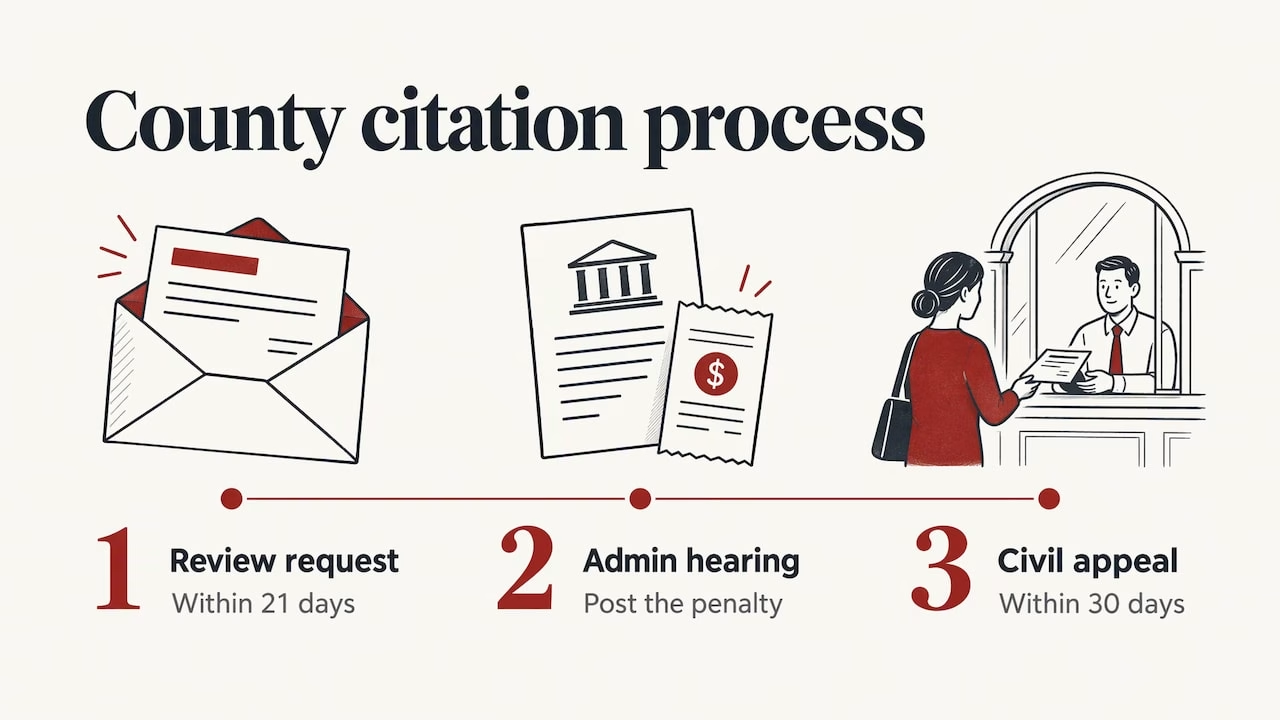
County parking citations are civil offenses with their own timeline. The San Diego County Sheriff describes a 21-day window to request an Administrative Review, then an Administrative Hearing (where the penalty must be posted), then a 30-day appeal to the Civil Division of the Superior Court. Delinquent citations can trigger a DMV registration hold.
 The rest of this article is about moving violations, since that is where points, insurance and traffic school come in.
Find your deadline and court notice
Look for the appear-by date printed on the citation. The court says that date is the deadline to take action: paying, requesting an extension, or setting a hearing. The case usually takes about two to three weeks to be filed after the ticket is issued, and the court mails a reminder notice about two weeks before your promise-to-appear date. That notice lists the bail amount, the due date, whether you are eligible for traffic violator school, fix-it ticket instructions and payment options (all per the court�s traffic page).
Do not wait for the reminder to arrive. If the ticket is in your glove box, the date on it is the one that counts.
What a San Diego traffic ticket really costs
The number printed as the base fine is rarely what you pay. California adds assessments on top of it. The San Diego County 2026 bail schedule, effective January 1, 2026, lists these components:
- A penalty assessment of $29 for every $10 of base fine
- A state surcharge on the base fine
- A $40 court operations assessment
- A $35 infraction conviction assessment
- A $52 traffic violator school fee, if you are ordered to attend
- A $10 prior-conviction recording fee
Because the penalty assessment is charged per $10 of the base fine, a higher base fine grows quickly. The court�s older ADM-295 explanation of how the amount is calculated (2023 edition) shows a red-light violation with $100 base bail totaling $486, which makes the point clearly.
Speeding examples
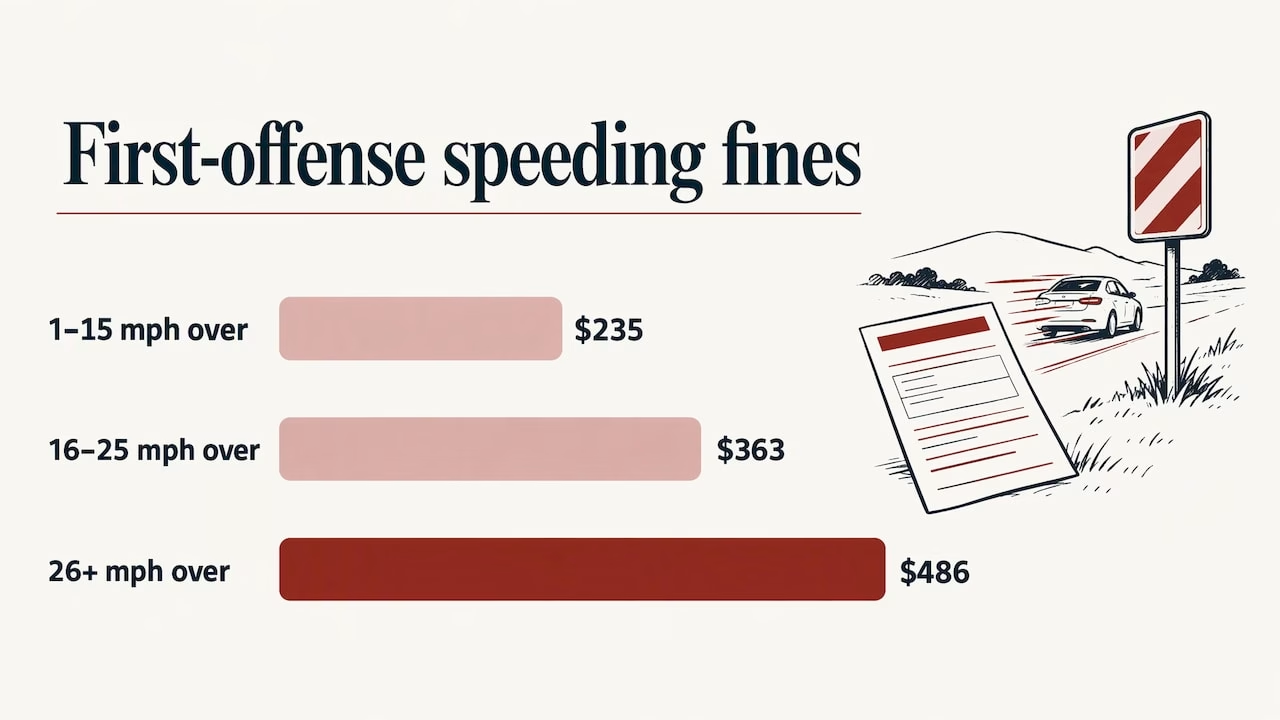
The court�s Probation and Sentencing Handbook (8th edition, effective February 2024) lists fines for speeding on roads with limits over 65 mph under Vehicle Code 22349(a):
| Speed over the limit | Fine (first offense) | Fine with a prior within a year |
|---|---|---|
| 1 to 15 mph | $235 | $286 |
| 16 to 25 mph | $363 | $414 |
| 26 mph or more | $486 | $537 |
Each amount can be increased by a $52 traffic school fee if the court orders it, and the handbook notes possible license suspension of up to 30 days for a first offense, rising with repeat offenses. Fines are revised periodically, so treat these as examples from that edition and rely on the amount on your own notice or the court�s current schedule for the figure you actually owe.
One more detail: the court states that a payment vendor may add a 2.75% service fee for credit or debit card, prepaid card or mobile payment app payments, effective July 1, 2026. Check the payment screen before you confirm.
Your options: pay, contest or go to traffic school
You have three basic paths. They are not equal, because the first one closes the others.
Paying the ticket
You can pay online on the court�s website, by mail or in person, according to the California Courts self-help guide. Paying the bail (forfeiting it) is treated as a conviction. That means the violation goes on your driving record and can be reported to your insurer, and for most drivers that is the outcome they were trying to avoid.
Paying makes sense when the ticket is accurate, you are not eligible for traffic school, and you accept the record entry.
Contesting the ticket
If you believe the ticket is wrong, you can contest it. The self-help guide explains two routes:
- Trial in person. No bail deposit is required first.
- Trial by written declaration. You file form TR-205 and generally post the full bail first, which is refunded if you win. The court�s MyCitations tool is an exception for declaration trials.
You can still ask for traffic school or a lower fine after choosing trial, according to the same guide.
Some practical points for a contest. Gather what you can before filing: photos of the intersection or signage, your own account written while the memory is fresh, and any witness details. Be accurate about the vehicle code section on your ticket, since the defense depends on what you were cited for.
A stop sign ticket under CVC 22450(a), for instance, turns on whether you came to a full stop at the limit line. A speeding ticket turns on how the speed was measured and the conditions. California�s speed laws also include the basic speed law, which prohibits driving faster than is reasonable or prudent, so conditions matter even if you were under the posted limit.
If you have a complicated case, such as a misdemeanor, a commercial license or a possible suspension, speak with a licensed California attorney. That is a legal question, not a driver education one.
Requesting traffic school
For many first-time moving violations, traffic school is the practical answer. The self-help guide states that completing it keeps the conviction confidential from insurance companies. The point stays on your DMV record, but insurers do not see it, so it usually will not affect your rates.
The main rules:
- You can keep only one conviction per 18-month period confidential this way.
- It is not available for offenses that carry multiple points or for commercial drivers.
- Your notice will state whether you are eligible, so look for the traffic violator school line on the court�s reminder.
- You normally pay the bail to the court and the school fee, and you then finish the course by the deadline the court gives you.
The courses you take must be approved for the court that handles your case. Make sure the program you enroll in is approved for California and for your citation before you start, and always confirm the completion deadline with the court.
We cover the general process in more detail in our guides to traffic school for ticket dismissal and how to keep a ticket off your record.
If the amount is a hardship
A ticket that adds up to several hundred dollars can be a real strain, and the court has options. Its payment options and financial hardship page lists what is available.
Without showing hardship you can:
- Set up an installment plan with at least 10% paid upfront and at least $35 per month (a $35 transaction fee applies in traffic violator school cases)
- Request up to two 30-day extensions per case
If you can show hardship, you can:
- Ask for a fine reduction through the MyCitations Ability to Pay tool or form TR-320
- Ask to do community service instead of paying
Act before the appear-by date. A missed deadline can add penalties and turn a simple infraction into a bigger problem.
Fix-it tickets
Some citations are correctable, such as an expired registration or a broken light. You fix the problem and show proof, and the charge can be dismissed. The court may order a $25 proof-of-correction fee for each dismissed charge under Vehicle Code section 40611, as stated on its court appearance information sheet. Note that this is far less than paying the full fine.
What a ticket does to your record and insurance
Two things are at stake after a moving violation: points on your DMV record and what your insurer sees.
A conviction normally adds points to your DMV record, and those stay visible for years. An insurer reviewing your record at renewal can raise your premium. That is why the decision about how to handle the ticket matters more than the fine itself. A single speeding conviction can cost more in higher premiums over several years than the fine did.
Traffic school, when you qualify, is designed for this exact situation: the point remains with the DMV, but the conviction is confidential from insurers. Our guide to traffic school for point reduction explains how points and insurance fit together, and how to dismiss a speeding ticket explains the choices for the most common violation.
Can you go 5 mph over the limit in California?
People ask this because enforcement often seems relaxed at small margins. The law does not set a tolerance. Vehicle Code section 22348(a) prohibits driving faster than the established speed limit, and section 22350 separately prohibits driving faster than is reasonable or prudent for conditions. In practice, an officer has discretion, but five over is still a violation if you are cited.
Posted limits are not arbitrary. The Caltrans manual for setting speed limits says limits set by engineering and traffic surveys are normally near the 85th-percentile speed, meaning the speed at or below which 85% of drivers travel. It also notes that the basic speed law prohibits unsafe speeds even below the posted limit. Drive to the conditions, not just the sign.
A checklist for the first 48 hours
- Find the appear-by date and write it on your calendar with a reminder a week earlier.
- Confirm whether the ticket is a court violation, a city parking citation or a county parking citation.
- Read the violation section and note the points and fine it carries.
- Check whether traffic school is offered on your notice, and whether you have had another conviction in the past 18 months.
- Decide whether to pay, contest or request traffic school before you send money.
- If cost is the problem, ask about an installment plan or extension before the deadline.
Where our courses fit in
Our courses are state-approved online courses built around the situations in this article: dismissing a ticket, protecting your insurance rate and meeting a court requirement. You can learn at your own pace on any device, with multilingual read-along features, no hidden fees and a money-back guarantee.
We currently offer courses in Florida, Michigan, Delaware and Colorado. Published prices for Florida include the Basic Driver Improvement (BDI) course at $30, the Driver Education Traffic Safety Course (DETS) at $29.90, the Traffic Laws Substance Abuse Education course (TLSAE) at $29.95, the Mature Driver Insurance Discount Course at $14.50 and the Wireless Devices Distracted Driver Course at $24.50. If your ticket or court requirement is in one of those states, you can see the full list on our courses page. Drivers in California can start from our California page.
 Fleet managers whose drivers collect tickets can ask about a custom fleet safety course.
Our view on handling a ticket
A ticket feels like a bill, but the real cost is what it does to your record and your insurance over the next three years. We design our courses around that. Our curriculum is developed in-house by certified educators and safety specialists, and it is updated for statutory requirements, so what you learn matches what the state expects.
We believe the best way to handle a ticket is to make the decision before the deadline, not after. Know what you were cited for, know whether you qualify for a course, and finish it on your own schedule. That is why our courses work on a phone, a tablet or a computer, why the read-along feature supports learners in more than one language, and why we publish our prices up front.
A course that is clear, fair and finishes on time keeps your record clean and stops points from hitting your insurance. That is what we want for every driver who comes to us.
the author
FAQ
How much is a speeding ticket in San Diego County?
It depends on how far over the limit you were. The court�s 2024 handbook lists first-offense fines of $235, $363 and $486 for 1 to 15, 16 to 25 and 26 or more mph over on roads with limits above 65 mph, plus a $52 traffic school fee if ordered. Fines are updated periodically, so use the amount on your notice.
How do I check if I have traffic fines?
For a moving violation, use the San Diego Superior Court�s traffic division and have your citation number ready. For a city parking citation, use the City of San Diego�s Customer Services Portal. County parking citations go through the Sheriff�s administrative process.
Can I still go to traffic school after I pay?
Paying the bail is treated as a conviction, so decide first. Even so, the court can sometimes allow traffic school in eligible cases, and you can ask for it after choosing trial. Contact the court before the appear-by date to ask what is possible for your citation.
How bad is my first speeding ticket?
For most drivers, a first ticket is manageable if you act before the deadline. If you qualify for traffic school, the conviction stays confidential from insurers, which protects your rates. Paying it without that step puts the conviction in view of insurers.
What if I cannot afford the fine?
The court offers installment plans with at least 10% upfront and $35 a month, up to two 30-day extensions, and with a hardship showing, fine reductions or community service. Ask before your due date.
Sources
- Traffic / Minor Offense Division, San Diego Superior Court
- Citations, City of San Diego
- Traffic and Parking, San Diego County Sheriff
- 2026 Bail Schedule, San Diego Superior Court
- ADM-295 How the Amount Due is Calculated on Citations
- Probation and Sentencing Handbook, San Diego Superior Court
- Guide to traffic tickets, California Courts Self-Help
- Payment Options and Financial Hardship Information, San Diego Superior Court
- Court Appearance Information Sheet MO-042C
- California Vehicle Code, Division 11, Chapter 7
- California Manual for Setting Speed Limits, Caltrans
Recommended
- Traffic School Deadlines Explained for Drivers
- Dismiss a Traffic Ticket: Steps to Court and Dismissal Options
- How to Meet Court Deadlines for Traffic Cases
This article is provided for general information and is not a professional advice.