The best way to prevent a backing accident is to avoid backing when you can, and to follow the same short routine every time you can�t: walk around the vehicle, back slowly, look through the rear window, and use a spotter when your view is limited. Mirrors and cameras help, but they work best as added views, not your only one. Good habits like these are what defensive driving training is built to teach, and our state-approved online courses at DriverEducators let you build them at your own pace.
Key Takeaways
- Plan your parking so you can pull through or drive out forward. Every backing move you skip is a risk you never take.
- Walk around the vehicle before you move. Children, pets and low objects are easy to miss from the driver�s seat.
- Back slowly, turn your head and look through the rear window, and keep checking mirrors. Do not rely on a camera alone.
- With a spotter, agree on signals first and stop the moment you lose sight of them.
- Fleet drivers and employers need a written plan, trained operators and regular refreshers.
Table of Contents
- Why Backing Crashes Happen So Often
- Avoid the Backing Move in the First Place
- Do a Walk-Around Before You Move
- How to Back Up Step by Step
- Use a Spotter the Right Way
- What Mirrors and Rearview Cameras Can and Can�t Do
- Backing Safety for Fleets and Work Vehicles
- Get the Habits Training Builds
- Our Perspective
- FAQ
- Sources
Why Backing Crashes Happen So Often
Backing feels routine, which is exactly why it catches people out. You are moving slowly, often in a parking lot or driveway, and your view is worst in the direction you are traveling.
The numbers show where the risk sits. A 2026 NHTSA evaluation of rearview image requirements counted 66,000 non-traffic backover crashes from 2016 to 2021, including 1,555 pedestrian deaths. More than 85% happened in residential locations or commercial parking lots. NHTSA names blind spots and driver distraction as factors in these crashes.
The same pattern shows up at work. The Texas Division of Workers� Compensation points to poor backing technique and limited rear visibility, such as around truck beds or equipment bodies, as key causes. People, coworkers, other vehicles and fixed objects can all be out of sight.
The common thread is that nearly all of this is within the driver�s control. Backing crashes come down to planning, checking and speed, and each of those is a habit you can train.
Avoid the Backing Move in the First Place
The strongest prevention happens before you shift into reverse. The League of Minnesota Cities calls avoiding backing altogether the best prevention for fleets, and the same logic holds for any driver.
Here is how to cut backing out of your day:
- Choose pull-through spaces. When a lot lets you drive through one space into the next, you leave facing forward.
- Back in when you arrive. The Texas Division of Workers� Compensation advises that if pull-through parking isn�t available, backing into the stall on arrival lets you drive out forward. You make the tricky move when you are fresh and the lot is calmer, and you leave with a clear view ahead.
- Think ahead in driveways and alleys. Park so your exit path is open, away from play areas, deliveries and tight turns.
- Plan your route. Delivery and service drivers can choose stops and approaches that avoid reversing into busy areas.
This is defensive driving in its simplest form: reduce the number of situations where something can go wrong. Our guide on defensive driving techniques covers the wider habit of looking ahead and giving yourself room.
Do a Walk-Around Before You Move
What you can�t see from the driver�s seat can still be right behind your bumper. Ohio�s driver guidance says to check behind the vehicle before getting in, because children and small objects may not be visible from inside.
A good walk-around takes less than half a minute. Look for:
- People, especially small children, and pets near the wheels or under the vehicle.
- Objects such as toys, bikes, carts, poles and low walls.
- Ground problems: soft or muddy patches, potholes and anything that could harm a tire.
- Overhead and side clearances, if you drive a tall or wide vehicle.
The Texas fact sheet adds a point many drivers miss: back up promptly after the check, because conditions can change once you walk away. If a child or a car appears while you are buckling up, check again.
If you have kids or pets at home, make the walk-around a family rule. A family safety checklist for kids and pets can help you set up the routines that keep everyone aware of where the vehicle is moving.
Our article on pre-drive safety checks shows how to fold this into the other things you check before every trip.
How to Back Up Step by Step
Once you have decided backing is necessary and checked the area, follow the same sequence each time.
- Set your mirrors and seat. Adjust mirrors before you start so you aren�t fiddling while the vehicle moves.
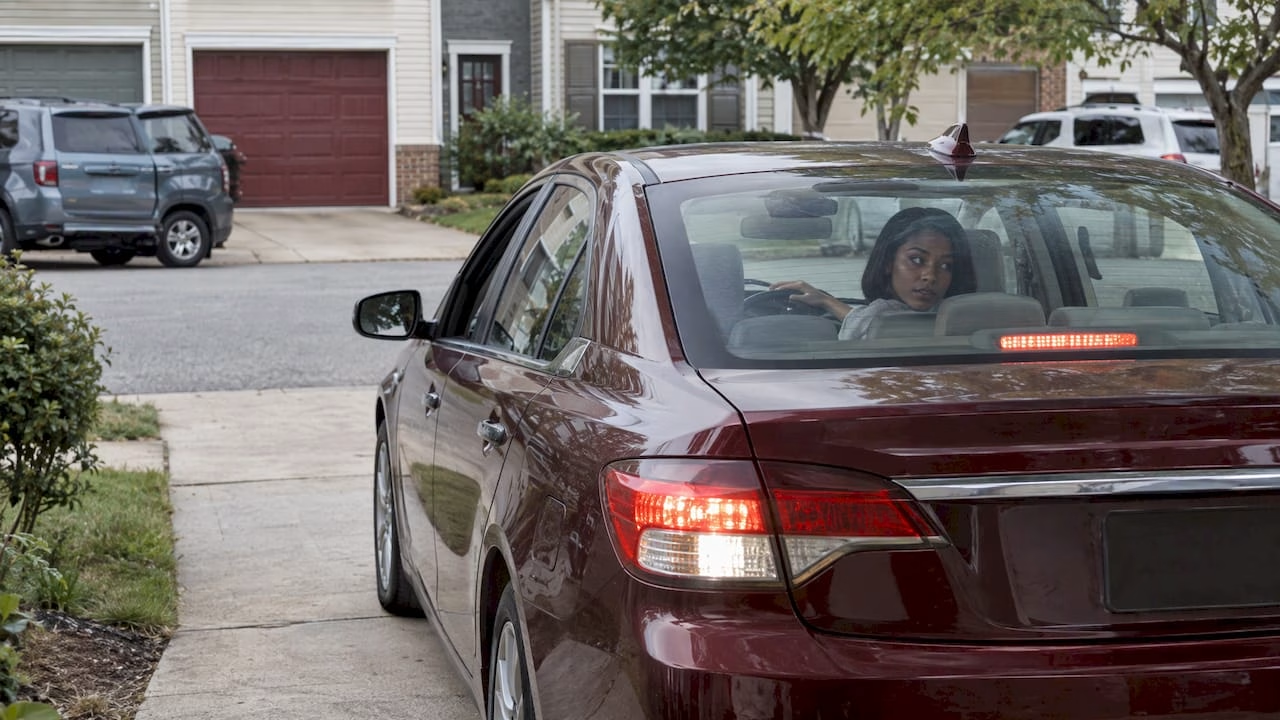
- Scan again. Check mirrors, then turn and look over your shoulder. Know which direction to turn the wheel before you move.
- Look through the rear window. The Iowa DOT driver manual says to check behind you and in your blind spots before and during backing. Your head turn gives you a wider view than any mirror.
- Move slowly. The same manual advises a slow speed with little or no accelerator. Let the engine�s idle speed move you. A slow vehicle gives you time to stop.
- Keep checking. Glance at both mirrors and front corners as you go. The front of your vehicle swings as you turn.
- Stop and get out if unsure. The Kentucky Transportation Cabinet�s employee safety tip sheet recommends stopping to get out and reassess when clearance is uncertain. Keep the distance you back as short as you can.
Oregon�s commercial driver manual adds that backing toward the driver�s side is better when you can, because you see more of the path on your side of the vehicle.
Blind spots are the hidden part of this routine, so it helps to know exactly where yours are. Our guide on how to check your blind spot walks through it.
Use a Spotter the Right Way
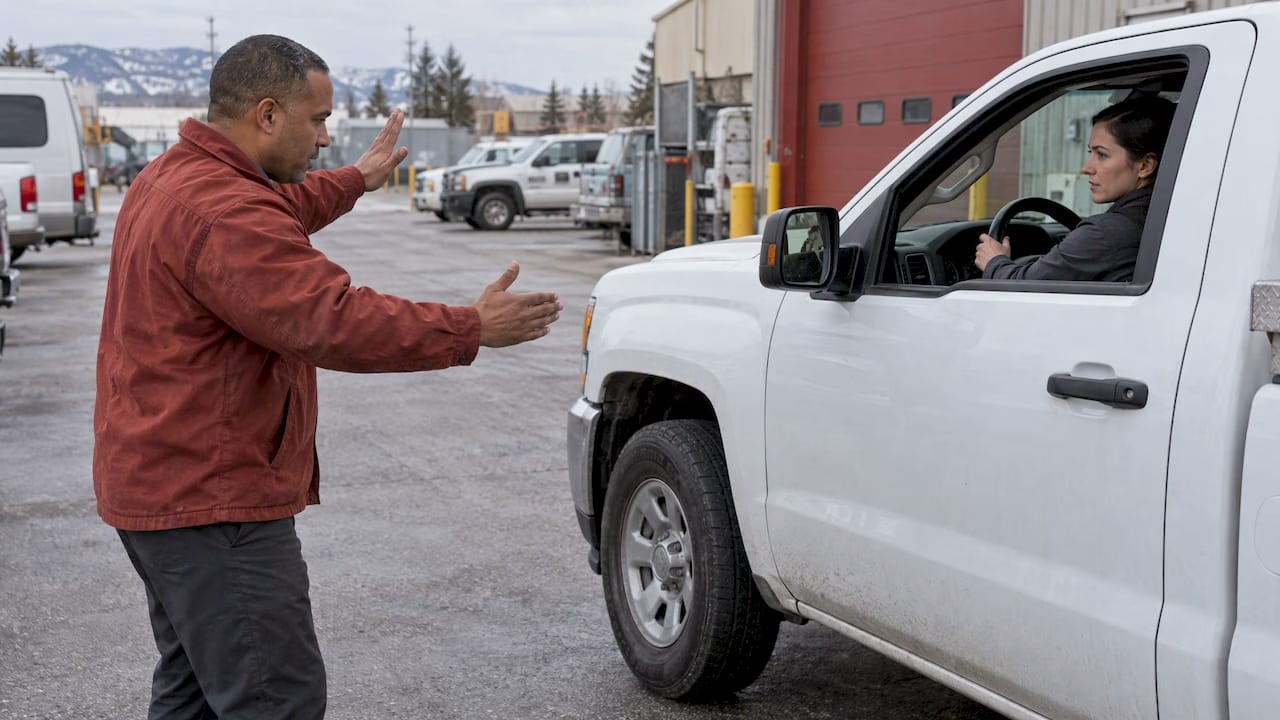 A spotter is a second set of eyes, and when your view is poor, it is the best protection you can add. It only works if both of you follow the same rules.
According to the Texas fact sheet and NIOSH guidance, a safe setup looks like this:
- Agree on signals before you move. Hand signals, especially a clear stop signal, beat shouting. Confirm you both understand them.
- Keep the spotter in view. NIOSH�s 2024 guidance says the spotter should stay visible in your mirrors with a clear view of the blind-spot area.
- Stop when you lose sight of them. No exceptions. Get out and look.
- Spotter stays out of the vehicle�s path. They should not walk backward while guiding, and in work zones they should wear high-visibility clothing.
- Roll down your window so you can hear as well as see.
For work vehicles, NIOSH�s dump-truck guidance recommends a trained, dedicated spotter with communication confirmed before the vehicle moves, and workers kept out of blind spots. A spotter who is also doing another job is not a dedicated spotter.
What Mirrors and Rearview Cameras Can and Can�t Do
Cameras do reduce risk. NHTSA�s evaluation estimated that rearview image systems required under the federal standard were 65.2% effective at preventing pedestrian backover crashes in non-traffic settings. It also found vehicles with factory rearview images had 60% lower odds of such crashes than vehicles without them. The standard, FMVSS No. 111, applies to new vehicles up to 10,000 pounds GVWR built on or after May 1, 2018.
Use that benefit well:
- Treat the screen as an addition to your head turn, not a replacement. The Iowa manual warns that mirrors and cameras don�t show the full area and can mislead you about distance.
- Keep lenses clean and check mirrors and windows before you drive. OSHA�s backover prevention toolbox talk lists pre-operation checks of mirrors, windows and warning equipment for work vehicles.
- Remember that sensors and alarms add awareness. The League of Minnesota Cities says they supplement, not replace, safe backing practices.
If your vehicle has a camera, you have an advantage. Pair it with the walk-around and a slow speed, and you cover the gaps each tool leaves.
Backing Safety for Fleets and Work Vehicles
For employers, backing crashes are a training and planning problem as much as a driver problem. OSHA�s toolbox talk recommends that employers set up a traffic-control plan, improve visibility and lighting, train operators, use spotters in low-visibility areas and review near misses.
The stakes are real. NIOSH�s 2023 guidance reports 809 deaths among construction and extraction workers involving dump trucks from 2011 through 2020, and recommends staging areas that shorten backing distance. A 2025 peer-reviewed study of dump-truck fatalities found that 22% involved a backing dump truck, and the authors recommend initial and refresher training for drivers and for workers in the truck hazard zone.
PennDOT�s safety talk book lists reduced visibility, fixed objects, moving equipment and uneven terrain as backing hazards, and recommends eliminating unnecessary backing and making fixed objects more visible.
A practical fleet checklist:
- Write down when backing is allowed and when a spotter is required.
- Design lots and job sites so drivers pull through or back in on arrival.
- Teach one set of spotter signals to everyone.
- Retrain on a schedule and after any near miss.
If you manage drivers, our custom fleet safety course is built for your team�s needs.
Get the Habits Training Builds
Knowing the routine is one thing. Doing it every time, including when you are late and the lot is crowded, is another. Structured driver education helps those habits stick, whether you are a new driver, a ticketed driver or a fleet manager.
Our courses are state-approved, run online on any device and are developed in-house by certified educators and safety specialists. Florida drivers can choose from the Basic Driver Improvement course at $30, the Driver Education Traffic Safety course at $29.90, the Traffic Laws Substance Abuse Education course at $29.95, the Mature Driver Insurance Discount course at $14.50 and the Wireless Devices Distracted Driver course at $24.50. We publish our pricing with no hidden fees and back every course with a money-back guarantee.
 See every course and requirement on our Florida courses page, and pick the one that matches your court, insurance or license need. For the broader skills behind safe backing, start with our top defensive driving safety tips.
Our Perspective
Backing crashes are some of the most preventable events a driver faces. They happen at low speed, in familiar places, when attention drifts. That is why we treat them as a habit problem, not a skill problem.
Our courses are developed in-house by certified educators and safety specialists, and the content is kept current with statutory requirements and real-world safety. We build them so you can learn at your own pace, on your phone or computer, with read-along features in several languages. A driver who understands why the walk-around, the slow speed and the forward exit matter is far more likely to use them on a rushed Tuesday afternoon.
For fleets, we believe the same applies at scale: a shared routine, shared signals and regular training. That is the thinking behind our custom fleet safety course.
the author
FAQ
What is the best way to avoid a backing accident?
Avoid backing when you can by choosing pull-through spaces or backing into a stall when you arrive. When you must reverse, walk around the vehicle first, move slowly, look through the rear window and use a spotter if your view is limited.
Is a rearview camera enough to back up safely?
A camera is a valuable aid, and NHTSA found rearview image systems were 65.2% effective at preventing pedestrian backover crashes in non-traffic settings. It does not show the whole area or judge distance perfectly, so keep turning your head, checking mirrors and moving slowly.
Where do most backing crashes happen?
NHTSA�s 2016 to 2021 data shows more than 85% of non-traffic backover crashes occurred in residential locations or commercial parking lots. Driveways and parking lots are where your routine matters most.
How should a spotter guide me?
Agree on hand signals before you start and keep the spotter in your sight. They should stand outside your path and never walk backward. If you lose sight of them, stop and get out to look.
Can a driver improvement course help reduce risky habits like this?
Yes. Our state-approved online courses are designed to build safer driving habits, and many drivers take them to meet ticket, court or insurance requirements. Visit our courses page to find the one for your situation.
Sources
- NHTSA: Evaluation of the FMVSS No. 111 Rearview Image Requirements
- Texas Division of Workers� Compensation: Vehicle Backing Safety Fact Sheet
- League of Minnesota Cities: Think Before You Back
- Iowa DOT: Iowa Driver�s License Manual
- Ohio Public Safety: Section 5, Learning to Drive
- Oregon DMV: Commercial Driver Manual, Section 2
- Kentucky Transportation Cabinet: Safe Backing Tips
- NIOSH: Preventing Struck-by Injuries and Deaths When Working with Refuse Trucks
- NIOSH: Preventing Dump Truck-related Injuries and Deaths
- OSHA: Mirror Check Backover Prevention Toolbox Talk
- MDPI Safety: Quantitative and Narrative Analysis of Dump Truck-Related Fatalities
- PennDOT: Daily Safety Talk Book
- Kin Watchdog: Family Safety Checklist
Recommended
- How to Avoid Car Accidents and Drive Safer Today
- Driver Safety Tips for Safer Streets
- Crash Avoidance Strategies: Real-Time Techniques for Safe Driving
- Safe Driving Tips: Improve Your Skills on the Road
This article is provided for general information and is not a professional advice.