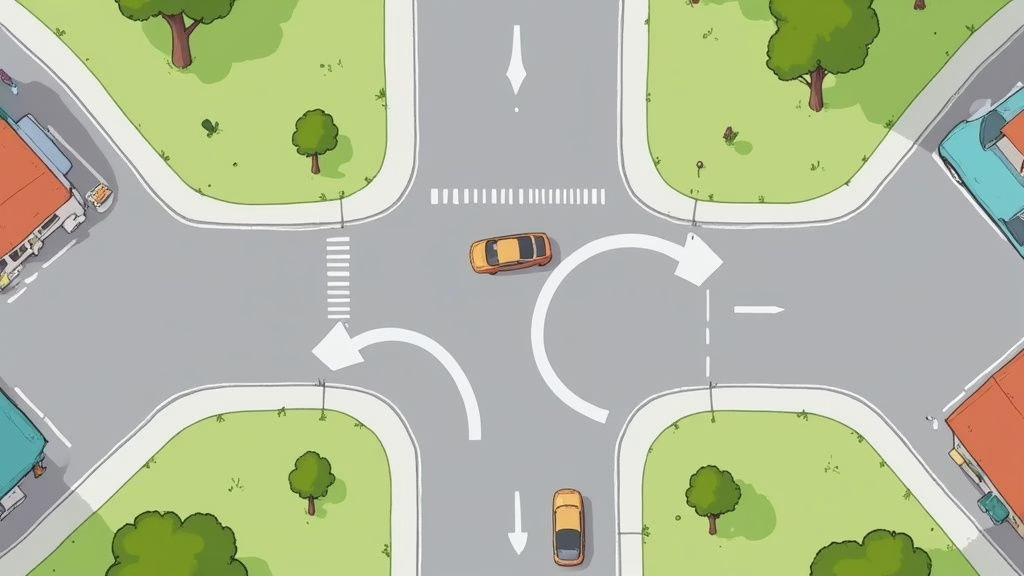
Ever found yourself on a narrow street, maybe a dead end, with no room to make a U-turn? We’ve all been there. This is exactly when the three-point turn comes to the rescue. It�s a specific, controlled maneuver designed to get your car facing the opposite direction when space is tight.
Think of it as a neat, three-step dance: forward, back, then forward again. Getting this move down is a core skill for handling tricky driving situations with confidence.
What Is a Three-Point Turn and Why Does It Matter?
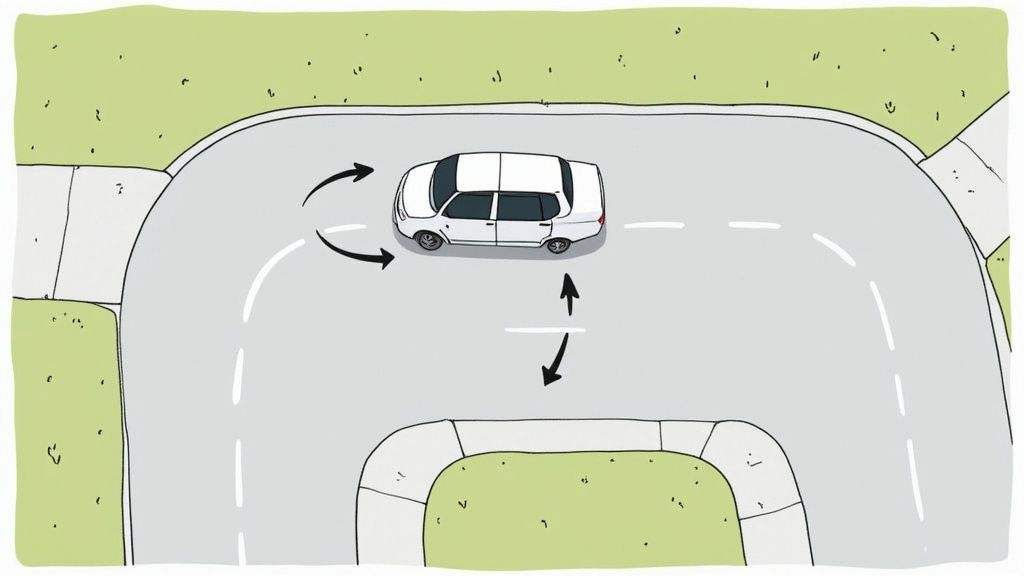
So, you’ve taken a wrong turn and now you’re stuck on a road that’s too cramped for a simple U-turn and has no side roads or driveways. This is precisely where knowing how to execute a three-point turn turns a moment of panic into a simple, controlled solution.
It’s a standard part of nearly every driver’s test for a good reason. Sometimes called a Y-turn or K-turn, this maneuver is a true test of a driver’s ability to handle their car with precision and awareness. It�s not just a hoop to jump through for your license; it’s a practical skill you’ll actually use.
The Real-World Purpose of This Maneuver
At its core, the three-point turn is your go-to move for safely reversing your direction of travel in a confined space. Without it, you might be tempted to make a risky, multi-step reverse or try to squeeze in a U-turn, which could easily lead to hitting a curb or another car.
This maneuver is so important because it forces you to develop three key driving habits:
- Vehicle Control: It’s all about slow, deliberate actions. You learn to handle the steering, gas, and brake with a delicate touch, not brute force.
- Spatial Awareness: You have to constantly judge the distance between your bumpers and the curbs, which sharpens your feel for the car’s true size.
- Situational Safety: The process demands that you’re always checking for other cars, cyclists, or pedestrians. It�s a perfect exercise in defensive driving.
Mastering the three-point turn is a mark of a truly competent driver. It shows you can handle a common road problem calmly and methodically instead of getting flustered.
Ultimately, knowing how to do a three-point turn properly is a fundamental part of being a skilled driver. It’s a skill that builds confidence and proves you can stay in command of your vehicle, even when the road throws you a curveball. For drivers looking to sharpen these kinds of abilities, you can learn more about how to improve driving skills in our dedicated guide.
When to Use a Three-Point Turn
Knowing the steps to a three-point turn is one thing, but knowing when to use it is what separates a good driver from a great one. Think of this maneuver as your go-to solution for getting out of a tight spot, especially when a simple U-turn just isn’t an option.
It�s the perfect escape plan for those narrow residential roads, sudden dead ends, or when you realize you�ve taken a wrong turn with no driveway in sight to help you out. The key is to make a quick but careful decision based on what�s happening around you.
Assessing the Situation
Before you even touch your turn signal, you need to size up the scene. The big three factors are road width, traffic, and visibility. The road has to be too tight for a U-turn, yet just wide enough to allow you to move forward and backward without scraping a curb.
Most importantly, you need a clear, traffic-free stretch of road in both directions. This is absolutely not a move for a busy street. You also need excellent visibility�if you can�t see far enough down the road to spot an approaching car, don’t even think about it.
A three-point turn is a calculated maneuver, not a rushed escape. Its safety depends entirely on choosing the right time and place, which is why driver training has always emphasized situational awareness as much as the mechanical steps.
When You Absolutely Should Not Attempt This Turn
Knowing when not to do a three-point turn is just as crucial. There are a handful of situations where trying this is not only a bad idea but downright dangerous and often illegal.
- On or near a hill or a blind curve: Another driver simply won’t see you in time.
- Close to an intersection: This is a recipe for confusion and creates a serious hazard. You can get a better handle on these tricky spots by understanding the right-of-way rules at intersections.
- On a highway or busy street: The speed and volume of traffic make this extremely dangerous.
- When visibility is poor: Never try this in fog, heavy rain, or on a dark, unlit road.
Driving manuals have long codified these safety checks. This is because research shows that intersections and narrow roads are hotspots for collisions, underscoring the need for extreme caution when turning around. Read more about the historical context and safety data of this maneuver on mossandfog.com.
How to Perform a Perfect Three-Point Turn Step by Step
Let’s break down the three-point turn. It might seem complicated at first, but it’s really just three simple, distinct movements: forward, back, and forward again. The secret is to take your time. Slow, deliberate movements and constant safety checks are far more important than speed.
Think of it as building muscle memory. With a little practice, you’ll be able to handle this maneuver with calm control, turning a tight spot into a routine, confident turn.
Before you even touch the gas pedal, you need to decide if a three-point turn is the right move. This flowchart breaks down that thought process, focusing on the key factors: road width, traffic, and how well you can see.
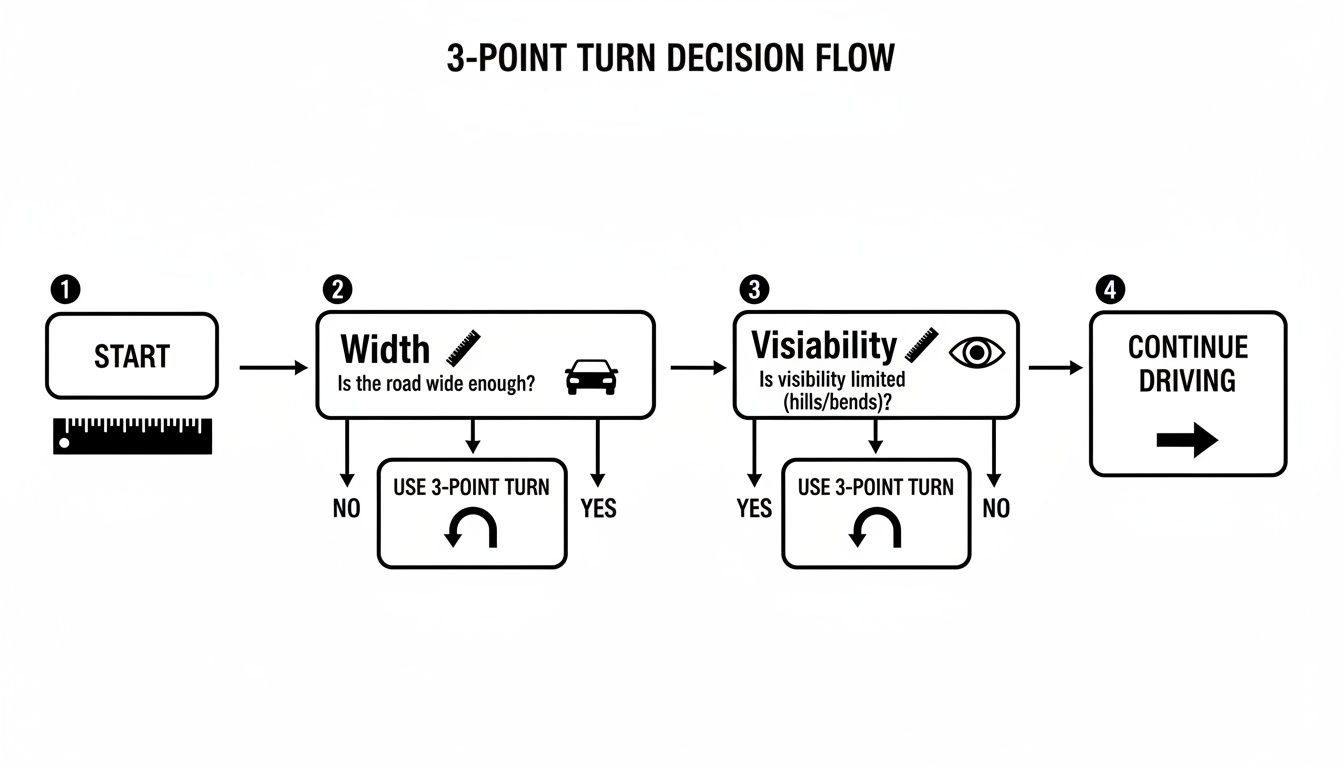
As you can see, a successful turn starts long before you move. It begins with confirming you have the space, clear sightlines, and minimal traffic to work with.
The Initial Setup
What you do before you start turning is just as critical as the maneuver itself. This is all about communicating your intentions and making sure the coast is clear.
- Pull Over and Signal: Your first move is to pull over to the far right side of the road and come to a complete stop. Flick on your right turn signal as you do this. Once stopped, switch to your left turn signal to let everyone know you’re about to move across the lane. Knowing exactly when to use turn signals is fundamental to safe driving.
- Scan Everything: This is non-negotiable. Check your rearview mirror, both side mirrors, and your blind spots. Look as far down the road as you can in both directions. You’re looking for cars, cyclists, and pedestrians. You need a big, safe gap in traffic before you even think about starting.
Executing the Three Movements
Once you’re certain the area is secure, you can begin. Each movement should be slow and controlled. Many drivers find it helpful to only use the brake to control their speed, creeping forward and backward.
Pro Tip: Try to keep your foot hovering over the brake throughout the entire turn. This gives you instant stopping power and maximum control if a car appears out of nowhere.
Step 1: The First Forward Turn
- With your left signal still on and the road clear, crank the steering wheel all the way to the left.
- Slowly creep forward until your car is pointing across the road, stopping just before your front wheels touch the opposite curb. There’s no prize for speed here, so focus on being precise.
Step 2: The Reverse Movement
- Now, immediately turn your steering wheel all the way to the right.
- Shift the car into reverse. Before you move an inch, do another full safety check�look over your right shoulder, scan all your mirrors again, and check for any new hazards.
- Gently back up just far enough to give your front end room to clear the curb when you pull forward. Stop well before hitting the curb behind you.
Step 3: The Final Forward Turn
- Put the car in drive and spin the steering wheel back all the way to the left.
- Check traffic one last time. When it’s clear, pull forward into the correct lane, straightening out the wheel as you go.
And that’s it! You’ve successfully completed the turn and are now facing the opposite direction, ready to accelerate smoothly down the road.
Common Mistakes to Avoid During a Three-Point Turn

Pulling off a three-point turn is all about balancing precision with awareness. It’s a skill that looks simple on paper, but even small slip-ups can lead to a failed driving test or, worse, a dangerous situation on the road. From what I’ve seen, most problems come down to two things: forgetting basic safety checks or simply misjudging the size of your car.
New drivers often get so fixated on the steering wheel that they completely forget the golden rule of driving: always be looking. Not scanning for traffic before each of the three distinct movements is a massive�and very common�error. Another classic mistake is rushing the maneuver, which almost always ends with overshooting the turn or bumping a curb.
Steering Clear of Trouble
The key to nailing this under pressure is to build the right habits during practice. Don’t just go through the motions. Instead, focus on actively spotting and correcting your mistakes as they happen. This is how you build real confidence.
Think of it like troubleshooting. We’ve put together a quick guide to help you identify and fix the most frequent errors I see on the road.
Troubleshooting Common Three Point Turn Errors
| Common Mistake | Correction Tip |
|---|---|
| Forgetting to Check Traffic | Before you move an inch�forward, back, or forward again�make a full 360-degree check a non-negotiable habit. Glance over both shoulders and check every single mirror. |
| Bumping the Curb | This is almost always a result of moving too fast. Slow it down to a crawl. Creeping gives you way more time to react and stop before your tires make contact. |
| Turning the Wheel Wrong | Feeling flustered? Just remember this simple pattern: Left, Right, Left. Turn the wheel all the way left for the first move, all the way right for the reverse, and left again to pull away. |
| Not Using Turn Signals | Even though it’s a slow maneuver, you must signal your intentions. Signal right before pulling over to the curb to start, and signal left before your final move back into the lane. |
By practicing with these corrections in mind, you’ll find that what once felt like a stressful test item becomes just another useful tool in your driving skill set.
Remember, the goal of a three-point turn isn’t speed�it’s safe, controlled precision. It’s always better to be slow and correct than fast and sloppy. This same mindset is crucial for other technical skills, as you’ll see in our guide on how to master parallel parking step-by-step.
Mastering Safety and Situational Awareness
Getting the mechanics of a three-point turn right is one thing, but the real test is your situational awareness. This isn’t just about controlling your car; it�s about safely managing the entire environment around you.
A well-executed turn on a quiet street with clear visibility is perfectly legal and safe. But try that same maneuver near the crest of a hill, on a blind curve, or close to a busy intersection, and it becomes a recipe for disaster. The difference is all about one thing: continuous observation.
This means your head needs to be on a swivel. Before you even begin the first turn, and before each subsequent movement, you must be checking everything�mirrors, blind spots, and the road ahead and behind.
The Defensive Driving Mindset
This constant scanning is the very essence of defensive driving. You’re not just looking for cars that are already there; you’re actively anticipating what could happen. A pedestrian stepping out, a car coming over the hill, a cyclist appearing from nowhere�these are the potential hazards you need to look for.
The ability to manage your vehicle and surroundings at the same time is what separates a novice from a confident, safe driver. It shows you can think ahead and prioritize safety over simply getting the turn done quickly.
Mastering these fundamental skills is a huge part of road safety. Traffic incidents cause millions of injuries and fatalities across the globe each year, and so much of it comes down to driver competence. In fact, training on specific maneuvers like the three-point turn is part of a wider strategy that has helped reduce road casualties. You can learn more by checking out these global road safety reports from the WHO.
When you see the three-point turn as an exercise in awareness, it stops being just another maneuver for the driving test. It becomes a skill that makes you a safer, more responsible driver every time you get behind the wheel.
Common Questions About the Three-Point Turn
Even with a step-by-step guide, it’s natural to have a few lingering questions about the three-point turn. Getting these details straight is what builds the real-world confidence you need to pull off the maneuver without a second thought. Let’s tackle some of the things drivers ask most often.
Is a Three-Point Turn the Same as a K-Turn or U-Turn?
This is a common point of confusion, and the answer is a little bit of both.
A three-point turn and a K-turn are just two names for the same thing. Some people call it a K-turn because the path your car traces�forward, back, and forward again�looks a bit like the letter ‘K’.
A U-turn, however, is a completely different beast. A U-turn is a single, sweeping 180-degree turn you can make when the road is wide enough. A three-point turn is your go-to move for turning around on a road that�s too narrow for a U-turn, requiring those three distinct steps to get pointed in the opposite direction.
What If It Takes More Than Three Moves?
While the goal is three clean, efficient movements, real-world streets aren’t always so forgiving. On a particularly tight road, you might find yourself needing to perform a five-point turn.
For a driving test, nailing it in three shows the examiner you have excellent spatial awareness and control. In reality, though, safety is what matters most. It’s always better to take an extra step or two, maintaining full control, than to rush it and end up bumping a curb.
How Fast Should I Go During a Three-Point Turn?
Slow. Incredibly slow. Think of it as a crawl.
Ideally, you shouldn’t need the gas pedal at all. Use your brake to control the vehicle’s creep, giving you maximum time to steer precisely and scan your surroundings. A deliberate, controlled pace is the key to a perfect three-point turn.
The most critical part of this entire maneuver is constant observation. Before you even start, and before each of the three steps, you absolutely must check your mirrors, glance over your shoulder for blind spots, and look both ways for any approaching cars, cyclists, or pedestrians.
Most people who fail this on their driving test don’t mess up the steering; they forget to check their surroundings at every single stage. For anyone just starting their driver’s permit acquisition, mastering this habit of constant scanning is one of the most important lessons you can learn. Safety always comes first.
At BDISchool, we are committed to helping you become a safe, confident, and responsible driver. Our Florida-approved online courses are designed to provide the knowledge you need, whether you’re a new driver, looking to dismiss a ticket, or aiming to lower your insurance rates.