You’re holding a citation with a date on it, or you’ve decided at 34 that it’s finally time to get a Florida license, and you’re searching for online drivers ed for adults at 11 p.m. because that’s the only hour that’s yours. Both situations land on the same website, and both get sold the same course. That’s the problem.
An online course is a record decision, not a convenience purchase. The right one clears points, satisfies a court, or advances a licensing step. The wrong one takes your money and leaves the deadline running.
Here’s how to pick correctly, in the order that protects you.
Choose Your Florida Online Course at a Glance
Find your row. That’s the whole decision.
| Your situation | Course | Length |
|---|---|---|
| Recent noncriminal moving violation | Basic Driver Improvement (BDI) | 4 hours |
| Court-ordered, or want deeper safe-driving training | Intermediate Driver Improvement (IDI) | 8 hours |
| Habitual offender with road rage or aggressive driving | Aggressive Driver Course | 8 hours |
| Age 55 or older wanting a refresher | Mature Driver Course | 6 hours |
| First-time adult applying for a license | Not a traffic-school course; check the full licensing path | Set by your licensing path, not by traffic school |
The deadline is the part many drivers misunderstand. A driver who receives a noncriminal moving violation can elect an FLHSMV-approved Basic Driver Improvement course instead of taking points, but the election must be made within 30 days of the citation. Florida allows that election once every 12 months and no more than eight times in a lifetime. Miss the window and points land on your record, and in some cases the license itself is at risk.
Waiting a week doesn’t cost you a week. It costs you options. Court clerks process elections on their own schedule, and a citation that’s already been converted to a conviction can’t be walked back by a completion certificate.
The lengths in that table are course hours, not calendar time. An online format lets you finish a 4-hour course across a lunch break, two evenings, and a Saturday morning. You pause, you resume, the timer holds your place.
Do this now: write your citation date on a sticky note, count 30 days forward, and treat that date as the real deadline for everything else in this article.
Then open the course list at bdischool.com/courses while the window is still open. Choosing takes four minutes. Recovering from a missed election takes months.
What Online Driver Education Teaches Adults
A printed handbook states the rule and moves on. A well-built online course states the rule, puts you at a four-way stop with two other cars, and asks what you do next. You answer. It tells you why you were wrong.
That feedback loop is the entire value of the format, and it is why the content is organized the way it is. Before you pay for any course, though, treat it as a licensing and record decision first. The question is not whether the lessons are engaging. The question is whether completion satisfies the requirement attached to your citation or your license, and whether the school is approved to report it.
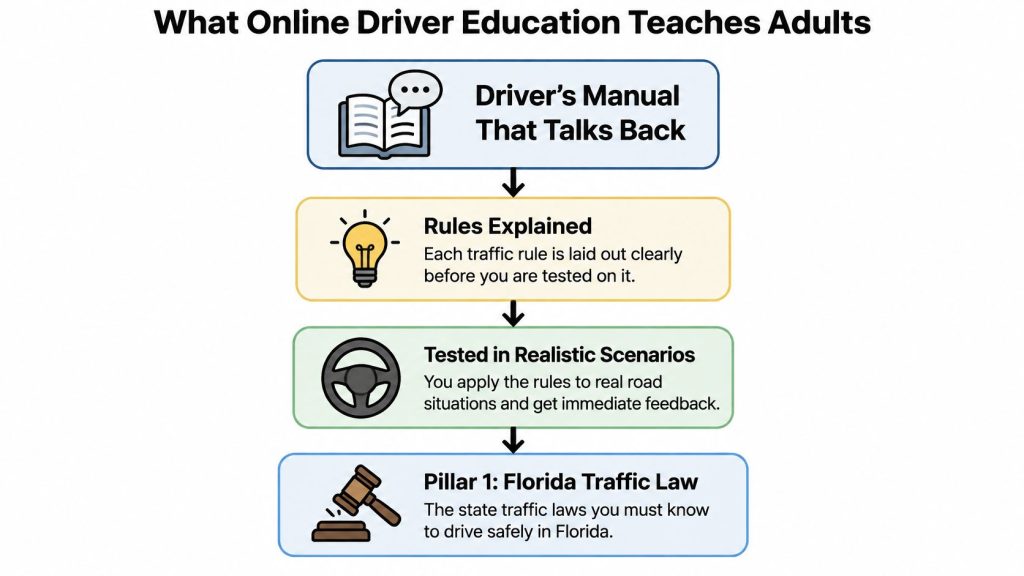
Pillar one, Florida traffic law
Right-of-way at unmarked intersections. Sign shapes and what each one demands. Following distance expressed as seconds rather than car lengths, because seconds scale with speed and car lengths don’t. This is the material a first-time adult learner has never been tested on and a returning driver half remembers.
Pillar two, defensive driving
Scanning the road well ahead instead of staring at the bumper in front of you. Maintaining a space cushion you can escape into. Assuming the driver beside you hasn’t seen you, and driving accordingly. Adults often arrive with years of watching other drivers make bad decisions, and the course gives those observations a structure.
Pillar three, impairment and distraction
Alcohol, drugs, and phones all attack the same resource: reaction time. A course shows the arithmetic of it, the distance covered between the moment a hazard appears and the moment a delayed driver responds. That number changes behavior in a way a warning slogan never does.
Pillar four, attitude and decision-making
Aggression, road rage, and the habits that harden over twenty years of driving. The Aggressive Driver Course and the Intermediate Driver Improvement course do their heaviest lifting there, and a driver who thinks he doesn’t need a refresher usually does.
A single lesson runs in a predictable rhythm. A short module explains a rule with clear text, visuals, and real-life scenarios. A question tests your understanding of it. You move forward as you complete each unit.
The structure is enforced, not optional. Florida requires identity validation during the course, which can include biometrics, security questions, or other methods, and you must pass the final exam along with any in-course assessments before completion counts. The school keeps records of your course study and completion for at least seven years, because the certificate is a legal document, not a souvenir.
For adults, the practical advantages are straightforward. You study at your own pace, anytime and anywhere. Any device with a browser works. You can pause between shifts and pick up exactly where you stopped.
Keep one idea fixed in your head through all of it: the course builds rule knowledge and judgment, and the certificate it produces is the reason you enrolled.
What an Online Course Cannot Replace
The clerk asks one question: does this course clear the line on your notice? If you cannot answer before you pay, do not enroll yet.
A citation course and a first-time license path are different purchases. Florida expects a first-time adult applicant to complete Traffic Law and Substance Abuse Education before applying for a license. Licensing still splits into a knowledge exam, vision and hearing checks, and a driving-skill test. Finishing one piece does not finish the others.
Match the course to the requirement written on your paperwork. A traffic-school course addresses a moving violation and the record that follows it. A license-preparation path feeds the steps the state uses to issue a first license. Course design does not turn one into the other.
What online training validates well
Rule knowledge holds up online. Hazard perception, impairment reasoning, and the ability to read a described scene and name the next failure hold up too. That is the job a browser course can do when the requirement is knowledge rather than a road test.
What it cannot validate
Live scanning in traffic. Speed control on a wet ramp. Braking when the car ahead stops short. Lane position through a construction zone. Those show up only when someone watches you drive in changing traffic, weather, and distraction.
Online modules can teach right-of-way, impairment risk, following distance, and how distraction works. They cannot sign off on the physical skill. Use the course as study beside supervised practice, not as a stand-in for it.
A passed quiz proves retained course knowledge. Driving competence is a different claim, made by an examiner in a moving car.
Answer these three questions before you enroll.
- Does this course satisfy my court, DMV, or licensing requirement? If you cannot name the requirement in one sentence, you are not ready to buy.
- Do I still need supervised driving hours or a road test? For most first-time adults in Florida, yes.
- Does an out-of-state certificate transfer? Ask before you pay, not after you finish.
Starting from zero means you need the licensing path, not a citation fix. Read the Florida driver permit course details and compare them with the state’s steps so you know which piece you are about to buy.
Ticket Costs, Points and Insurance Protection
Points are the expensive part of a ticket, and they outlast the fine. Serious violations carry more points than minor ones. That matters because paying the fine alone is treated as a conviction and may add points.
Electing an eligible Basic Driver Improvement course is the alternative. FLHSMV citation guidance states that eligible drivers who elect a driver-improvement course may receive an 18% reduction in the citation’s civil penalty.
That is the small saving. The record protection is the larger reason to look closely at the course.
The three record benefits
Completing an eligible Florida driver-improvement course produces three concrete outcomes, according to the FLHSMV driver improvement course FAQ.
- Adjudication is withheld on the violation, so it does not become a conviction on your record.
- No points are assessed for that violation.
- Your insurer generally cannot impose an additional premium or refuse to renew a policy solely because of that noncriminal traffic infraction.
There is one exception, and it is narrow. The insurance protection does not apply when the infraction involved a crash for which your insurer was at fault and incurred a loss.
BDISchool’s Florida’s Basic Driver Improvement Course, also called Florida Four-Hour Traffic School, is aimed at drivers who have recently received a moving violation. The four-hour course helps drivers avoid points on their driver license and maintain Excellent Driver Safe Driver Status or Discount. Completing it results in no insurance rate increase because of the moving violation.
Drivers over 55 chasing a premium reduction through a different route should look at the Florida mature driver insurance discount course instead, since that discount is controlled by the carrier rather than the state.
Eligibility decides the outcome, not the points
The possible point consequence tells you what is at stake. It does not tell you whether you qualify.
You may not elect BDI for exceeding the speed limit by more than 30 mph, and FLHSMV citation guidance is the place to check that election limit. The election also carries the once-per-12-months and eight-in-a-lifetime limits that come with the 30-day window. A speeding citation above that limit is not a BDI case, no matter how badly you want it to be.
Run your own numbers: add the course fee to the 18% penalty reduction, then weigh that against points and whatever your carrier does at renewal. On a speeding ticket, the course usually wins by a wide margin.
The clock on all of it is that election window. Check eligibility today, not the day before it closes.
Refresher Options for Mature and Returning Drivers
Two different readers end up in this section, and they need different things.
The first is 55 or older and wants a refresher plus a possible break on insurance. The second hasn’t driven in a decade and needs to rebuild confidence before merging onto I-4.
For drivers 55 and older
Florida recognizes online education as a delivery method for certain driver-improvement programs, and the state says an insurance discount may be available to drivers over age 55 who complete a Mature Driver Discount course, per FLHSMV’s education courses page. FLHSMV identifies the Older People Citizen Discount Insurance course as intended for drivers over 55.
Read that carefully. The state identifies the course. The insurer controls the discount. Confirm acceptance and terms with your carrier before you enroll, because a completion certificate your insurer doesn’t recognize is a $0 discount.
The 6-hour Mature Driver Course covers rule changes since you last studied, hazard awareness, defensive driving, and the technology now built into modern vehicles. That last piece matters more than expected. Lane-keeping assist and adaptive cruise change how you should hold the wheel.
For adults returning after a long break
An online course rebuilds rule knowledge and confidence at a pace you control. It cannot replace supervised practice behind the wheel. If you’ve been off the road for years, plan for both.
Older learners and returning drivers benefit from specific habits, and this guide to tips for older learner drivers from Lendrum’s Driving School covers the mindset side well.
Some signals mean an in-car evaluation is the better first move than any online module.
- A recent change in vision, or a new prescription you’re still adjusting to.
- A medication change, especially anything with a drowsiness warning.
- A crash in the past year, even a minor one.
- Existing license restrictions you’re unsure how to satisfy.
- A state renewal process that includes a road test.
Three-step decision: check whether your insurer accepts the course. Compare the 6-hour refresher against what you actually need to relearn. If hands-on retraining is the gap, add a session with an instructor alongside the online work.
Accessibility deserves a direct answer too. Before you start, confirm the course runs on the device you own, that it resumes cleanly when your connection drops, and that you can reach a human by phone. Driving anxiety is common among returning drivers. Take modules in short sessions, review before each assessment, and treat repetition as the mechanism, because that’s what it is. When you want structured time back in the car, a driving lesson refresher pairs well with the online material.
How to Check a Course Before You Pay
Every item below is a yes-or-no check. A no is a reason to keep looking.
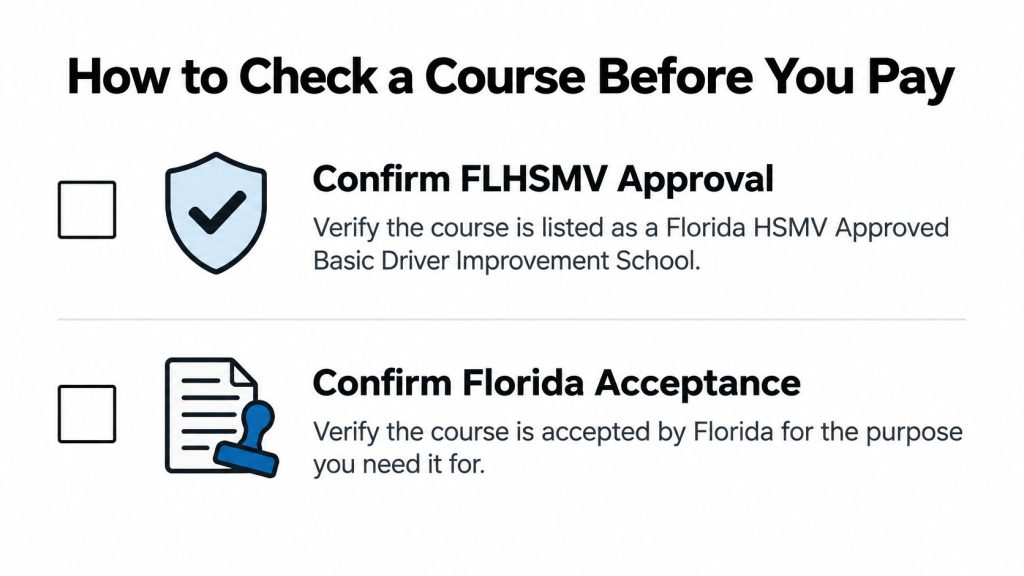
The seven checks
- FLHSMV approval. Confirm the provider is listed as a Florida HSMV Approved Basic Driver Improvement School. BDI School holds that approval.
- Court and county acceptance. The course should be approved by the State of Florida for all courts and counties. A course approved for one county clerk’s process and not another is a wasted payment.
- Current statutes and DMV requirements. Ask when the curriculum was last updated. Florida traffic law changes, and a course written five years ago teaches five-year-old rules.
- Identity validation, explained up front. You’ll be asked to prove you’re the person taking the course, and the provider should tell you how before you begin rather than surprising you mid-module.
- Refund rules in writing. Our policy is specific: a full refund is issued if you request cancellation within thirty calendar days of purchase, including weekends and holidays, and you haven’t completed the course or obtained a certificate. After you finish all modules, after the course expires, or after failing the final exam, refunds generally aren’t issued.
- Certificate reporting and chargeback terms. Certificates go to FLHSMV electronically. If a chargeback fee goes unpaid for five business days, the certificate is voided and the court or the Florida Department of Motor Vehicles is notified.
- Support phone and language options. Call the number before you pay. If nobody answers during business hours, that’s your answer.
Why each check protects you
Checks one through three protect your case. If the court doesn’t recognize the certificate, you’ve spent money and burned days on a deadline that doesn’t pause.
Checks five and six protect your money. Refund windows and certificate voiding rules are where disputes happen, and they’re always buried in a policy page nobody reads until it matters.
The one question worth asking any provider directly: what happens if I fail the final exam? A clear answer tells you the policy exists. A vague one tells you it hasn’t been tested.
How to Enroll and Finish Your Online Course
Seven steps, in order. Each one protects the record you are trying to protect, so treat this as a court-and-license decision, not a casual online purchase.
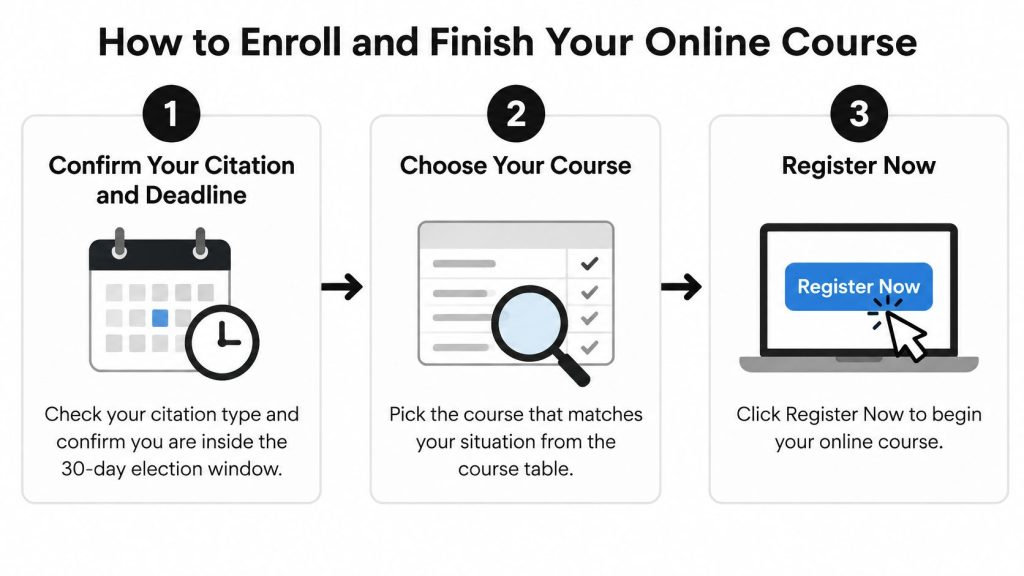
1. Confirm your citation type and your election window. Check the citation itself, then confirm you’re inside the 30-day window. If you’re outside it, call the clerk before you enroll anywhere. The common slip is assuming the window resets when you start a course. It doesn’t.
2. Choose the course that matches your situation. Use the table at the top of this article. First-time applicants and citation holders are buying two different products, and confusing them is the most expensive mistake in this process.
3. Register through the Register Now button. Students register through the Register Now button and log in through the Student Login link. The registration form asks for your name, driver license number, and email address, and that information generates your completion certificate at the end. The common slip is a mistyped license number. It doesn’t fail loudly. It fails when the certificate can’t be matched to your record. If you want the registration mechanics laid out separately, this walkthrough of how to register for online traffic school covers the form fields and login sequence in detail.
4. Log in and pass identity validation. Students must pass identity validation requirements during the course, which can include biometrics, security questions, or other required methods. The common slip is starting on a shared device or a borrowed laptop, which can trigger extra verification. Use your own device and stay on it.
5. Work through the modules at your own pace. The course is online and self-paced, so you can pause and resume as needed. The common slip is rushing a module to reach the quiz and then guessing. The feedback loop is the part that teaches you.
6. Pass the final exam and any in-course assessments. Students must pass the final exam and any other in-course assessment requirements set by course guidelines. Review before you attempt them, because failed assessments aren’t refundable under course guidelines. The common slip is taking the exam cold after a week away from the material. Skim the modules again first.
7. Receive your certificate and confirm reporting. The certificate arrives electronically, the school reports completion to FLHSMV, and student records are kept for at least seven years as Florida HSMV requires. The common slip is closing the browser and assuming the court knows. Keep your copy.
What done actually looks like
Done means a certificate issued in your name, reported to FLHSMV, and a completion record you can produce if anyone asks. A login confirmation and a payment receipt are not completion.
For a recent moving violation, the right finish is the one that preserves the record you came to protect. Florida’s Basic Driver Improvement Course, also called Florida Four-Hour Traffic School, is the four-hour option for that situation. It is aimed at drivers who have recently received a moving violation and helps them avoid points on their driver license, with no insurance rate increase due to the moving violation. BDI School is a Florida HSMV Approved Basic Driver Improvement School, and the course is state-approved and meets all requirements set by the Florida DMV.
Treat the last step as part of enrollment, not an afterthought. Keep the certificate, confirm the reporting, and make sure the name and license number match the record tied to your citation. If those details are wrong, the course may be finished while the record problem remains.
Register for Your Florida Course Today
Three actions, in this order. Confirm your situation in the table. Verify approval and refund terms. Then enroll.
Browse the full catalog at bdischool.com/courses or at floridadetscourse.com/courses.
The Basic Driver Improvement course is Florida’s 4-hour online program for drivers with a recent moving violation. It’s self-paced, runs on any device, and is offered in English, Spanish, and Portuguese. There’s a Register Now button for new students and a Student Login for anyone returning.
What you gain by acting now: no points on the violation, a protected driving record, and no insurance increase tied to that infraction.
Questions before you commit? Call 888-237-5669 and ask them directly.
Register inside the 30-day window and keep every option open.
BDISchool runs Florida’s HSMV-approved Basic Driver Improvement course, along with Intermediate Driver Improvement, Aggressive Driver, and Mature Driver programs, all online and self-paced so they fit around a real schedule. If you’re holding a citation or finally ready to start driving as an adult, the right course is one decision away, and the deadline isn’t waiting. Visit BDISchool to compare the courses and register today.