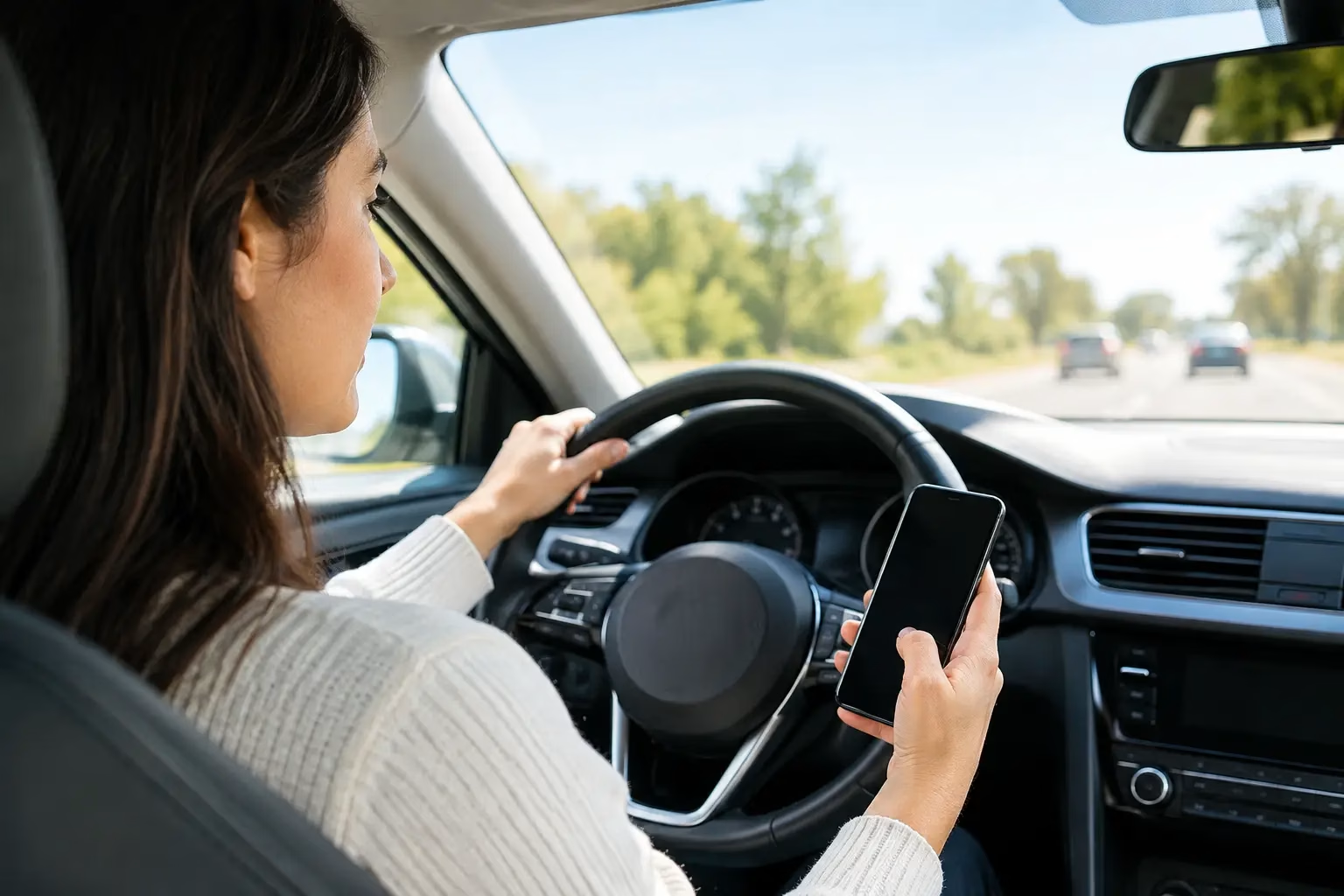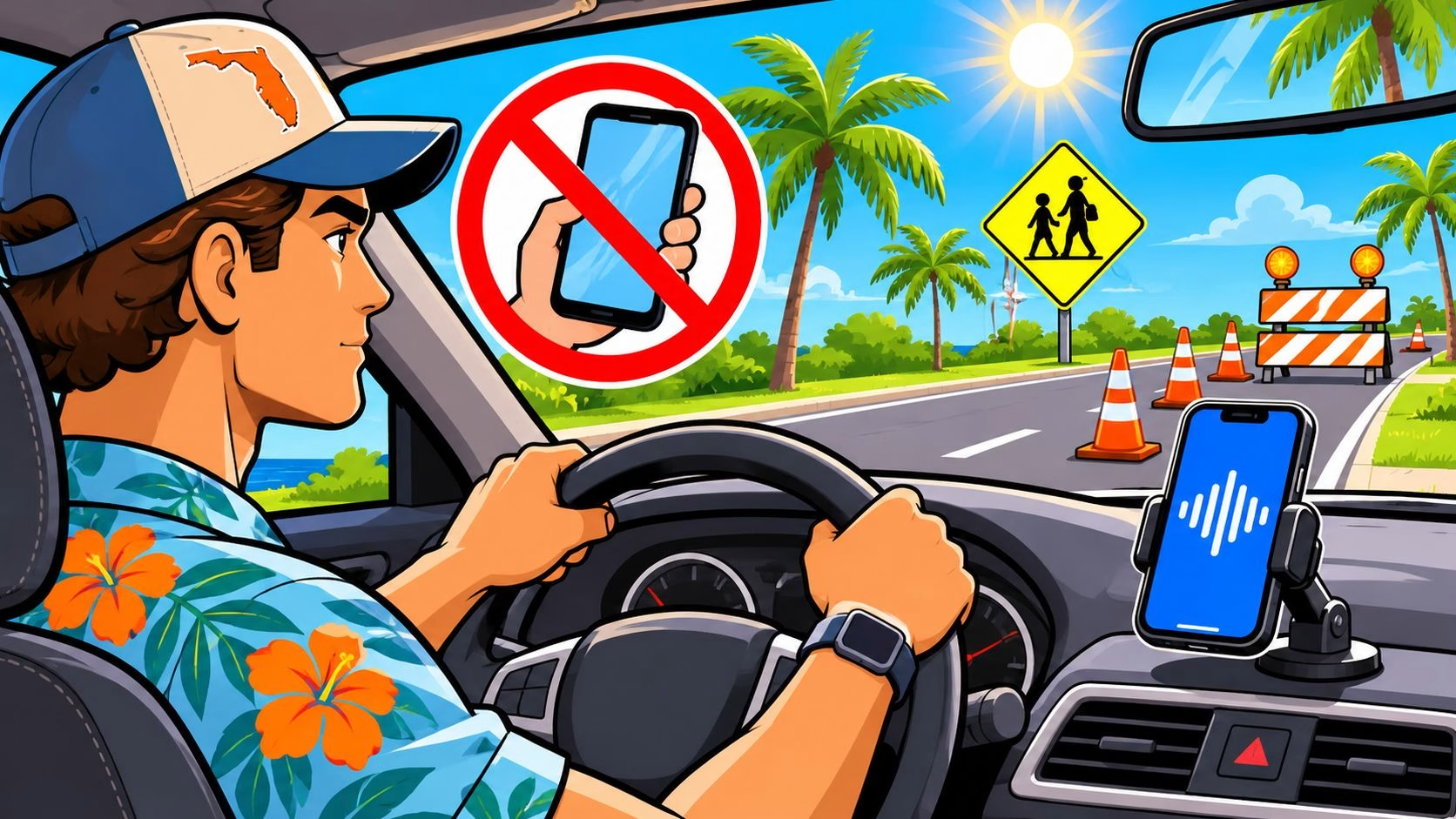
Manually typing or reading a text, email, or instant message while you drive is illegal in Florida under section 316.305. Holding a phone in a school crossing, school zone, or active work zone is a separate violation under section 316.306, and an officer can stop you for that alone.
So why does half the state believe Florida passed a full hands-free law? Because most summaries mash two different statutes into one slogan and drop the part that determines whether you broke a rule.
Florida never banned handheld calls on ordinary roads. It banned your thumbs, your eyes, and your habit of reading a screen at 45 mph, then layered a location rule on top that tightens everything the moment you enter a school zone or a work zone. Two questions settle nearly every Florida distracted driving laws case: what are your hands doing with the device, and where are you driving?
Answer both, and you’ll never need a lawyer to interpret a statute. Answer them carelessly, and you’ll learn the difference between a nonmoving infraction and a moving violation the expensive way.
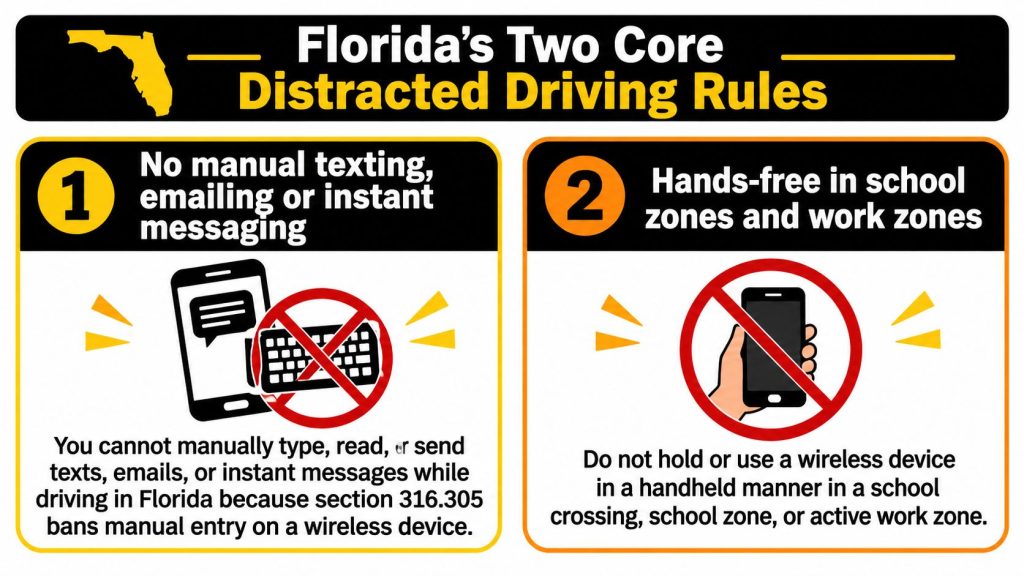
Florida’s Two Core Distracted Driving Rules
The first rule is about your hands. Section 316.305 bans manually typing or entering multiple letters, numbers, symbols, or other characters into a wireless communications device while you operate a motor vehicle. It also bans sending or reading data for nonvoice interpersonal communication, which covers texts, email, and instant messages. A voice call placed through your car’s system on an ordinary road doesn’t violate that statute.
The second rule is about your location. Section 316.306 bans using a wireless device in a handheld manner while driving in a designated school crossing, school zone, or work zone. Handheld means what it sounds like: the phone in your palm, your fingers on the glass, the screen tilted toward your face. An officer can stop you for that conduct alone, with no speeding, no lane drift, and no second violation needed.
Florida is not a full hands-free state, and that gap is where drivers get caught. You can legally hold a phone to your ear on a normal road while the car is moving. You cannot legally hold that same phone ten feet into a school zone. Same device, same hand, different rule, because the Legislature wrote a texting statute and a zone statute rather than one blanket ban.
Here’s the structure in one view:
Three Takeaways That Cover Every Drive
- Hand-typed texting is illegal everywhere. No road, no stoplight, no traffic jam creates an exception for manual entry or for reading a message.
- Holding the phone is illegal in protected zones. School crossings, school zones, and active work zones change the analysis from what you’re typing to whether you’re holding.
- Voice, Bluetooth, and mounted navigation are the safe default. They’re the uses the statutes leave open, and they’re the habits that survive a sign you didn’t notice.
Keep the phone out of your hands any time the car is moving, and treat every school zone sign as a signal to go voice-only before you cross the line. That single habit eliminates the violation most drivers never see coming.
What Counts as Illegal Texting While Driving
Illegal texting in Florida means manually entering multiple characters into a wireless device, or reading a nonvoice message, while you operate a motor vehicle.
The 2025 text of section 316.305 makes it unlawful to operate a motor vehicle “while manually typing or entering multiple letters, numbers, symbols, or other characters into a wireless communications device,” and it extends to “sending or reading data for nonvoice interpersonal communication,” including texts, email, and instant messages. The same statute authorizes an officer who observes that conduct to stop the vehicle and write a citation, so this isn’t a suggestion appended to a safety pamphlet. It’s an enforceable restriction on what your hands do with a phone.
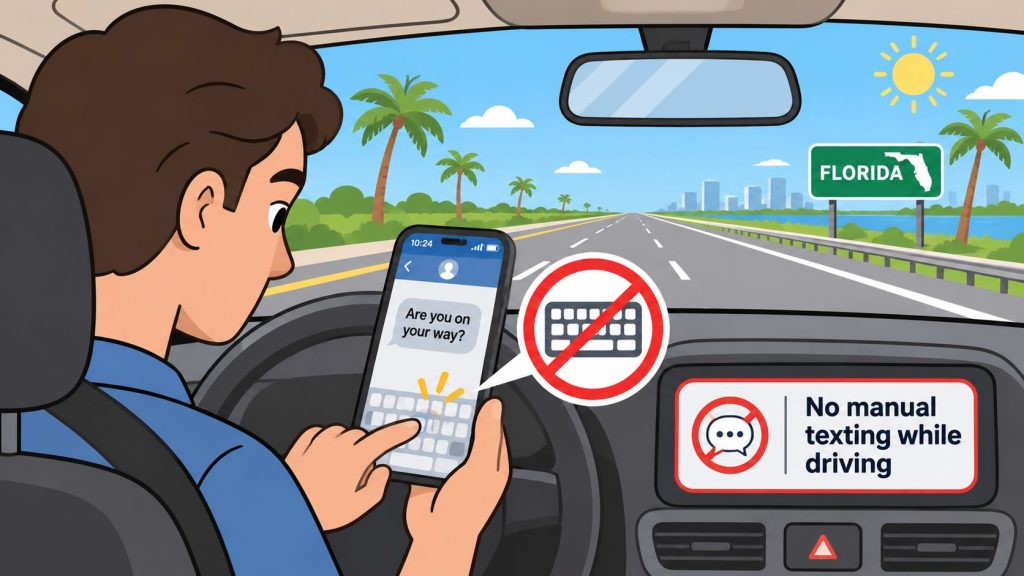
Examples You’ll Recognize
- The red-light reply. You stop at a signal, pick up the phone, and type “on my way.” The engine is running and you’re in the driver’s seat, so you’re still operating the vehicle. A stoplight doesn’t turn your car into a phone booth.
- The group chat scroll. Reading counts the same as typing. Flicking through twenty messages while traffic crawls on I-4 is reading data for nonvoice communication.
- The dashboard email. Newer vehicles mirror text and email onto the center screen. Reading a message there is still reading a message, and the statute doesn’t carve out a display owned by the manufacturer.
- The parking-lot draft. Composing a message in a parking space before you pull out is fine. Reading the answer at the next red light is not, and that’s the sequence most drivers run.
Practical rule: if the phone is in your hand and the screen is on, assume you’re one glance away from a violation. Hands-free voice is the only mode that keeps you clean without you having to think about it.
Distraction you can’t cite still matters. Eating while driving isn’t banned by the texting statute, but a burrito in one hand produces the same delayed reaction as a phone, and an officer who sees you drift can write a careless driving citation instead.
Where drivers get it wrong is assuming intent matters. The officer doesn’t need to know what you were typing. Manual entry plus a moving vehicle is the whole case.
Fines, Points and Repeat Offense Penalties
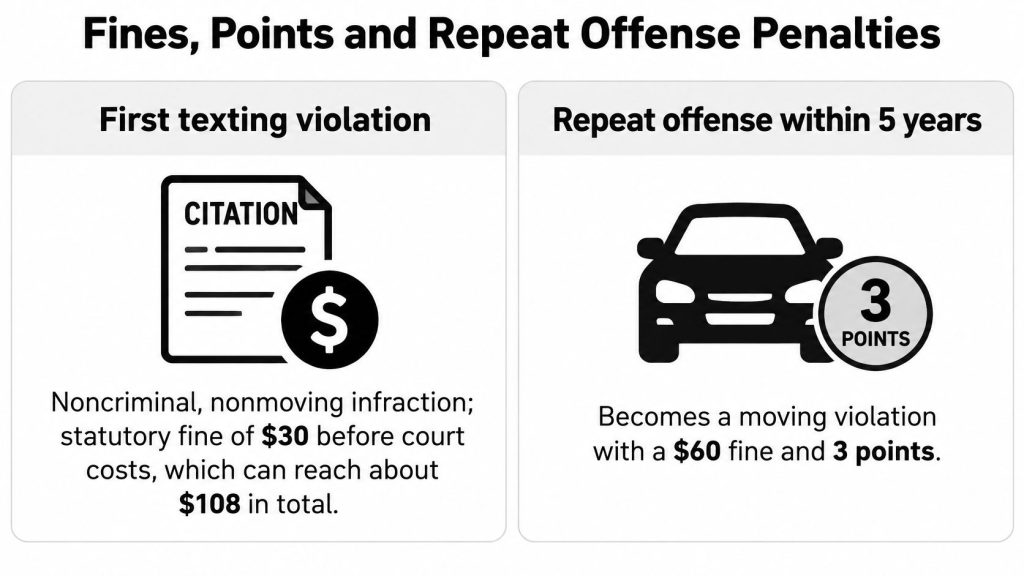
Your first texting violation is a noncriminal traffic infraction treated as a nonmoving violation, which is the cheapest version of this mistake Florida sells. A Florida Senate bill analysis identifies the statutory fine at $30 for a first offense, before applicable court costs, with totals around $108 once those costs land. Chapter 316 of the Florida Statutes confirms the infraction stays noncriminal.
Here’s the penalty structure at a glance:
Why the Moving-Violation Label Matters
A second violation within five years of a prior conviction is still noncriminal, but the Legislature upgrades it to a moving violation, and that word carries a real cost. The fine rises to $60 before court costs, roughly $158 in total according to the same bill analysis of the texting statute. Moving violations feed your driving record, and your driving record is what your insurer prices.
The state’s own enforcement numbers show how few drivers ever reach that second stage. The 2019 legislative record on section 316.305 reports 1,671 citations issued under the statute in calendar year 2018, split into 1,632 first violations and 39 subsequent violations. Nearly every driver who got caught was getting caught for the first time, which tells you the first ticket is usually the only warning the system gives you.
| Violation | Classification | Fine before court costs | Approximate total | Points |
|---|---|---|---|---|
| First texting violation | Noncriminal, nonmoving | $30 | About $108 | None, because it’s nonmoving |
| Repeat texting violation within 5 years | Noncriminal, moving | $60 | About $158 | Points assessed as a moving violation |
| Handheld use in a school or work zone | Noncriminal, moving | Statutory penalty plus court costs | Waived on completion of an approved course | 3 |
Watch this short walkthrough before you decide to just pay the ticket:
One caution before you budget from a table. Those totals are statutory fines plus standard costs, and courts can add local fees, so the number on your citation may run higher than the figure here. Call the clerk’s office with your case number and ask for the actual amount before you mail anything in.
Protected Zone Handheld Rules and Permitted Hands-Free Uses
The zone rule is short and unforgiving. Under section 316.306 as published by the Florida Legislature, you may not use a wireless communications device in a handheld manner while operating in a designated school crossing, school zone, or work zone. It doesn’t matter whether you’re calling, texting, or checking a map. Holding is the violation.
| Road zone | Texting by hand | Handheld calls | Hands-free voice use |
|---|---|---|---|
| Ordinary roads | Banned | Allowed | Allowed |
| School crossing or school zone | Banned | Banned | Allowed |
| Active work zone | Banned | Banned | Allowed |
What Changed on January 1, 2020
Since January 1, 2020, an officer may stop a vehicle solely for observing handheld use in those zones. That makes the rule independently enforceable rather than a tag-on charge you’d only face after a crash or a speeding stop. The offense is a noncriminal moving violation carrying three driver-license points.
The statute also hands you an exit. After an eligible violation, you may elect an FLHSMV-approved wireless communications device safety program, and completing it can allow the clerk to waive the statutory penalty, the associated costs, and the points. That’s a better outcome than paying and absorbing three points, and it’s the route most drivers never ask about.
The Uses Florida Still Allows
The FLHSMV’s distracted driving guidance makes the scope clear: section 316.305 targets manual typing and reading of nonvoice messages, and it permits limited uses such as navigation, emergency or traffic alerts, radio broadcasts, and communication that doesn’t require manual entry or reading text. Hands-free voice operation and Bluetooth are identified exceptions, so a phone in a mount steered by your voice stays lawful even in a protected zone.
The test isn’t whether the phone is on. It’s whether your hand is on it.
That distinction is why labeling Florida a hands-free state is wrong in both directions. It’s stricter than drivers think inside a school zone and looser than they think on the highway.
What the crash statistics capture is a separate problem. A 2002 Florida Senate staff analysis found driver distraction identified as a contributing cause in 603 of 102,293 crashes in 2001, with about 140 involving cell-phone use, and the same record warned the figures likely understated distraction because crash investigations didn’t consistently capture it. Citation counts and coded crash causes are floors, not totals.
Other distractions sit outside the statute but inside a careless driving citation. Eating, adjusting the entertainment system, or reaching for a dropped item can all support a stop when your lane position suffers. If an action takes a hand or your eyes off the road for more than a moment, park first.
How to Stay Compliant on Every Drive
Compliance is a routine, not a decision you make at each red light. Build the routine once and the statute stops being something you have to remember.
- Enter the destination before you move. Type the address, confirm the route, and start navigation while the car is still in park. You can’t fumble with a search box at highway speed if the search is already finished.
- Pair the phone and set up voice commands. Bluetooth through the vehicle system lets you answer calls, dictate replies, and redirect navigation by voice, which is the mode Florida’s statutes leave open on every road.
- Turn on driving mode or do not disturb. A screen that stays dark can’t pull your eyes down. This is the single setting that prevents the reflex glance at a notification.
- Hand messages to a passenger. Let someone in the passenger seat read and reply for you. Nothing in the statute cares who taps the glass when the driver isn’t the one tapping.
- Park before you type. If you must compose something, leave the roadway, pull into a lot or a legal space, stop, and shift into park. The shoulder of a busy interstate is not a parking space.
- Switch to voice before the zone sign, not after. Protected zones change the handheld rule, so make the switch on approach rather than reacting once you’re inside one.
- Mount the phone where you never need to hold it. A dash or windshield mount at eye level keeps the device hands-free and the screen glanceable, which is the physical setup the law rewards.
The habit that covers everything: if an action costs you a hand or your eyes for longer than a moment, it waits until the car is parked.
For drivers holding a commercial license or permit, this stops being about a fine. Under section 322.61, a commercial driver or commercial learner’s permit holder convicted of two listed serious traffic violations within a three-year period may face a 60-day commercial-motor-vehicle disqualification when the offenses come from separate incidents, and texting while driving is expressly on that list. The statute also provides a one-year disqualification for certain listed offenses committed in a commercial motor vehicle. If you drive for a living, treat device compliance as a licensing requirement.
If distraction keeps showing up on your record, our guide to how to avoid distracted driving covers the habits that hold up over months rather than the ones that last a week.
Choosing a Florida Traffic School Course After a Violation
If you picked up a moving violation, find out whether your citation qualifies for the FLHSMV-approved wireless communications device safety program before you pay a cent. Completing an eligible program can allow the clerk to waive the penalty, the associated costs, and the points, and paying the fine outright usually costs you more over the following three years.
Eligibility depends on the violation and on the court handling it, so confirm the program with the clerk using your case number before you enroll anywhere.
For drivers who need a general course rather than a citation-specific program, the Florida Basic Driver Improvement Course, also called Florida Four-Hour Traffic School, is the standard option, and BDI School is a Florida HSMV Approved Basic Driver Improvement School. It runs online and self-paced, so you can work through it from any device on your own schedule.
- Confirm with the clerk which program your citation qualifies for.
- Verify the course’s approval for your court before you pay for anything.
- Register at BDISchool’s course list or DriverEducators’ course list and complete the registration form with your name, driver license number, and email address.
- Start the course and finish it before your court or DMV deadline.
Keep the paperwork straight after any incident, including a fender bender, and our guide to handling a minor collision safely covers what to document at the scene.
One more item worth checking before you choose: the Florida traffic school rules that govern deadlines, eligibility, and how completion gets reported. Register this week rather than the week your deadline lands, so a slow certificate never becomes your problem.
BDISchool is a Florida HSMV-approved Basic Driver Improvement school, and our Florida Basic Driver Improvement Course, also called Florida Four-Hour Traffic School, is built for drivers who just received a moving violation and want it resolved without points or an insurance increase. The course is online and self-paced, so you can finish it around work and meet your court deadline. Start today at BDISchool and put the citation behind you.