Watching your teen pull out of the driveway alone for the first time is a strange mix of pride and nerves. You remember the practice turns, the parking lot lessons, the reminders about mirrors and turn signals. Then the car disappears around the corner, and the quiet hits.
Most Florida parents feel the same tension. Your teen passed the test, but you still know that a license doesn�t create experience overnight. That gap between �legal to drive� and �ready for real traffic� is where a defensive driving course for teens can help.
The good news is that this doesn�t have to feel complicated. If you�re trying to sort out what a course teaches, whether Florida approval matters, and how it may help with insurance or a ticket later, you can think through it one step at a time.
Your Teen Has a License Now What
A lot of parents expect to feel relief after the road test. Instead, many feel more alert than ever. The permit stage had structure. You were in the passenger seat. You could correct a late brake or a rushed left turn. Once your teen starts driving alone, that safety net changes.
That�s usually when parents start noticing the practical questions. Can my teen judge a fast-approaching car at an intersection? Will they leave enough following distance on I-95? What happens when friends are in the car and everyone�s talking at once?
The difference between licensed and prepared
A new driver often knows the rules but hasn�t yet built the habit of reading risk early. They may stop correctly at a sign and still miss the cyclist coming from the right. They may use a turn signal and still move over too quickly because they haven�t learned to scan traffic patterns calmly.
That�s why many families add extra training after licensure instead of treating the license as the finish line.
Practical rule: The first months of solo driving are less about teaching your teen how to start a car and more about teaching them how to anticipate trouble before it develops.
What parents usually want most
Most families aren�t looking for a lecture or a punishment. They want three things:
- Better judgment in traffic: Not just knowing the law, but recognizing when another driver is about to do something careless.
- More consistency under pressure: Braking, spacing, lane changes, and speed choices that stay steady even when the road gets busy.
- A safer transition to independence: Confidence that doesn�t turn into overconfidence.
If that sounds like where your family is right now, you�re not overreacting. You�re doing what good driving coaches do. You�re looking for ways to reduce risk before a mistake becomes a crash.
What Is a Teen Defensive Driving Course Really
A teen defensive driving course isn�t the same as basic driver�s ed. Driver�s ed teaches the mechanics and rules: signs, signals, right-of-way, lane position, parking, and test preparation. Defensive driving teaches the strategy behind staying out of trouble when other people on the road make mistakes.
Think of it this way. Basic training teaches your teen how to operate the car. Defensive training teaches them how to think ahead.
Driving offense versus driving defense
One way I explain it to parents is with a sports comparison. A young driver on �offense� focuses only on what they plan to do next: turn left, merge, park, go straight. A young driver on �defense� keeps reading the whole field. They notice the car drifting in the next lane, the pickup following too closely behind them, the pedestrian near the crosswalk, and the traffic light that�s been green long enough to change soon.
That mindset matters because most crashes don�t happen because someone didn�t know what a stop sign means. They happen because a driver didn�t spot a developing hazard soon enough to respond smoothly.
If you want a plain-language breakdown of the concept, this explanation of what defensive driving means is a useful starting point.
Why it matters for teens in particular
Teen drivers who complete a defensive driving course are 62% less likely to receive traffic violations and 43% less likely to be involved in an auto accident compared to teens without that training, according to Florida DETS course guidance on why parents enroll teens in defensive driving.
That doesn�t mean a course makes a teen perfect. It means structured coaching can change how often they make the kinds of choices that lead to tickets and collisions.
A strong course doesn�t treat a teen like a problem driver. It treats them like a new driver who needs a system for spotting trouble early.
What your teen is actually practicing mentally
A good defensive driving course pushes your teen to ask questions like:
-
What could go wrong here?
A car may run the yellow. A driver may swing wide in a turn. A stopped vehicle may open a door into traffic. -
What�s my safe buffer?
Do I have enough space in front, enough room beside me, and an escape path if traffic changes quickly? -
What should I do before I have to do it?
Slow early. Move lanes sooner. Cover the brake. Delay the turn. Let the impatient driver go.
That is the core of defensive driving. It�s not fear. It�s preparation.
Florida’s Rules and Rewards for Young Drivers
Florida families usually care about safety first, but practical details matter too. If your teen takes a state-approved course, the value isn�t only educational. It can also affect insurance, points, and what happens after a citation.
Florida�s licensing framework also makes supervised learning and gradual skill-building especially important for young drivers. If you want a quick refresher on the staged process, this guide to Florida graduated driver licensing is helpful for parents.
The insurance angle
For many households, this is the first question after safety: will the course save money? In Florida, enrolling in an approved defensive driving course can lower insurance premiums by up to 10% and prevent the accumulation of points from a traffic violation that could lead to license suspension, as noted earlier in the Florida-specific guidance.
The key phrase is approved course. Insurers usually want proof that the provider meets Florida requirements. That�s why the certificate matters, not just the learning itself.
When parents call an insurance company, the most useful questions are simple:
- Does my teen qualify for a discount after completion?
- Which course approvals do you accept?
- How should I submit the certificate?
- How long does the discount remain in effect?
The points issue
Teens don�t always need a course because they�re nervous beginners. Sometimes they need one because they got a moving violation and the family wants to protect their record early.
Florida�s point system can raise the stakes of a first ticket. For a young driver, avoiding points isn�t only about today�s fine. It can affect insurance costs, future driving privileges, and the way a small mistake follows them for years.
Here�s the practical parent view:
| Situation | Why the course may matter |
|---|---|
| First moving violation | It may help keep points off the driving record when eligible |
| Insurance review | It may support a discount or help prevent added costs tied to points |
| Court direction | It may satisfy a required step after a citation |
Before choosing a class, verify that it�s the correct one for your teen�s situation. A general improvement course and a court-ordered requirement are not always the same thing.
After you understand the administrative side, this short video gives a helpful overview of the Florida traffic school process:
When compliance matters more than convenience
Some families shop for the easiest course first. I�d reverse that. Start with compliance, then choose the easiest approved option.
If a teen takes the wrong course, the time spent may not solve the problem you were trying to fix.
For Florida parents, that means checking whether the program is approved, whether it fits the teen�s exact situation, and whether completion reporting is handled properly. Convenience matters. Accuracy matters more.
Inside the Curriculum What Your Teen Will Actually Learn
Parents often ask whether these courses are just videos and quiz questions. A good one shouldn�t feel passive. Even when the format is online, the strongest programs teach your teen to make better decisions in situations that feel ordinary right up until they turn dangerous.
Hazard recognition and space management
The first big skill is seeing risk sooner. Your teen learns how to scan intersections, identify hidden hazards, and avoid getting boxed in by surrounding traffic. That includes practical habits like maintaining a proper buffer around the vehicle and using the 3-4 second rule for following distance, which gives a new driver more time to react smoothly.
That sounds basic, but it changes real behavior. A teen who learns to leave more room usually brakes earlier, changes lanes more deliberately, and gets rattled less often by sudden moves from other drivers.
Some programs reinforce these lessons with short scenario-based visuals. If you�re curious how safety instructors can make lessons clearer with simple visual examples. Video-based explanation used for Florida new drivers can help students absorb procedural skills.
Vehicle control and crash avoidance
Even online courses draw from the same principles used in advanced hands-on training. According to various driver training overview, those programs include exercises like a slalom to improve steering, emergency ABS braking to shorten stopping distances, and wet skid pad training to recover from understeer or oversteer.
Most teens won�t attend a skid pad session as part of a standard online course, but the learning principles still matter. They need to understand what the car does when they brake hard, turn abruptly, or enter a curve too fast. That knowledge builds respect for traction and control before they ever face a true emergency.
For parents who want a broader view of the skills involved, this roundup of defensive driving techniques gives a practical summary.
The behavior side that parents care about
A teen�s problem on the road is rarely just technical. It�s often social or emotional. A passenger laughs. A phone buzzes. Another driver tailgates. Your teen feels rushed and starts making decisions faster than they can evaluate them.
That�s why modern courses also work on judgment. They address distraction, peer pressure, impatience, and the temptation to match other drivers� bad behavior.
A useful curriculum usually includes topics like:
- Reading intersections: Spotting the driver who may fail to yield or turn unexpectedly.
- Handling pressure from behind: Letting an aggressive driver pass instead of speeding up.
- Managing in-car distractions: Keeping attention on the road when friends, phones, or music compete for it.
- Choosing the safer option early: Missing a turn, slowing down, or taking extra time rather than forcing a risky move.
The safest teen drivers aren�t the ones who never feel pressure. They�re the ones who know what to do when pressure shows up.
Choosing the Right Format Online vs In-Person
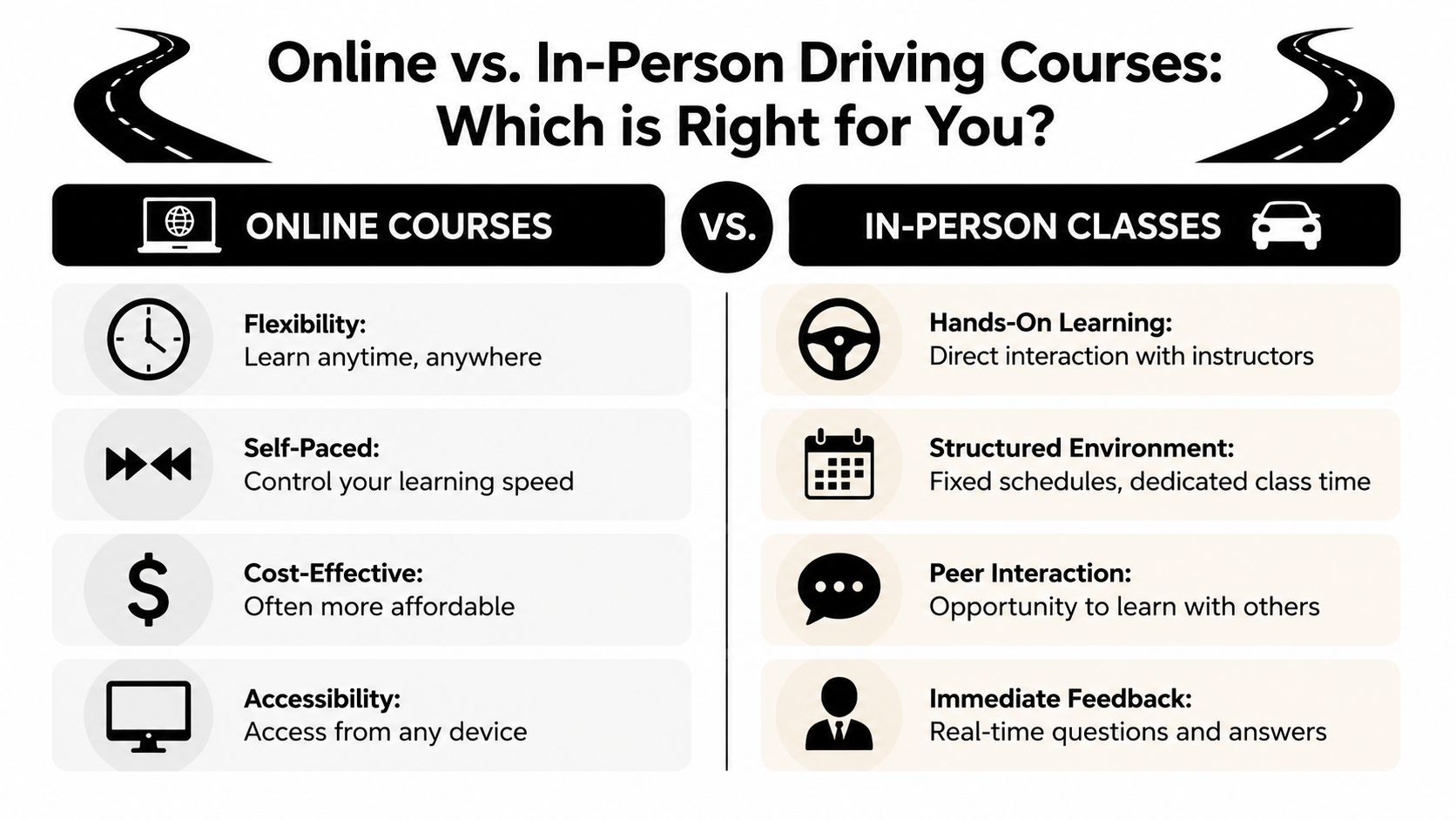
Parents usually don�t need to be convinced that training helps. The harder question is format. Should your teen take an online course that fits around school and sports, or an in-person class with direct instructor contact?
When online works best
Online courses fit many Florida families because schedules are already full. A teen may have school, activities, part-time work, and family responsibilities. A parent may be coordinating everything around their own workday.
Online learning tends to be a strong fit when your teen:
- Learns well independently: They can read, watch, and answer questions without constant prompting.
- Needs scheduling flexibility: They can complete sections in shorter blocks instead of committing to a fixed classroom time.
- Feels less pressure at home: Some students absorb material better when they can pause and revisit it.
For many families, convenience isn�t a luxury. It�s the difference between taking the course soon and putting it off.
When in-person can be the better choice
Some teens benefit from a live instructor, especially if they ask lots of questions or need stronger external structure. In-person formats can also work well for students who tune out on screens or do better when they know a teacher is watching their progress in real time.
Hands-on programs are a separate category worth noting. If your family is looking beyond a compliance course and wants advanced vehicle control practice, in-person training may offer experiences that an online format cannot.
Here�s a simple comparison:
| Format | Best for | Main tradeoff |
|---|---|---|
| Online | Busy families, self-paced learners, easy access from home | Less direct live interaction |
| In-person classroom | Teens who want real-time questions and a set schedule | Less flexible timing |
| Hands-on driving clinic | Families seeking advanced skill practice in controlled conditions | More planning and travel |
A good decision question for parents
Don�t ask which format is �better� in the abstract. Ask which format your teen will complete, understand, and take seriously.
Parent checkpoint: The right course is the one that matches your teen�s learning style and satisfies the Florida requirement you�re trying to meet.
If your teen is responsible, comfortable with self-paced learning, and mainly needs approved instruction for safety, compliance, or insurance purposes, online may be the easiest fit. If your teen needs stronger accountability or direct coaching, in-person may be worth the extra coordination.
From Enrollment to Certificate A Step-by-Step Guide
Once you decide to move forward, the process is usually simpler than parents expect. The key is handling it in the right order so you don�t waste time on the wrong course.
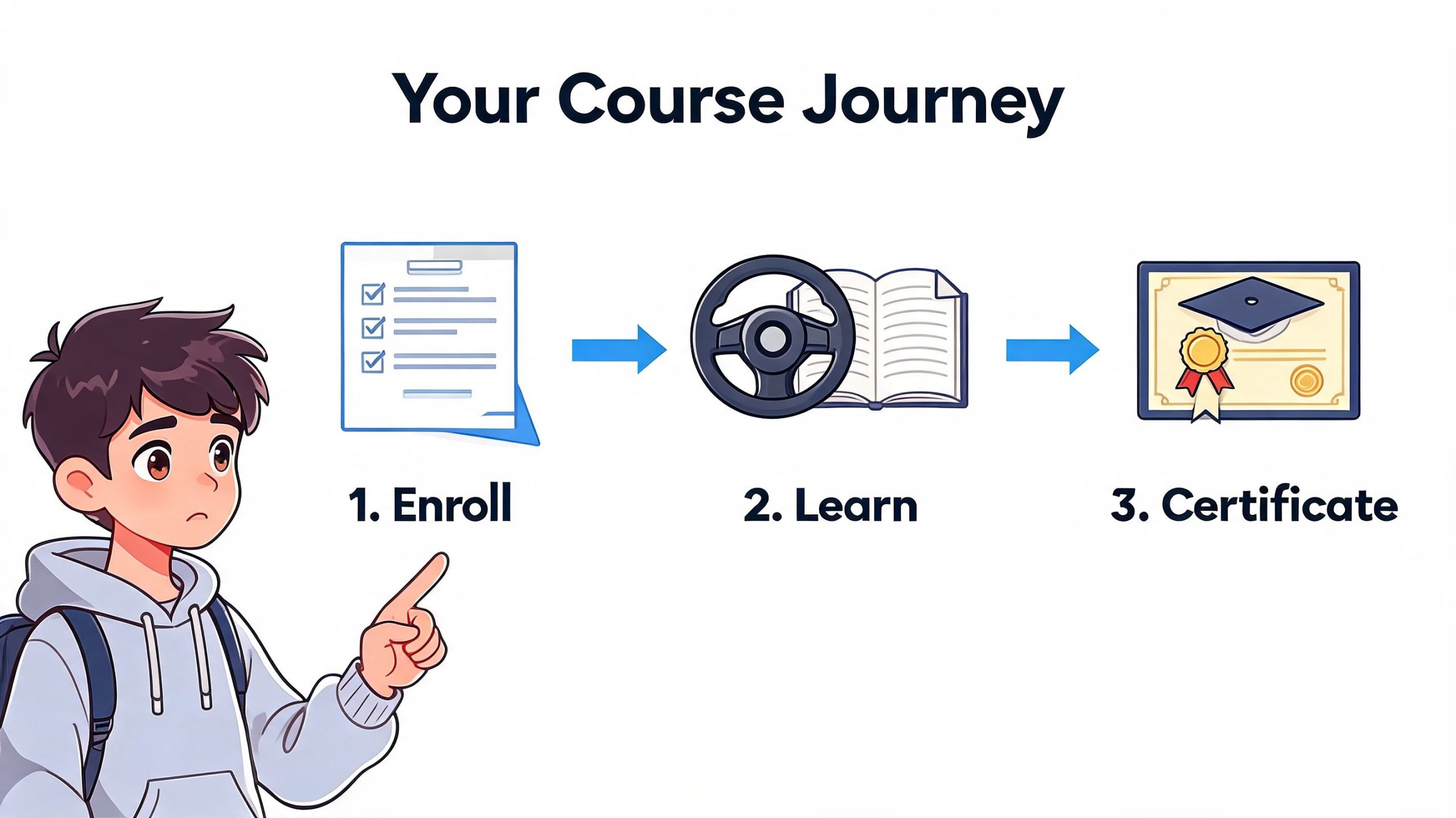
Step one to verify the course type
Start by identifying your teen�s reason for taking the course. Is this for general safety education, insurance eligibility, a moving violation, or a court requirement? That question determines what approval you need.
Then confirm that the provider is Florida-approved and that the course matches the teen�s situation. If your family needs language support, this matters here too. In diverse states like Florida, where nearly a third of residents may speak a language other than English at home, access to multilingual defensive driving courses in Spanish or Portuguese is an important and often overlooked part of safety education and compliance.
Step two to enroll and complete the coursework
Most online providers let you register in a few minutes. After that, your teen can log in and move through the lessons at their own pace. That�s especially helpful when attention span, school obligations, or sports schedules make long classroom sessions difficult.
A smooth enrollment experience usually includes:
- Clear course labeling: So you can tell whether it�s a basic improvement course, a court-ordered option, or a general education program.
- Device flexibility: Your teen should be able to access the material from a phone, tablet, or computer.
- Language options: This can make a major difference for bilingual families or parents helping a teen complete requirements.
Step three to finish and handle the certificate correctly
At the end, your teen typically completes a final assessment and receives a certificate. What happens next depends on why the course was taken.
If the course was for insurance, keep a copy of the certificate and contact the carrier for submission instructions. If it was for a ticket or court matter, make sure the reporting process is clear before enrollment. Many parents assume they�ll need to manage every step manually, but some approved providers report completion electronically, which removes a lot of stress.
A simple checklist helps:
- Save the completion certificate
- Confirm reporting or submission requirements
- Notify the insurer if a discount applies
- Keep a record for your family files
The families who have the easiest experience are usually the ones who slow down for five minutes at the start and verify the course type before paying.
Common Questions From Florida Parents
Is a defensive driving course actually proven to help
Yes. A thorough AAA Foundation study found that formal driver education programs reduce teen crashes by 4.3% and traffic convictions by nearly 40%.
That�s why many instructors view a defensive driving course for teens as more than a box to check. It gives a new driver a structure for recognizing hazards, managing pressure, and making calmer choices.
My teen is already careful. Why do they still need it
Because being careful isn�t the same as being experienced. A careful teen may obey speed limits and avoid obvious risks, but still miss subtle ones. They may not yet predict the driver who�s about to turn without enough gap, drift into their lane, or stop short in heavy traffic.
The course helps bridge that experience gap. It teaches a teen to read the road earlier and respond sooner.
If your teen is still in the permit stage or your family is sorting through restrictions, this guide on driving at night with a permit can help clarify one of the questions parents ask most often.
How do I use the certificate for an insurance discount
Call the insurer before or right after enrollment and ask exactly what they need. Some carriers want the certificate emailed. Others may ask for upload through a customer portal or submission through an agent. Keep a copy saved in more than one place so you�re not searching for it later.
Bring the process down to paperwork. Confirm the accepted course, complete it, save the certificate, and ask the insurer how they want it delivered.
What if my teen got a ticket and I�m not sure which course applies
Don�t guess. Check the citation details, any court paperwork, and the Florida approval status of the provider before enrolling. The right course can help. The wrong course may only create more delay.
A little caution at that stage can save a lot of frustration later.
If you’re looking for a Florida-approved option that�s fully online, self-paced, and available in English, Spanish, and Portuguese, BDISchool offers traffic school courses designed to help drivers meet state requirements, protect their record, and build safer long-term habits.