You just got the ticket, or maybe the court notice, and now you’re trying to figure out one thing that matters: will an online course count in Virginia, or are you about to waste a night and a payment on the wrong class? That’s the right question. A Virginia DMV approved online driver improvement course can help, but only if you pick the right kind of provider and understand what approval really means.
The mistake most drivers make is assuming every course with �approved� in the headline is automatically good for points, court, and insurance. Virginia doesn’t work that loosely. The state treats approval as a real licensing system, and that’s exactly why you need to choose carefully.
What a Virginia DMV Approved Online Driver Improvement Course Really Is
A driver walks in mad, tired, and already behind. He’s got a citation in one hand and his phone in the other, and the first thing he wants to know is simple, will this online class count, or is it just marketing? That’s the moment where Virginia’s definition matters, because �approved� is not a casual label, it’s a DMV license tied to a real clinic.
Virginia DMV defines an online driver improvement clinic as one that is licensed by the DMV to conduct driver improvement via the internet or other approved electronic means. That definition matters because it separates a real Virginia clinic from a random traffic school site that just wants your card number. The state is licensing the provider, not merely blessing a web page.
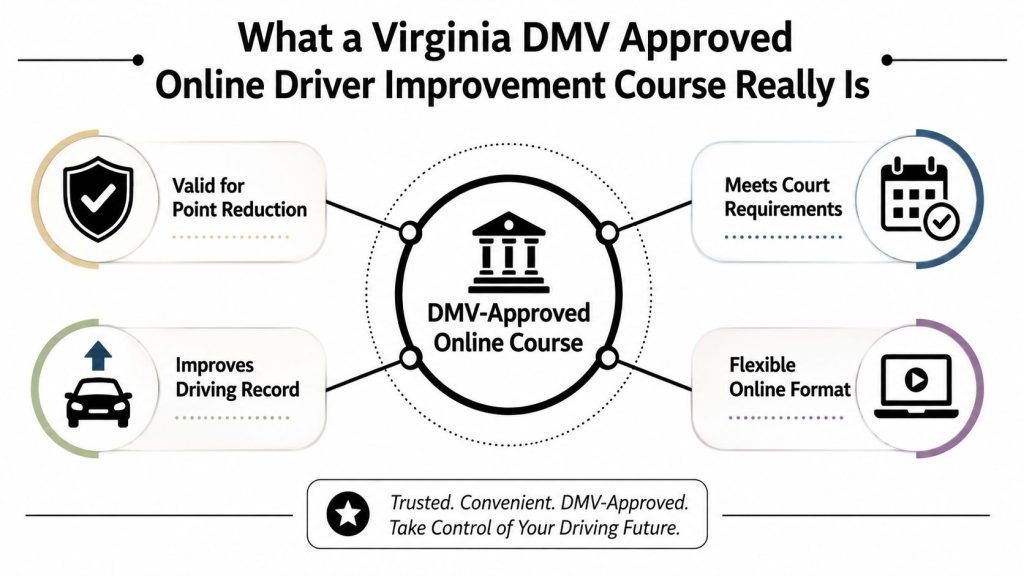
What that means in practice is that the course has to fit Virginia’s rules for both content and delivery. The older model was an in-person clinic, and the modern version is the same basic state function delivered online. The format changed, but the legal idea did not.
Virginia has been running this system for a long time. The program has operated since January 1975, and an interim Virginia Transportation Research Council report said it had already treated more than 200,000 drivers by the time of that report, with completion earning 5 safe driving points and the treatment charge listed at $70 in that era (VTRC report). That history tells you something important, this isn’t a trendy add-on, it’s a statewide driver management tool.
If you want a clean starting point, the state’s own approved online traffic school information is the right place to look, and this overview on Virginia DMV approved online traffic school options fits that search intent well. Start there, then check the clinic itself. Don’t start with the ads.
How the Enrollment and Completion Process Works
A Virginia driver improvement course should run like a checklist, not a guess. Start with a DMV-approved vendor, then register under the same legal name that appears on your license. If the name does not match, the process slows down, and that is avoidable trouble.
What happens after you sign up
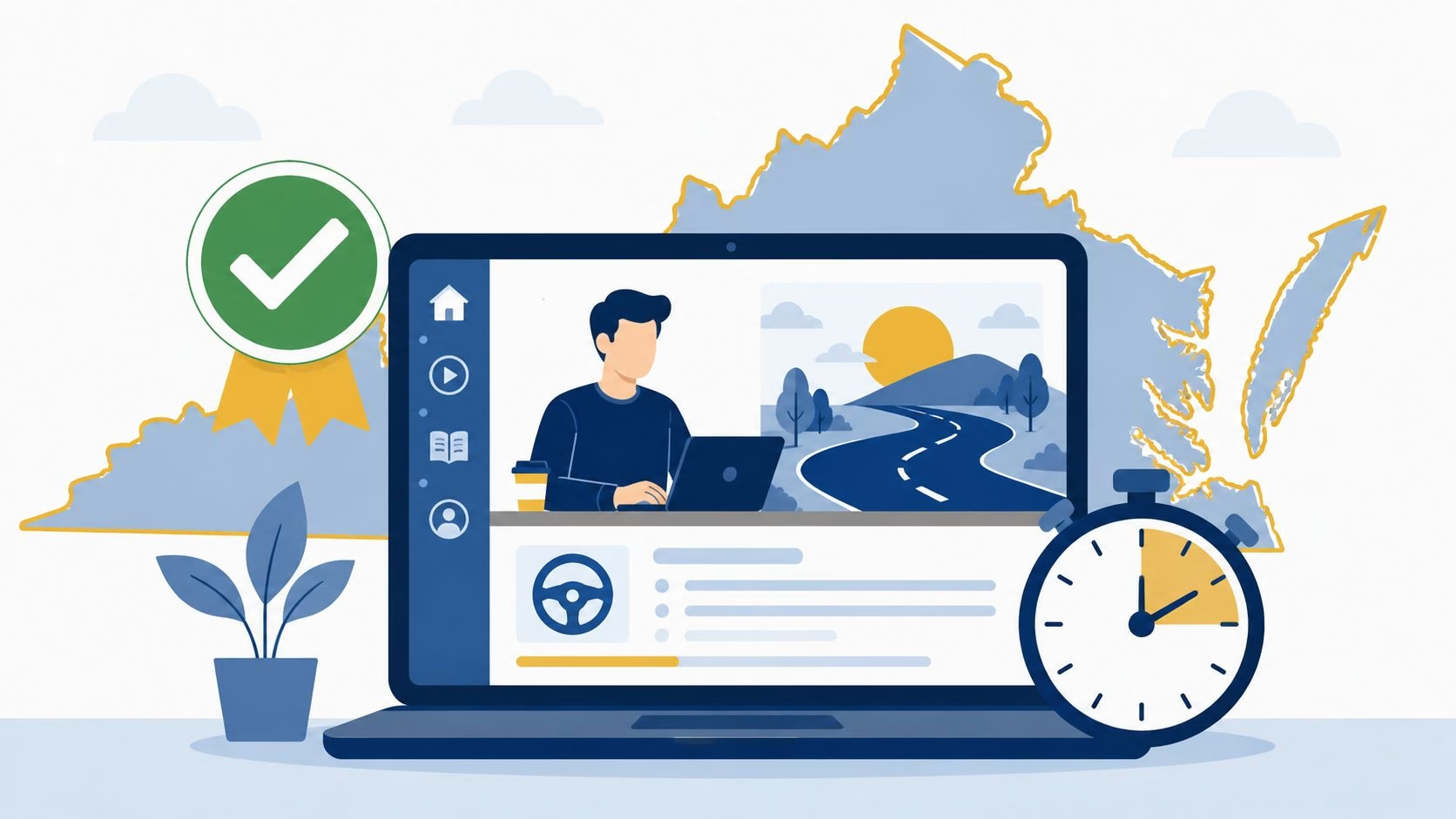
Once you enroll, the work is done in modules, and the course is completed online at your own pace. Virginia DMV rules treat the online driver improvement course as an 8-hour course, and providers can deliver it through internet-based instruction or other approved electronic means (Virginia DMV driver improvement course rules). That format gives you flexibility, but it does not change the standard. You still have to finish the full course and complete the required checks before you get credit.
Identity verification shows up during the course and again before the final test, and you should expect that every time. Virginia DMV requires providers to validate student identity throughout the course, and the provider requirements spell out that approved clinics must handle that part of the process directly (Virginia DMV provider requirements). Identity verification is what makes the certificate usable.
Practical rule: if registration feels too fast, slow down and read the details. A real Virginia course has to know who is taking it.
At the end, you pass the final assessment and receive your certificate. Save it right away, whether it arrives by email or through a download link. If you cannot produce the certificate when a court, insurer, or attorney asks for it, the completion does you no good.
If you want a format you can work through on your schedule, a self-paced online course option fits that need well. That matters when you are trying to finish the course around work, family, and a deadline that does not move.
Why DMV Approval Is More Than a Badge on a Website
A driver in a hurry sees �DMV approved� on a website and assumes the job is done. In Virginia, that is the wrong way to judge it. Approval has two parts, and I watch for both every time. A provider has to carry the right course content, and it has to use identity verification that proves the right person is taking the class.
The first part is the curriculum
Virginia looks at the course itself. The provider has to submit the curriculum, the quizzes, the answer keys, and the paperwork that shows how student identity is checked at the keyboard. That review tells you the state is looking past the sales pitch and into the material a driver completes. The approval is not just a marketing label. It is a review of the course content and the system behind it.
The second part is the anti-fraud layer
Virginia also requires identity verification throughout the course and before the final test. That is the part too many drivers ignore. A progress bar does not prove who completed the lessons, and a final click-through screen does not fix that problem.
Approval in Virginia is closer to proctored-by-process than simple online attendance tracking.
That is the standard you should care about. A site can look polished and still fail the basic test if it cannot explain how it ties the student to the work being done. If the vendor cannot show how it confirms identity, the approval claim means less than it should.
I tell drivers to read the approval claim the same way they read a court notice. Ask what was reviewed, ask how identity is checked, and ask whether the provider can point you to the state’s provider rules, not just its own sales copy. The DMV reinstatement guide for Texas drivers is a separate example of why state rules matter, because each state sets its own process and the label alone never tells the full story.
A real Virginia-approved clinic earns trust in two ways. It has the right content, and it has the technology to verify the student from start to finish. If a provider cannot explain both pieces in plain language, I would not trust it with a court deadline or a point-reduction requirement.
What You Get From the Course and When It Applies
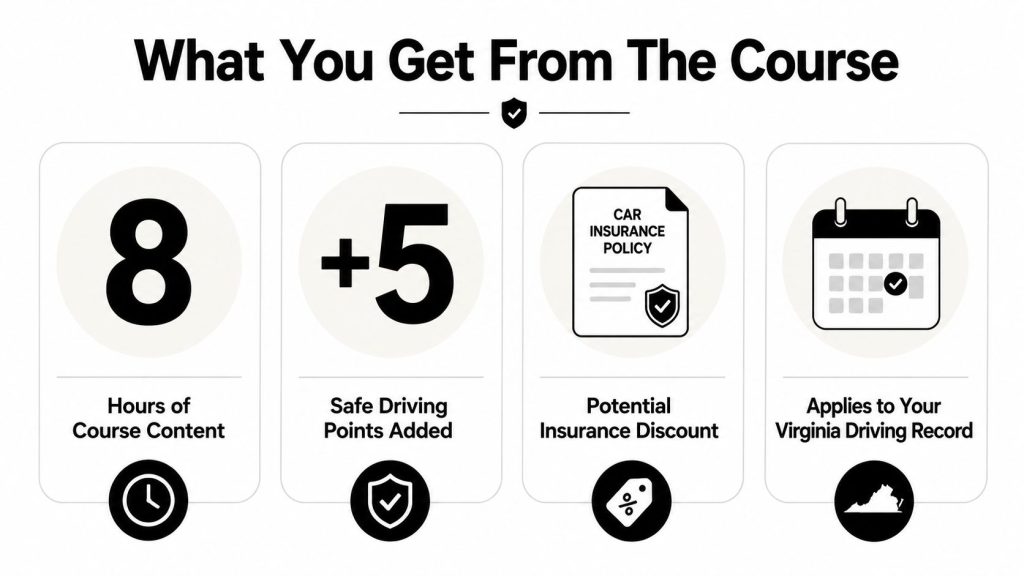
The first thing drivers need to understand is simple. A Virginia DMV approved online driver improvement course is an 8-hour course, and completion can earn +5 safe driving points under Virginia’s program rules (Virginia DMV driver improvement rules). That is the main reason people take it. Points are what keep a record from sliding in the wrong direction.
Who gets referred to it
Virginia’s point referral thresholds are specific. Drivers 18 or older are directed to attend after 12 or more demerit points in 12 months or 18 or more in 24 months, while drivers under 18 are directed after 9 or more in 12 months or 12 or more in 24 months (Virginia point referral thresholds). Those are the numbers that move the course from optional to required.
Why the course can still make sense voluntarily
You do not have to hit the threshold for the class to be useful. Some drivers take it early because they want a cleaner record, fewer problems later, and a better response to a ticket. That is a practical choice when the alternative is waiting too long and hoping the court takes a softer view.
The insurance side matters too. A driver safety course for insurance discount can be a separate reason to complete the class, and many drivers use it as part of both record management and premium management. If you want a separate example of how post-violation cleanup can work in another state, the DMV reinstatement guide for Texas drivers shows why state rules never line up neatly from one place to another.
I tell adult drivers the same thing every time. If you already need the class, take it early. If you do not need it yet, it can still be a smart preventive move, especially if you are trying to stay ahead of points or satisfy a court order without dragging it out.
DMV Approval, Court Acceptance, and Insurance Discounts Are Not the Same Thing
Drivers often waste time, assuming a single approval resolves every issue. It doesn’t.
| Approval Type | Who Grants It | What It Confirms | What It Does Not Cover |
|---|---|---|---|
| DMV Approval | Virginia DMV | The clinic is licensed to deliver the Virginia driver improvement curriculum and use approved electronic delivery | It does not automatically guarantee every court, insurer, or personal goal will treat it the same way |
| Court Acceptance | The judge or court order | The course satisfies that specific court requirement and outcome code | It does not replace DMV licensing or insurer rules |
| Insurance Discount | Your insurance carrier | The carrier’s policy allows a discount after completion | It does not mean the court will accept it, or that DMV point treatment is automatic |
The smartest drivers separate those three questions before they pay. DMV approval says the course is legitimate in Virginia. Court acceptance depends on the actual order, and insurance depends on your carrier’s policy.
If you’re fighting a ticket, that distinction matters even more. A good place to read about ticket strategy is this ticket help resource from Fiscella Law LLC, because the court question and the course question often travel together. You don’t want to buy a class first and ask the legal question later.
For drivers focused on premium savings, this driver safety course for insurance discount guide is the better fit than a court-focused search. Pick the right goal first, then choose the course that matches it.
Verifying Approval and Submitting Your Certificate the Right Way
A driver who waits until the last minute usually finds out the hard way that �looks approved� is not the same as being approved. Start by checking whether the provider is on Virginia’s published approved list, then inspect the course page for clear approval details and identity-verification steps. If the site buries that information or avoids saying how it confirms who you are, walk away.
The test has two parts. First, the provider must have the right course content approval. Second, the platform has to verify the student’s identity in a way that matches Virginia’s process, because a certificate is only useful if the right person completed the work.
What to verify before and after you finish
Before you begin, line up the basics. Your device should run smoothly, your registered name should match your license exactly, and the provider should explain how completion gets recorded and how the certificate is delivered. That is what keeps a simple online course from turning into a scramble later.
After you finish, save the certificate immediately and keep it in more than one place. I tell drivers to keep one copy for the court, one for the insurer, and one for their own file. If the certificate does not appear right away, contact the provider and ask how completion reporting works.
Keep your own copy even if the provider says it reports automatically.
Virginia DMV approval is a formal process, and the vendors worth trusting make their approval status and delivery steps easy to understand. If a site is vague about reporting or identity checks, do not use it for a deadline. A course that clears points or satisfies a court order has to be built for proof, not just for marketing.
Before you enroll, check where you stand with your record so you are not guessing about what the course needs to fix. A practical how to check driving record guide helps you confirm the facts before you start the class.
Your Pre-Course Checklist and Common Pitfalls to Avoid
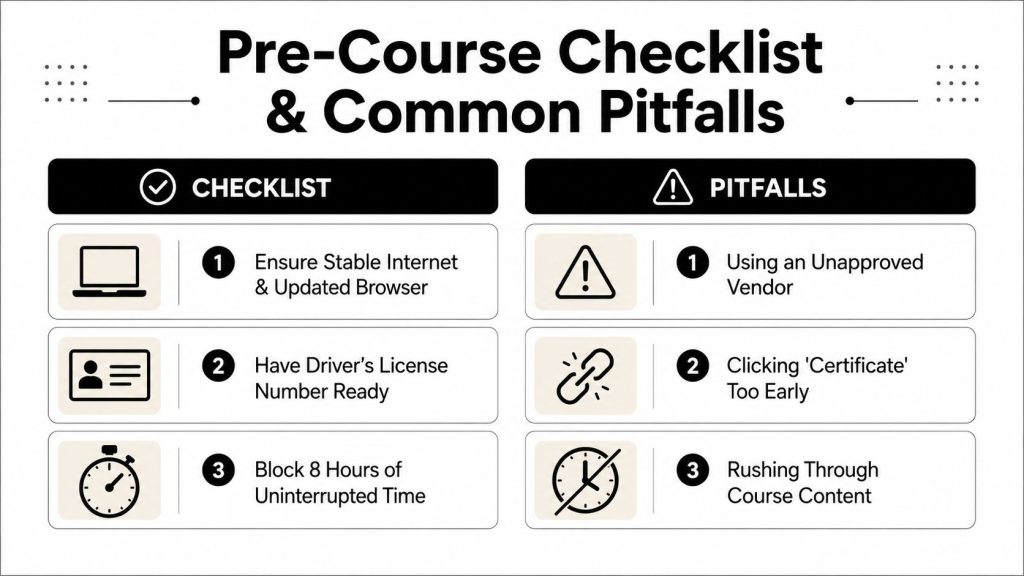
The smart move is to prepare before you click enroll. Have a stable internet connection, an updated browser, and your driver’s license number ready. Block out 8 uninterrupted hours, because even a self-paced course goes faster when you’re not stopping every few minutes.
The mistakes I see most
- Using an unapproved vendor: If the clinic isn’t on Virginia’s approved list, the certificate is a gamble.
- Waiting too long: Starting the night before a court date is how people create avoidable stress.
- Skipping identity steps: If the vendor needs verification prompts, treat them seriously instead of clicking through blindly.
Your registered name should match your license exactly. That sounds basic, but small mismatches cause the kind of delay that turns a manageable task into a cleanup job.
If you’re choosing between two providers, pick the one that explains approval, identity checks, and certificate delivery clearly. That’s the vendor that understands how Virginia’s system works.
FAQ and How to Start Your Course Today
How long does the course take in practice? Virginia treats it as an 8-hour driver improvement course, and self-paced delivery lets you split it up if the provider allows it, as noted earlier in the DMV rules.
Does the same certificate work for court and insurance? The certificate shows you finished the course, but court acceptance and insurance discounts depend on the order you received and the carrier’s own policy. That is why you need to know the reason you are taking the course before you enroll.
What if identity verification fails mid-course? Stop and fix it right away. The DMV requires identity verification throughout the course and before the final test, so a failed check is a problem you should not brush off, as the provider requirements explain earlier.
Can drivers outside Virginia take the course? They can use it only if Virginia approval matches their legal or insurance situation. Approval in one state does not automatically satisfy another state’s rules.
If you need a clean, direct path, register through one of the official course catalogs and start now. BDISchool offers online driver improvement options that fit the Virginia approval framework, and the fastest way to stop guessing is to enroll and get moving.
If you need a Virginia driver improvement course that is built around real DMV requirements, BDISchool gives you a straightforward place to start. Pick the right course, finish it on your schedule, and keep your record cleanup moving instead of putting it off another week. Visit BDISchool and register today.