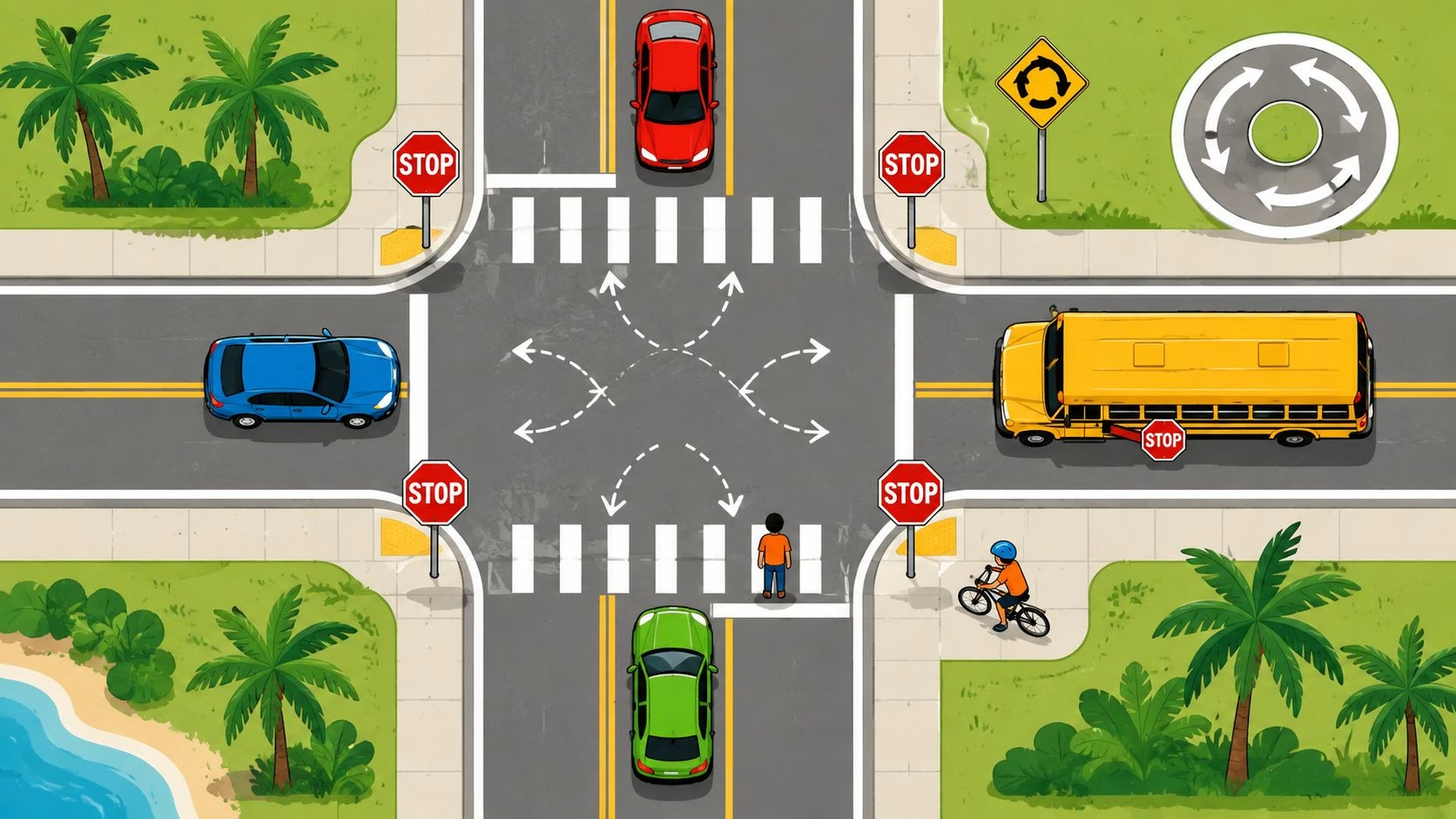
You’re approaching a four-way stop, and another driver reaches the intersection at the same moment. Both cars pause. A third vehicle rolls up behind you, while a pedestrian waits near the corner. This ordinary Florida moment can become confusing fast, especially when each driver assumes someone else will go first.
Florida’s right of way rules are easier to follow when you stop thinking of them as permission to claim the road. They create a duty to yield, identify who should proceed first, and reduce conflict among drivers, pedestrians, and cyclists. The safest driver doesn’t force priority. They recognize the rule, communicate clearly, and proceed only when the path is safe.
What Right of Way Actually Means in Florida
At that quiet Tampa four-way stop, the two cars that stopped together must use Florida’s tie-breaking rule. The driver on the left yields to the driver on the right. The third vehicle, arriving later, waits until the earlier traffic has moved and the intersection is clear.
Florida Statute 316.123 frames right of way as a yielding responsibility, not a permanent privilege. A driver approaching an intersection must yield to a vehicle already in the intersection. When vehicles enter at the same time from different highways, the driver on the left yields to the driver on the right. At a stop intersection, the first vehicle to stop proceeds first, and simultaneous arrivals follow the left-to-right rule. These requirements remain part of the 2026 Florida Statutes on yielding.
The same framework applies beyond a traditional intersection. A driver entering a state-maintained road from a paved or unpaved road must yield to approaching traffic. Someone entering from a driveway, alley, or private road must yield to vehicles close enough to create an immediate hazard.
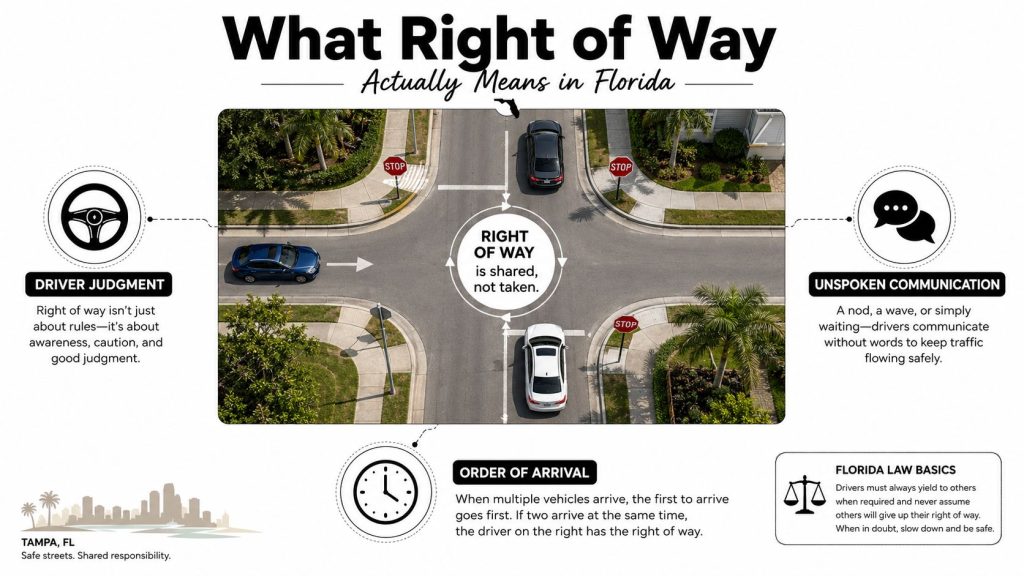
Florida’s crash data shows why these decisions matter. The Florida Traffic Crash Facts Annual Report 2022 recorded 16,550 property-damage-only crashes, 3,162 injury crashes, and 453 fatal crashes tied to failure to yield, for 20,165 crashes in total. The defensive habit is simple: slow early, identify who must yield, and leave room for another person’s mistake.
Uncontrolled Intersections and Driveway Entries
On a residential Jacksonville street with no signs, signals, or clear pavement markings, reduce speed before reaching the crossing. Look for a vehicle already in the intersection, then scan left and right for traffic that may be hidden by parked cars, landscaping, or a large sport utility vehicle.
If two vehicles approach at the same time from different roads, the driver on the left yields to the driver on the right. Don’t roll forward to test the other driver’s intentions. Cover the brake, make eye contact when possible, and proceed only after the other vehicle has clearly yielded or passed.
Practical rule: At an uncontrolled intersection, being technically entitled to proceed doesn’t make it safe to proceed.
A driveway entry creates the same kind of risk on a larger scale. At a busy US-19 strip mall, a driver leaving a parking lot must yield to traffic on the through street and to pedestrians crossing the driveway entrance. The driver may have a clear view of one lane while a second vehicle or walker remains concealed.
Florida law requires a vehicle entering a highway from a driveway, alley, or private road to yield to all vehicles close enough to create an immediate hazard. Treat the driveway apron as a conflict point, not as an extension of your lane.
Use a deliberate sequence:
- Scan the crossing: Look for vehicles, pedestrians, bicycles, and scooters before reaching the edge.
- Control the approach: Keep your foot ready over the brake instead of accelerating into a blind junction.
- Resolve the order: Identify who arrived first, then apply the left-yields-to-right rule if arrival was simultaneous.
- Check again: Recheck the near lane and sidewalk before turning or entering the main road.
Stop Signs, Yield Signs, and Four-Way Stops
A stop sign requires a complete stop at the correct location. Stop at the marked stop line. If there isn’t one, stop before the near-side crosswalk. If there’s no crosswalk, stop at the point nearest the intersecting roadway that still gives you the best view of approaching traffic, as required by Florida’s stop-intersection statute.
A rolling stop doesn’t satisfy that duty. Pause fully, check for traffic and pedestrians, and yield to vehicles already in the intersection or close enough to create an immediate hazard.
Reading a four-way stop
Suppose four cars arrive at different times on a Miami neighborhood street. The first car to stop goes first. The next car proceeds after the path is clear, followed by the next arrival. If two cars stop together, the driver on the left yields to the driver on the right.
When two vehicles face each other and both intend to travel straight, they can generally proceed together after confirming that neither vehicle is turning across the other’s path. A left-turning driver must wait for the opposing vehicle going straight.
A yield sign works differently. Slow down, assess the traffic already using the roadway, and stop only when necessary. You must merge or enter without interfering with traffic that has priority. The sign doesn’t mean you should stop automatically when the road is empty, but it does mean you’re responsible for selecting a safe gap.
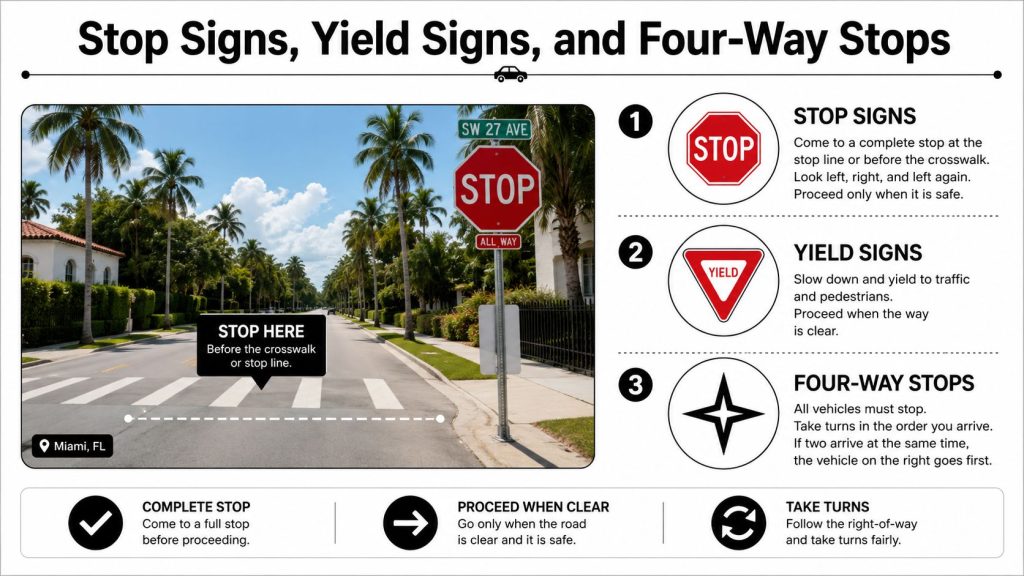
For more practice with arrival order and simultaneous stops, review these four-way stop rules. The sign controls the sequence, but your observation determines whether moving is safe.
Turning Scenarios That Trip Drivers Up
Turning mistakes usually happen when a driver focuses on the signal and forgets the people or vehicles crossing the intended path. A green light doesn’t erase the duty to yield when another road user has priority.
Unprotected left turns
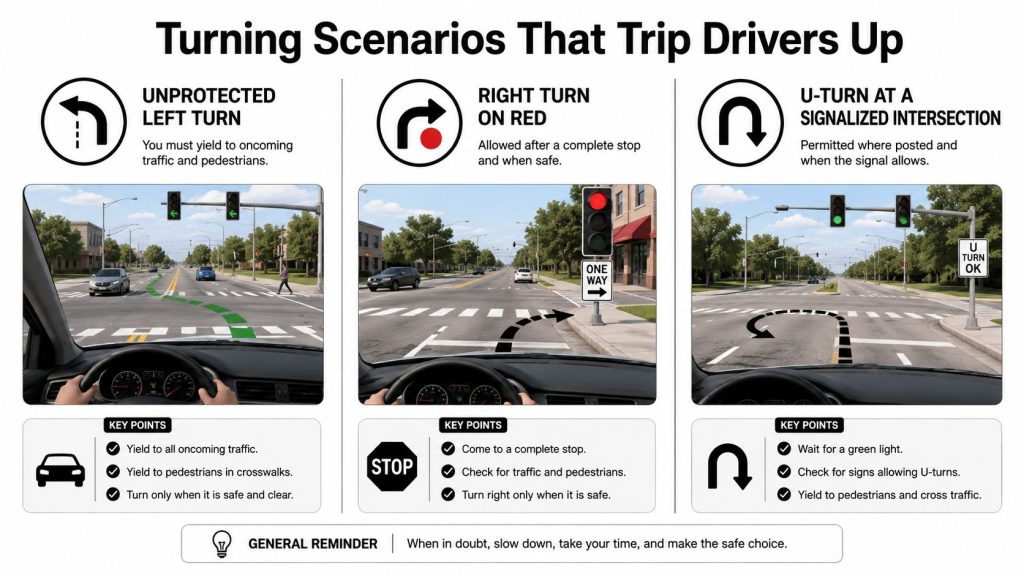
At an unprotected left, oncoming vehicles going straight or turning right generally have the conflict-free path. Wait behind the stop line or in the designated turning area, keep the wheels straight while waiting, and turn only when you can complete the movement without cutting off traffic.
A green arrow gives protected movement while it’s active. When it changes to yellow or red, don’t assume you can finish because you entered the intersection. If the gap disappears, remain stopped and wait for a lawful opportunity. This guide to the left-turn-yield-on-green meaning reinforces the distinction between a protected arrow and a permissive signal.
Right turns on red
Florida permits a right turn on red after a complete stop unless a sign prohibits the movement. Before turning, yield to approaching traffic and pedestrians in the crosswalk. A blocked view caused by a truck, landscaping, or a wide corner means you should wait, not edge forward aggressively.
U-turns
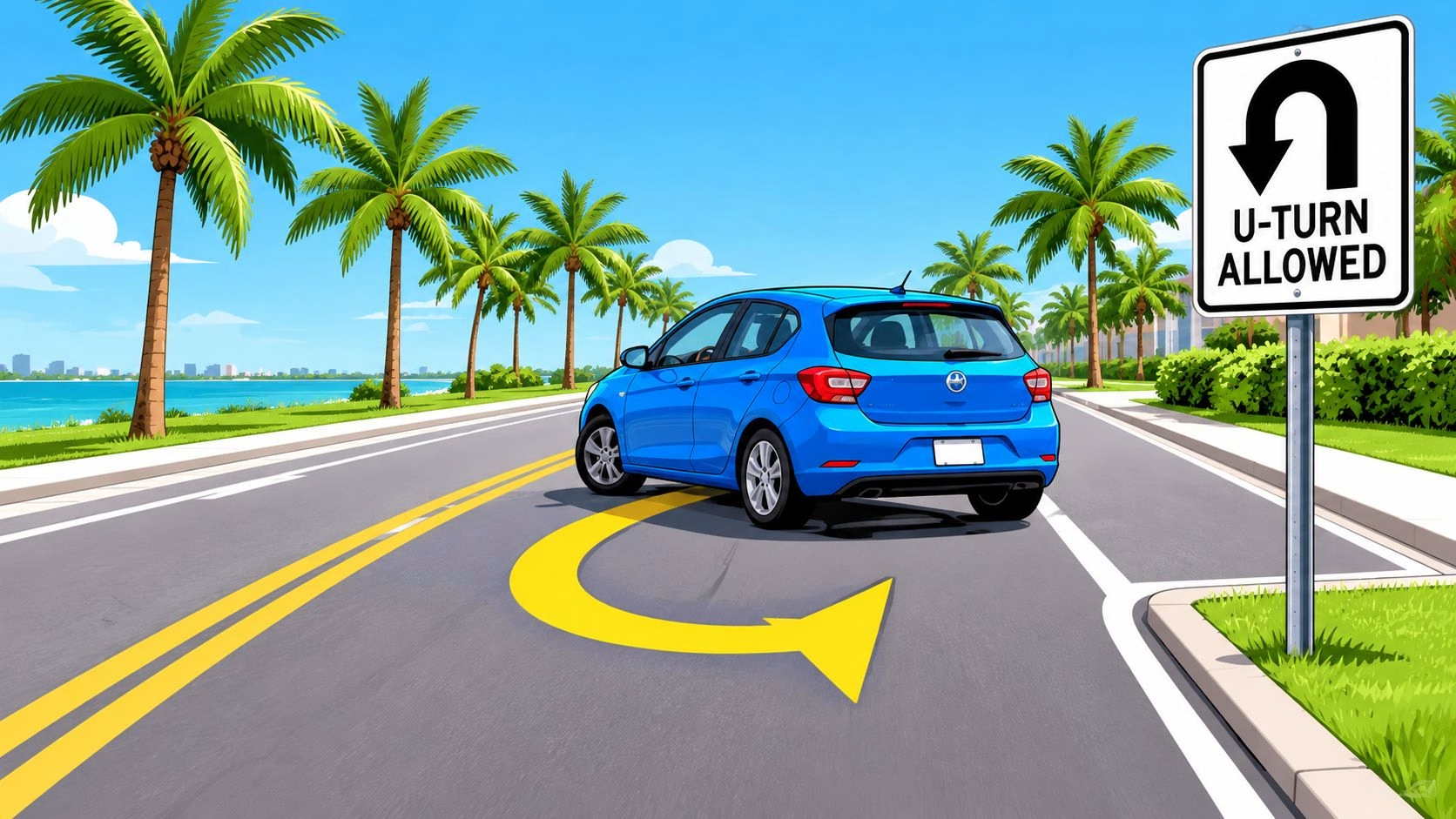
U-turns are generally allowed at intersections unless signs prohibit them, but the driver making the turn must do so safely and without interfering with other traffic. A right-turning driver and a U-turning driver shouldn’t rely on assumptions about who �owns� the turn. Read the signs, follow the signal, check lane position, and abandon the maneuver if another road user would be forced to brake or swerve.
The turning scenario video can help you visualize how lane paths and opposing traffic affect these decisions.
Pedestrian and Bicycle Priorities
A driver turns right at a Florida intersection and sees no painted lines across the side street. A person is already crossing there. The missing paint does not erase the crossing. At an intersection, an unmarked crosswalk can still give the pedestrian priority, so slow before turning and scan both sides.
At a signalized intersection, stop before the crosswalk when a pedestrian has a permitted signal and is in, or entering, the crosswalk. Remain stopped when someone approaching from the opposite half of the roadway is close enough to face danger. The rule is explained in Florida’s pedestrian signal rules.
When signals are not operating and no sign changes the instruction, yield to pedestrians in a crosswalk. A pedestrian outside a marked or unmarked crosswalk must yield to vehicles and should not step suddenly from the curb into a vehicle’s path. Florida’s pedestrian statute also covers bicyclists using sidewalks or crosswalks.
| Scenario | Who Must Yield | Specific Statute or Rule |
|---|---|---|
| Signalized intersection | Driver yields when the pedestrian has a permitted signal and is in or entering the crosswalk | Florida Statute 316.123 |
| Crosswalk without operating signals | Driver yields to a pedestrian in the crosswalk | Florida Statute 316.130 |
| Pedestrian outside a marked or unmarked crosswalk | Pedestrian yields to vehicles | Florida Statute 316.130 |
| Bicycle on a sidewalk or crosswalk | Cyclist receives pedestrian treatment in applicable situations | Florida Statute 316.130 |
| Cyclist passing a pedestrian | Cyclist yields and gives an audible signal before passing | Florida Statute 316.130(11) |
Painted lines help drivers identify a crossing, but they are not the only warning to watch for. Reduce speed near school zones, transit stops, and entrances where people may enter the roadway. The defensive habit is simple: check the sidewalk, curb, and crossing path before committing to the turn.
A cyclist riding in the roadway follows vehicle traffic rules. A cyclist on a sidewalk or crosswalk may receive pedestrian treatment under the statute. Before crossing a sidewalk or driveway, look for bicycles from both directions. A cyclist passing a pedestrian must yield and give an audible signal, so drivers should leave room rather than squeeze past.
Pedestrian hybrid beacons require attention to their displayed indications. Follow the sequence, stop when required, and restart only when the signal permits and the crossing is clear. A person reaching the opposite side does not mean every pedestrian has finished.
School Buses and Roundabouts
A school bus creates a special right-of-way situation because children may cross from either side of the road. When the yellow warning lights activate, reduce speed and prepare to stop. When the stop arm extends and the red lights signal a stop, remain stopped until the required warning has ended and the arm retracts.
On a two-lane road, traffic in both directions must stop for a stopped school bus. A divided highway requires closer attention to the median design. A physical barrier or a five-foot raised median can separate opposing traffic for purposes of the bus-stop rule, while a painted or flush median doesn’t provide the same protection. Drivers should never use a median design as an excuse to pass when children may be crossing.
The safest response to a bus arm is immediate, complete stopping, not a last-second decision about whether you can get through.
Roundabouts use a different visual order. Traffic already circulating has priority, and entering drivers yield before crossing the yield line. Approach slowly, read the lane arrows, select the lane that matches your intended movement, and watch for pedestrians at the entry and exit crossings.
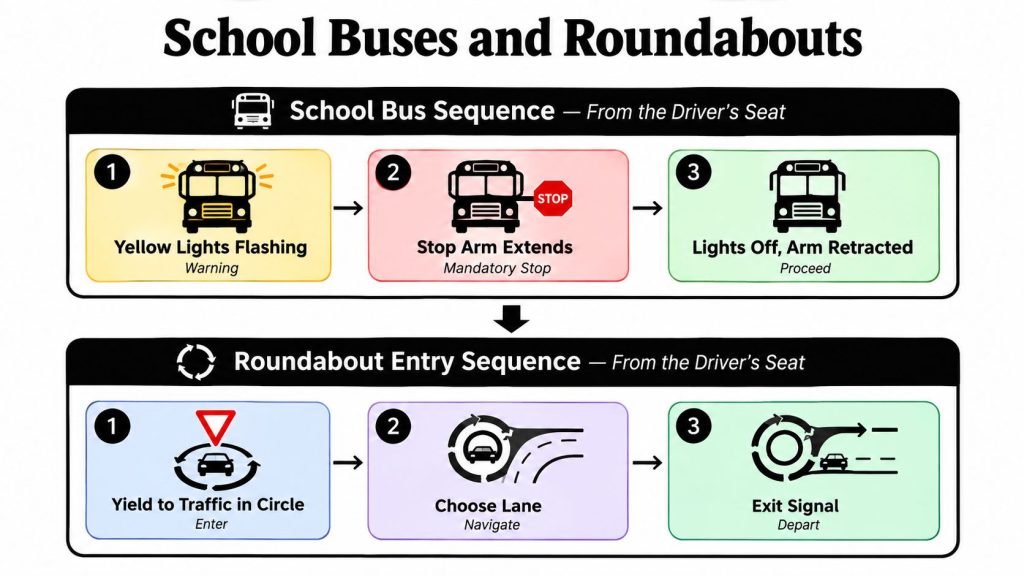
For a right turn, use the lane designated for that movement. For a through movement, follow the marked lane through the circle. For a left movement, choose the lane permitted by the pavement markings and signs. In a multi-lane roundabout, don’t change lanes casually inside the circle. Signal before exiting and yield to emergency vehicles already inside the roundabout, following the roundabout navigation guidance.
Common Right of Way Myths That Lead to Tickets
Myth one, pedestrians always have the right of way. Florida law doesn’t give pedestrians unlimited permission to cross anywhere. Pedestrians must obey signal indications, and those crossing outside a marked or unmarked crosswalk must yield to vehicles. Drivers still need to yield in the defined crosswalk situations described by Florida Statute 316.130.
Myth two, the larger vehicle wins. A pickup truck, bus, or sport utility vehicle doesn’t override the left-yields-to-right rule. Vehicle size doesn’t decide arrival order, and it doesn’t excuse a driver from yielding at an uncontrolled intersection.
Myth three, a flashing yellow arrow means proceed without checking. A flashing yellow arrow generally permits a turn only after the driver yields to oncoming traffic and pedestrians. Treat it as permission to turn cautiously, not as a protected movement.
Myth four, a rolling stop is enough. Florida’s stop-sign rule requires stopping at the marked line, before the near-side crosswalk, or at the safest viewing point when neither is present. Your wheels must stop moving before you assess the intersection.
Myth five, a horn creates right of way. Honking may alert another driver, but it doesn’t transfer the legal duty to yield. A driver who proceeds because they sounded the horn is still responsible for making a safe movement.
Replace each myth with a repeatable habit. Read the sign, identify the crossing users, determine who arrived first, and wait when the other person’s action remains unclear. Defensive driving isn’t passive. It’s the choice to avoid turning a confusing moment into a citation or crash.
Drive With Confidence and Keep Your Record Clean
Right-of-way knowledge gives you a practical way to manage pressure at intersections. Instead of guessing what another driver intends, you can use traffic control devices, arrival order, lane position, and crosswalk activity to decide who must wait.
Florida’s official crash reporting shows that failure to yield affects property-damage, injury, and fatal crashes, so the subject is more than a test question. The Florida crash and citation reporting portal provides access to the state’s ongoing reporting resources, while the statutes establish the behaviors drivers must follow.
Use this pre-intersection checklist:
- Identify control: Find the stop sign, yield sign, signal, lane marking, or absence of control.
- Scan vulnerable users: Check both sidewalks, crosswalks, bike paths, and driveway entrances.
- Establish the order: Determine who stopped first or whether the driver on your left or right arrived with you.
- Confirm the path: Look for approaching vehicles, hidden pedestrians, and vehicles already in the intersection.
- Proceed deliberately: Keep your speed controlled and avoid forcing another person to react.
A course can help turn these steps into consistent habits. BDISchool’s Florida BDI course online is designed for drivers dealing with a moving violation, court requirements, or a need to strengthen defensive-driving knowledge. Its Florida-approved programs include online, self-paced instruction, with course options covering basic, intermediate, aggressive-driver, and mature-driver education.
The most useful confidence behind the wheel doesn’t come from moving first. It comes from knowing when to yield, recognizing the exact point where a rule applies, and leaving enough space to prevent a mistake from becoming a collision.
BDISchool offers Florida-approved online traffic school courses that explain right-of-way rules, defensive driving, and safer intersection decisions in a flexible format. Visit BDISchool to choose the course that matches your moving violation, court requirement, or driver education goal, and start building safer habits today.