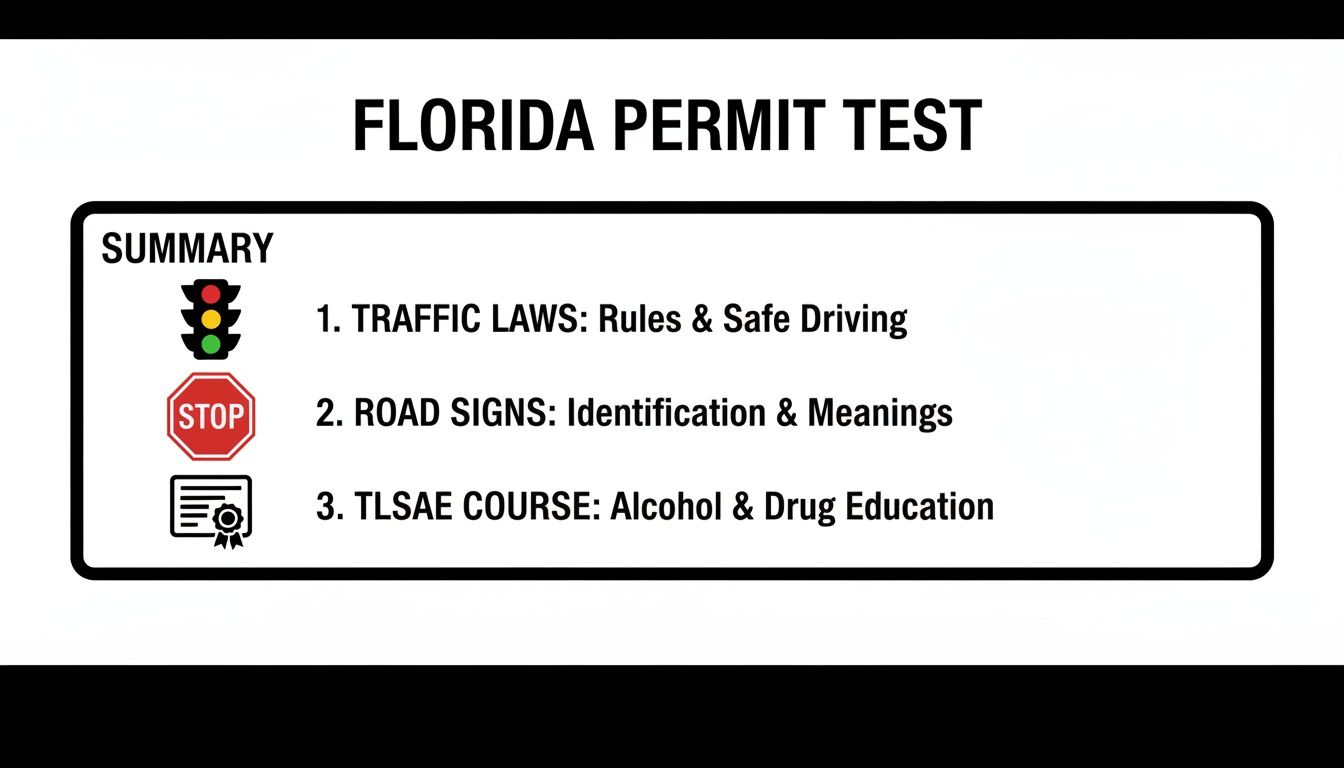
Getting your learner's permit is a huge step, but a lot of people underestimate the Florida permit test. This isn't just about knowing what a stop sign looks like. It�s a comprehensive exam covering traffic laws, safe driving practices, and the serious consequences of driving under the influence.
To pass, you need to answer at least 40 out of 50 questions correctly. That's an 80% score, and frankly, it catches a lot of unprepared teens off guard.
Why The Florida Permit Test Is Harder Than You Think
That first taste of driving freedom in Florida begins with passing the Class E Knowledge Exam. But don't mistake it for a simple quiz. While the test isn't designed to trick you, it absolutely demands a real understanding of the specific rules and situations you'll face on the road. Just glancing through the driver's handbook the night before is a classic recipe for failure.
The exam dives deep into a few key areas that go way beyond just the basics of steering and braking. You'll need to have a solid grasp of some complex scenarios and legal requirements to walk out with a passing grade.
The Mandatory TLSAE Foundation
Before you can even schedule your permit test, Florida law requires you to complete a Traffic Law and Substance Abuse Education (TLSAE) course. This isn't just a box to check; it�s the bedrock of knowledge for the entire exam.
The TLSAE course covers critical topics that pop up all over the test, like:
- How drugs and alcohol physically impact your ability to drive.
- The real legal consequences of a DUI�think fines, a suspended license, and even jail time.
- The direct link between following traffic laws and preventing crashes.
Honestly, you should treat the TLSAE course as your first real study session. It introduces the high-stakes concepts the exam will test you on, making sure every new driver gets the message about the responsibilities that come with a license. Ignoring what you learn here is a major misstep.
So many new drivers just study road signs and speed limits, but the permit test places just as much importance on understanding impaired driving and traffic laws. The TLSAE course is built to prepare you for exactly those questions.
It�s About Application, Not Just Memorization
What really trips people up is how the questions are structured. Instead of just asking for a simple definition, the exam often puts you in a real-world driving scenario. For instance, you won't just be asked, "What does a yield sign mean?" Instead, a question might describe a busy intersection and ask you to decide which car has the right-of-way.
This method tests your ability to apply the rules, not just spit them back out. It makes you think critically about situations with multiple signs, road markings, and other drivers all at once.
Your success will come from truly understanding the Florida-specific state driving laws, which can be quite different from other states. Getting the principles behind the rules will help you way more than trying to memorize the driver's handbook word-for-word.
Your Document Checklist For The Florida DMV
There�s nothing worse than the sinking feeling of getting to the front of the line at the DMV, only to be told you're missing a document. Walking in unprepared is a surefire way to turn what should be an exciting day into a major headache.
To make sure your trip is a success, you need to gather every required document before you go. The Florida Department of Highway Safety and Motor Vehicles (FLHSMV) has very specific rules, and they don't bend them. Think of it as proving your identity, your Social Security number, and that you actually live in Florida.
Proving Your Identity
First things first, you have to prove who you are. For this, you'll need one primary identity document. Remember, photocopies are a no-go here; you absolutely must bring the original or a government-certified copy.
- For U.S. Citizens: The easiest options are a valid, unexpired U.S. passport or an original/certified copy of your U.S. birth certificate.
- For Non-U.S. Citizens: You'll need to present a valid Permanent Resident Card (Green Card), a valid Employment Authorization Card, or other specific immigration documents.
Verifying Your Social Security Number
Next up is your Social Security number. The key here is bringing an official document that shows your full name and the complete number. Just knowing it isn't enough.
Some of the most common documents people use are:
- Your original Social Security card
- A W-2 form (it can't be handwritten)
- A pay stub that shows both your full name and SSN
- A 1099 form from the last tax year
Confirming Your Residential Address
This is where a lot of people get tripped up. You must bring two separate documents to prove you live in Florida. Don't make the common mistake of only bringing one.
Good examples of what to bring include:
- Mail from a bank or other financial institution (like a bank statement)
- A recent utility bill (power, water, etc.) from the last two months
- Your rental agreement or lease
- Mail from any government agency
A Quick Tip for Teens: If you're a minor and don't have bills in your name, don't panic! Your parent or guardian can fill out a Certification of Address form for you. They�ll just need to bring their own two proofs of residency along with the form.
To help you get organized, here�s a simple checklist of what you'll need to gather before heading to the DMV.
Florida Permit Application Document Checklist
| Document Category | Primary Examples | Secondary Examples |
|---|---|---|
| Proof of Identity | U.S. Birth Certificate, U.S. Passport | Permanent Resident Card |
| Proof of SSN | Social Security Card, W-2 Form | Pay Stub, 1099 Form |
| Proof of Address (2 req.) | Utility Bill, Bank Statement | Lease Agreement, Government Mail |
Having these items collected and organized in a folder will make your visit smooth and stress-free.
Vision And Hearing Requirements
Paperwork isn't the only thing you'll be tested on. You also have to pass a quick vision and hearing screening right there at the DMV.
Make sure to bring your glasses or contacts if you wear them. Your vision must be at least 20/40 in one or both eyes, with or without your corrective lenses. You�ll also need to pass a basic DMV vision test and a simple hearing check.
The Educational Prerequisite
Finally, there's one last box to check before you're eligible to take the permit test: a mandatory driver's ed course. In Florida, you can't just walk in and take the test without first completing the 4-hour Traffic Law and Substance Abuse Education (TLSAE) course.
The permit test itself consists of 50 multiple-choice questions, and you need to answer at least 40 of them correctly to achieve the 80% passing score. The TLSAE course is designed to give you the foundational knowledge to do just that.
Taking an approved online course is by far the most popular and convenient way to get this done. Once you finish, you�ll get a certificate of completion, which is another one of those crucial documents you need to bring with you. For a deeper dive into the whole process, check out our complete guide on how to get your Florida learner's permit.
Key Topics From The Florida Driver's Handbook
The official Florida Driver's Handbook is your ultimate guide, but let's be real�it's not exactly a page-turner. A common mistake I see teens make is trying to memorize the entire thing cover to cover. That's a surefire way to get overwhelmed.
A much smarter approach is to zero in on the topics that consistently show up on the exam and trip up new drivers. By focusing your energy on a few key areas, you'll study more effectively and build a practical understanding of what really matters on the road.
From my experience, most points are lost in three main areas: road signs, right-of-way rules, and speed limits. If you can master these, you�ll walk into your permit test in Florida with a serious confidence boost.
Decoding Florida Road Signs
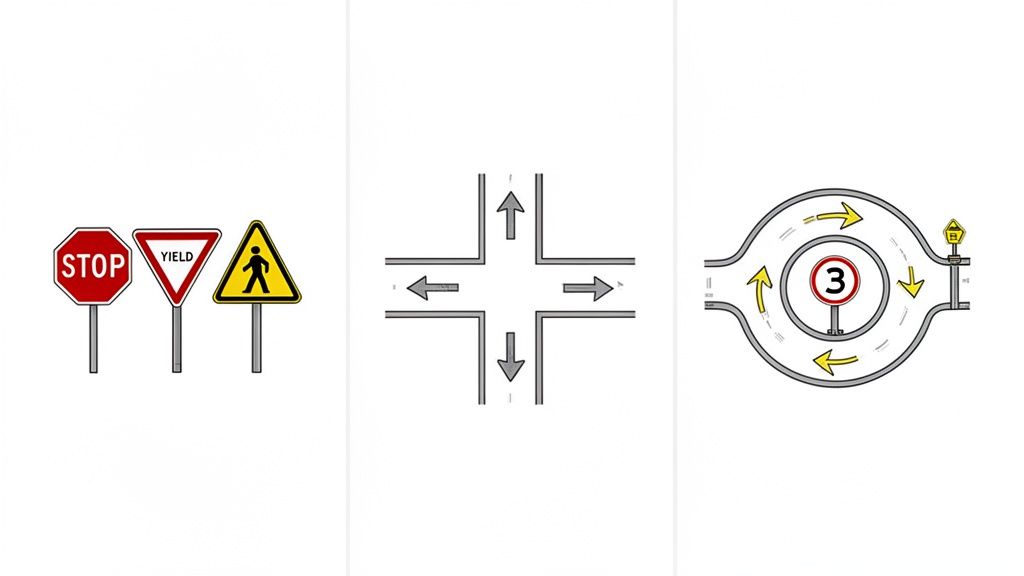
Think of road signs as the silent language of the road. The permit test won't just ask you to identify a stop sign; it will test your fluency. You have to know what each sign legally commands you to do in a real-world situation.
The test questions pull from three main sign categories. You need to know the difference instantly.
- Regulatory Signs: These are the black-and-white rule-makers. Signs like "Speed Limit" and "No U-Turn" are non-negotiable. Ignoring them is breaking the law, simple as that.
- Warning Signs: These are your heads-up signs, usually yellow and diamond-shaped. They alert you to things like a "Sharp Curve" or "Slippery When Wet" and demand you pay attention and adjust your driving.
- Guide Signs: Typically green or blue, these signs are your navigators. They point you toward cities, exits, and services like hospitals or gas stations.
A classic trap is confusing similar signs. For example, a "Merge" sign looks a bit like a "Lane Ends" sign, but they mean very different things for you as a driver. Merging is about blending, while a lane ending means you have to actively move over.
The permit test isn't just a vocabulary quiz on signs. It�s about application. Expect questions that put you in a scenario and ask what sign you�d see or how you should react to one.
Mastering Right-Of-Way Scenarios
Right-of-way rules exist to keep intersections from turning into total chaos, but they're a huge source of confusion for new drivers. The permit test in Florida is notorious for throwing tricky intersection scenarios at you to see if you can figure out who legally gets to go first. This isn't about being polite; it�s about following a strict set of laws to prevent collisions.
Let�s talk about the classic four-way stop. Picture two cars arriving at the exact same time. One wants to go straight, and the other is turning left. Who has the right-of-way? The rule is clear: the driver going straight goes first. The left-turning car must wait.
Roundabouts are another tough spot for many. In Florida, traffic already in the circle always has the right-of-way. If you're approaching, you must yield to the cars already circulating. You never, ever stop inside the roundabout�you find your gap and merge in smoothly.
Common Right-Of-Way Questions
- Uncontrolled Intersections: No signs, no signals. If you and another car arrive at the same time, the driver on the left yields to the driver on the right.
- Making a Left Turn: This is one of the most basic rules. You always yield to oncoming traffic when making a left turn.
- Emergency Vehicles: If you see flashing lights and hear sirens from a police car, fire truck, or ambulance, you must yield. Pull over to the right and stop.
To really nail down every scenario, a deep dive into the official Florida Driver's Handbook is your best bet.
Remembering Specific Florida Speed Limits
Finally, let's talk speed limits. This part is mostly memorization, but it's critical. While most roads have signs posting the speed limit, the permit test will want to know if you've memorized the default, or "statutory," speed limits for when there isn't a sign.
You absolutely have to know these by heart for the exam:
| Location | Maximum Speed Limit |
|---|---|
| School Zones | 20 MPH |
| Business or Residential Districts | 30 MPH |
| Rural Interstates | 70 MPH |
| Limited Access Highways | 70 MPH |
| All Other Roads and Highways | 55 MPH |
One last tip: these are the maximum speeds for perfect, sunny-day conditions. The test might ask about Florida's "prima facie" speed law. This just means you can still get a ticket for going the speed limit if conditions like heavy rain or fog make that speed unsafe. The number one rule is always to drive at a speed that is safe for the current conditions.
Common Mistakes That Lead To Failure
It might surprise you, but failing the Florida permit test is more common than you'd think. It's almost never because the person didn't study at all. The real problem usually comes down to how they studied. So many applicants try to just memorize facts, but that�s not enough for a test built to see how you'd actually behave on the road.
The exam is all about scenarios. It wants to know what you�ll do when you're at a confusing intersection or see a hazard up ahead, not just if you can recite a specific traffic law. Let's break down the most common mistakes I've seen trip people up so you can avoid them.
Underestimating The Test's Difficulty
The single biggest reason people fail is overconfidence. They hear "learner's permit," assume it'll be a cakewalk, and end up cramming the night before. That's a surefire way to fail the permit test Florida uses.
This became crystal clear back in 2015 when the state completely revamped its written driver's license test. Before the update, the pass rate was a solid 80%. After the new, tougher test was introduced, that number plummeted to just 40% in the first six months. Think about that�three out of every five applicants were failing. This proves the test demands real preparation, not just a quick glance at the handbook. You can read the full story on the surprising spike in Florida test failure rates to see just how serious it is.
Focusing On Memory Instead Of Understanding
Simply memorizing a list of facts from the driver's handbook is a losing strategy. The test is designed to check your comprehension and your ability to apply what you know in a real situation. You won't just be asked to identify a sign; you'll be put in a scenario where you have to figure out what that sign means for your next move.
Here�s where that really trips people up:
- Pavement Markings: It's great that you know a solid yellow line means "no passing." But can you apply that knowledge on a multi-lane road with different patterns of solid and dashed lines? That's what the test will measure.
- DUI Penalties: Memorizing that the legal BAC limit is 0.08% is easy. The test, however, is far more likely to ask about the specific consequences for a first-time offender, like how long their license will be suspended or the range of fines they face.
- Right-of-Way: You probably know the "first to arrive, first to go" rule for a four-way stop. But what happens if two cars pull up at the exact same time? The test wants to see if you know the deeper rule: the car on the left must yield to the car on the right.
As you study, constantly ask yourself "why." Why does a car turning left have to yield to oncoming traffic? Because it's crossing a lane where cars are moving straight, making it the riskier maneuver. Understanding the "why" is the key to passing.
Getting Caught By Tricky Wording
The last major hurdle is simply not reading the questions carefully enough. The FLHSMV needs to know you can process information accurately, even under a little pressure. Some questions are deliberately worded to test exactly that.
Be on the lookout for absolute words like "always," "never," or "except." A statement that seems mostly true can be instantly made false by one of these words. For example, a question might ask when you should always use your high beams. The correct answer is probably "never," because you are required to dim them for oncoming traffic.
Another classic trap is presenting two answers that look almost identical. Don't rush. Take a moment to read every single option before you make a choice. Often, the difference is just one small detail that changes the entire meaning of the answer.
For a great refresher on the visual cues you'll be tested on, check out our guide covering common traffic signs and their meanings. By knowing what to look for, you can build a smarter study plan that focuses on true understanding and sets you up for success.
A Practical Strategy For Test Day
You�ve put in the work. You�ve studied the handbook, finished your TLSAE course, and probably stared at more road signs than you care to admit. Now it�s game time.
Knowing the material is half the battle; the other half is having a calm, clear-headed approach on the day of your permit test in Florida. I've seen plenty of smart, prepared teens stumble because of nerves. A solid strategy can be the difference between walking out with a permit and walking out with a re-test date.
Your Test Day Morning Routine
How you start your morning sets the stage for the entire day. Scrambling to find your documents while chugging a soda is a recipe for anxiety. Your goal should be a calm, deliberate start.
First off, a good night's sleep is non-negotiable. Your brain simply works better when it�s rested. Wake up with plenty of time to eat a decent breakfast�a rumbling stomach is a major distraction when you're trying to remember right-of-way rules.
I�d also suggest skipping any last-minute, frantic cramming. A quick glance at your notes on the toughest topics is fine, but at this point, you have to trust the prep work you�ve already done.
Before you even think about leaving, do one final check of your documents. Make sure your proof of identity, Social Security info, two proofs of residency, and TLSAE certificate are all together and ready to go.
Arrive Early And Get Settled
Punctuality is your friend. Plan to get to the DMV or testing center at least 15-20 minutes before your appointment. This little bit of buffer time is your insurance against bad traffic or a full parking lot. More importantly, it gives you a moment to breathe.
Use this extra time to:
- Find the right office without rushing.
- Make a quick trip to the restroom.
- Sit down and take a few deep breaths to shake off any jitters.
Arriving flustered is the worst way to start. Giving yourself this cushion allows you to walk in calm, cool, and collected.
Effectively Managing Your Time During The Test
Once the permit test Florida requires is in front of you, the clock starts. You'll have 60 minutes to tackle 50 questions. That might sound like a lot of time, but it can fly by if you get hung up on a few tricky questions.
The good news is the test is digital. This means you can�and should�use the "skip" or "flag" feature. If a question stumps you, don't sit there and burn the clock. Flag it and move on.
The best approach is to go through and answer all the questions you know for sure first. This builds confidence and banks easy points. Then, you can loop back with your remaining time and focus on the ones you flagged. This strategy ensures you don't miss easy questions just because you got stuck on a tough one early on.
Strategic Test-Taking Techniques
How you read the questions is just as important as knowing the answers. These exams are designed to make you think, not just spit back memorized facts.
Here are a few proven techniques that actually work:
- Read Every Question Twice. Seriously. The first time, you'll get the gist. The second time, you'll catch crucial words like "not" or "except" that completely change the meaning.
- Use the Process of Elimination. On a multiple-choice question, knocking out one or two obviously wrong answers is a huge advantage. It dramatically improves your odds if you have to make an educated guess between the last two options.
- Trust Your Gut. More often than not, your first instinct is right. It�s pulling from the information you�ve studied. Avoid changing answers unless you have a sudden "aha!" moment and realize you misread something. Second-guessing is a classic path to easy mistakes.
Combine a relaxed morning with these simple test-day tactics, and you're not leaving it up to luck. You're walking in with a plan and giving yourself the best possible shot at success.
Got Questions About the Florida Permit Test? We've Got Answers.
Even after you've studied the handbook and feel ready to go, a few nagging questions can pop up about the Florida permit test. It's totally normal. We hear the same handful of questions all the time from new drivers, so let's clear them up right now.
Think of this as your final pre-test briefing, covering the practical details that will help you walk in with confidence.
Can I Take The Florida Permit Test Online?
Yes, but it depends entirely on your age.
If you�re under 18, you�re in luck. You can take the Class E Knowledge Exam online through a state-approved provider. It's a super convenient option that lets you test from home without the pressure of a busy DMV office.
However, once you turn 18 or older, the rules change. You must take the test in person at a driver license service center or a local tax collector's office. Just be sure to schedule an appointment ahead of time.
What Happens If I Fail The Permit Test?
First off, don't panic. It happens more often than you think and it's definitely not the end of the world. To pass, you need an 80% score, which means getting at least 40 out of the 50 questions right. If you fall short, you can take it again.
You will have to pay a retesting fee for each attempt after the first one. While you can often reschedule for the very next day, my advice is to take a beat. Use that first attempt as a learning experience. Figure out exactly what tripped you up�was it the road signs? The right-of-way rules? Whatever it was, go back to the handbook and focus on those weak spots before you give it another shot.
A failed test isn't a failure�it's a diagnostic tool. It tells you exactly what you need to study, so you can walk in next time and nail it.
How Long Is The Learner's Permit Valid?
Once you pass, your Florida learner's permit is valid for exactly one year from the issue date. Keep that date in mind, because the clock starts ticking on the requirements for your intermediate license.
During this year, your driving record needs to stay spotless. You have to hold the permit for a full 12 months without any traffic convictions before you can even think about applying for the next level of license.
What Are The Driving Restrictions With A Permit?
Florida is very clear about the rules for permit holders. They�re all about keeping you safe while you get the hang of being behind the wheel, so these are non-negotiable.
- You're Never Alone: You must always have a licensed driver who is at least 21 years old sitting in the front passenger seat. No exceptions.
- Daylight Hours Only (At First): For the first three months you have your permit, you can only drive during daylight hours.
- A Little More Freedom: After those first three months are up, your driving window extends until 10 p.m.
These restrictions are designed to ease you into driving, starting with the least risky conditions and gradually building from there.
Ready to stop worrying and start preparing with confidence? BDISchool offers Florida-approved online courses and practice tests that give you the knowledge you need to ace the permit test on your first try. Explore our resources today at https://bdischool.com.
![Teen Driver Licensing Requirements in Florida [2026]](https://floridadetscourse.com/wp-content/uploads/emplibot/florida-license-requirements-hero-1773544196.avif)