Points in Florida stay on the driving record for at least five years, and accumulating 12 points within 12 months can trigger a license suspension of up to 30 days. If you’ve just received a moving violation, opened a court notice, or found an unexpected entry on your FLHSMV record, the important question isn’t only how many points this ticket carries. You also need to know which clock is running, whether you can elect driver improvement, and what action is required before the deadline.
Many drivers treat a ticket as a single event that ends when they pay the fine. Florida treats it more like a running account. A new conviction can add to earlier convictions, while the citation may remain visible on your record long after it stops counting toward a specific suspension threshold.
How Florida’s Driver Points System Actually Works
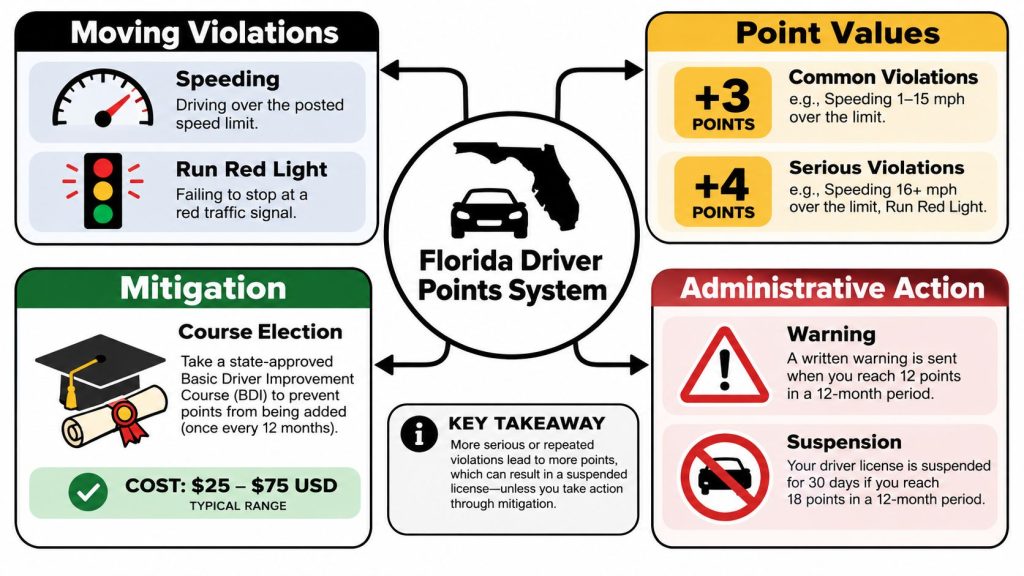
A Florida license point is an administrative mark, not the fine itself. It is assessed after a traffic conviction, helping the state track repeated unsafe driving rather than judging each violation alone. The violation determines the point value, with common moving offenses generally carrying three points and more serious conduct carrying more.
Begin with the document you received. It may be a citation, court letter, or FLHSMV record showing a conviction. Read the charge classification carefully. A small difference in the wording can change the point value and the options available to you.
Florida’s system runs on two timelines:
- The record-retention timeline: Points remain on the driving record for at least five years from the conviction or disposition date, according to Florida’s official point and suspension guidance.
- The suspension timeline: FLHSMV reviews rolling periods of 12, 18, and 36 months to determine whether accumulated points have reached a suspension threshold.
These timelines overlap, but they answer different questions. The five-year horizon explains why a citation can still appear on your Florida record. The rolling windows determine whether recent convictions combine to trigger a suspension. A citation may remain visible after it no longer counts toward one particular suspension calculation.
Practical rule: Do not judge a new ticket by its point value alone. Compare it with recent convictions and check the dates on your FLHSMV record.
That distinction forms the foundation of Florida’s license-points system. A three-point citation may have little effect on a clean record, yet become suspension-critical when it joins other recent violations.
Common Violations and Their Point Values
The point value reflects the seriousness of the conduct under Florida’s system. A standard moving violation generally adds three points, while higher speeds, reckless conduct, and certain crash-related violations carry more. Florida Statutes section 322.27 provides the legal framework, and FLHSMV publishes the corresponding point information.
| Violation | Points | When It Typically Applies |
|---|---|---|
| Speeding up to 15 mph over the limit | 3 | A speeding conviction within this lower excess-speed range |
| Most common moving violations | 3 | Everyday moving offenses classified in the standard category |
| Careless driving | 3 | Driving without the level of care expected under the circumstances |
| Speeding more than 15 mph over the limit | 4 | A conviction involving the higher excess-speed range |
| Reckless driving | 4 | More dangerous driving conduct classified as reckless |
| Passing a stopped school bus | 4 | A conviction for passing a stopped school bus under the applicable offense |
| Leaving a crash involving more than $50 in property damage | 6 | Leaving the scene when the property-damage condition applies |
The table shows why �only three points� can be misleading. Four separate three-point violations within the same 12-month period total 12 points, which reaches the first suspension threshold. A four-point or six-point violation can move a driver toward that threshold faster.
The charge on the citation is the starting point, not a substitute for checking the official record. Confirm the classification, conviction or disposition date, and the points posted before deciding whether to pay, contest the citation, or elect an approved course.
Suspension Thresholds Drivers Cannot Afford to Miss
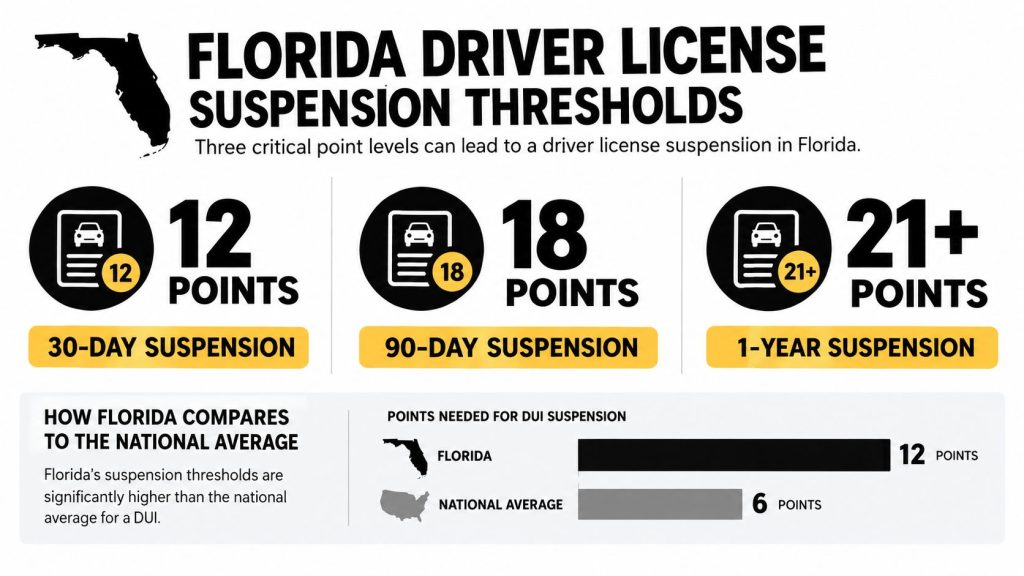
A driver can leave court thinking one ticket is behind them, then receive a suspension notice after several convictions accumulate. Florida measures points across rolling periods, so the date and total matter together. Under the state’s published schedule, 12 points within 12 months can result in a suspension of up to 30 days, 18 points within 18 months can result in a suspension of up to 3 months, and 24 points within 36 months can result in a suspension of up to 1 year. The official FLHSMV suspension schedule lists these escalating consequences.
Read the windows as rolling periods
The 18-month and 36-month thresholds add longer checks to the 12-month calculation. They do not erase the shorter window. A conviction may matter in more than one calculation, depending on when it was entered and which period FLHSMV is reviewing.
For example, a three-point conviction followed by three more three-point violations within the same 12-month period totals 12 points. Each citation may have seemed routine on its own. Together, they can trigger a suspension review.
A useful way to understand the system is to treat your driving record like a worksheet with several overlapping rulers. The five-year record-retention period answers whether an entry can still appear on your record. The rolling 12-, 18-, and 36-month periods answer whether it can count toward a particular suspension threshold. An older conviction may remain visible without counting in every current calculation.
Review your record in this order:
- Identify each conviction and its disposition date.
- Confirm the point value assigned to each offense.
- Add convictions inside the 12-month window.
- Repeat the calculation for 18 and 36 months.
- Compare each total with the applicable threshold.
For a broader explanation, see how many points can get your license suspended in Florida.
If your total is close to a threshold, check the posted record rather than relying on memory. The court disposition, point classification, and timing can change the calculation.
How Long Points Stay on Your Record
The clearest answer is at least five years from the conviction or disposition date, but that answer doesn’t tell you whether the points still count toward suspension. Florida uses two different timelines, and confusing them causes much of the anxiety surrounding old citations.
The record-retention horizon answers this question: �Can this violation still appear on my Florida driving record?� The rolling suspension windows answer a different question: �Does this conviction fall inside the period used to calculate a suspension?�
| Timeline | What it tells you |
|---|---|
| At least five years from disposition | How long the point entry remains on the driving record |
| Rolling 12 months | Whether the 12-point threshold may apply |
| Rolling 18 months | Whether the 18-point threshold may apply |
| Rolling 36 months | Whether the 24-point threshold may apply |
Suppose a citation reaches its disposition date and remains on the record for at least five years. Once it falls outside a specific 12-, 18-, or 36-month calculation window, it may no longer count toward that suspension threshold even though an insurer, employer, court, or agency reviewing the record can still see the entry.
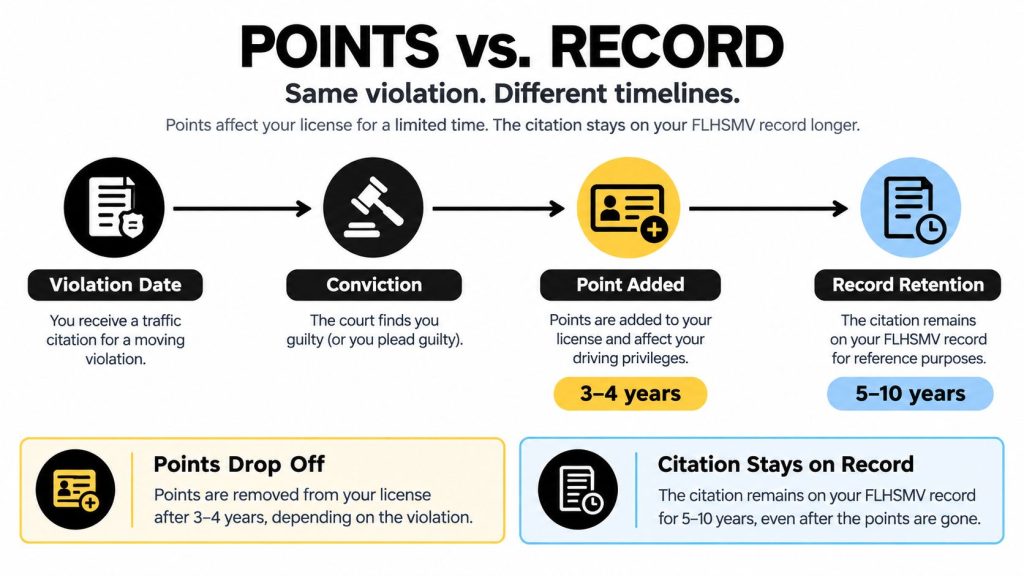
This distinction also matters if you move or change insurance companies. Relocating doesn’t rewrite the Florida driving record, and changing insurers doesn’t reset the state’s record-retention period. Insurance underwriting is a separate process, so an insurer may evaluate information differently from the way FLHSMV evaluates suspension eligibility.
For a focused explanation of the retention question, read how long points stay on your Florida license. The practical lesson is simple: a visible citation isn’t automatically an active suspension threat, but it also isn’t automatically irrelevant.
Using BDI to Keep Points Off Your License
For an eligible Florida citation, Basic Driver Improvement can prevent points from being added when the court permits adjudication to be withheld and the driver completes the approved process correctly. It doesn’t erase the citation, but it can reduce the immediate risk of reaching a suspension threshold.
Florida drivers who receive a noncriminal moving violation and don’t hold a commercial driver license may elect a FLHSMV-approved BDI course once every 12 months, with a lifetime limit of eight elections. The election must be made within 30 days of the citation, and the driver must pay the citation’s fine and fees within that period and notify the court that traffic school was selected. These requirements are summarized in FLHSMV’s driver improvement school guidance.
Follow the election process, not just the course
The safest sequence is:
- Check eligibility. Confirm that the citation qualifies and that you haven’t exceeded the election limits.
- Make the election with the court. Selecting a course online without properly notifying the court may not protect the citation.
- Pay the required fine and fees. Do this within the court’s stated deadline, including the 30-day election period when it applies.
- Choose an approved provider. The course must satisfy Florida’s approval requirements.
- Finish before the deadline. Late completion may fail to meet the court’s condition.
- Confirm transmission and acceptance. Keep completion records and verify that the court received and accepted the result.
When the applicable process is completed and adjudication is withheld, points may not be added. The citation can still remain part of the driving history, but avoiding the point assessment can keep the new violation from pushing the driver over a statutory threshold.
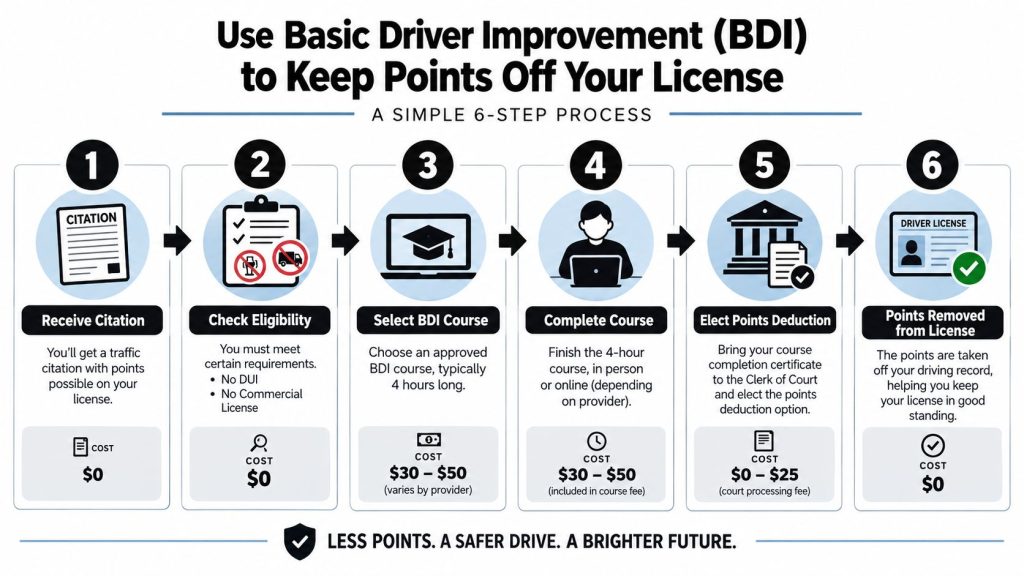
An online Florida BDI course can fit drivers who need to study around work, family, or travel, but convenience doesn’t replace the court election. Taking a course first, choosing the wrong course, or waiting until after the deadline may not deliver the intended point protection.
Which Florida Traffic Course Fits Your Situation
BDI is not the right answer for every driver or every court order. Florida offers several driver-improvement programs, and the correct choice depends on the citation, the driver’s history, and what the court requires.
| Course | Length | Typical Driver | Common Trigger |
|---|---|---|---|
| Basic Driver Improvement, BDI | 4 hours | Eligible driver with a qualifying noncriminal moving violation | Voluntary traffic-school election |
| Intermediate Driver Improvement, IDI | 8 hours | Driver needing more extensive corrective education | Court order or specified driving-history issue |
| Aggressive Driver Course | 8 hours | Driver whose conduct involves aggressive or dangerous driving patterns | Court-directed aggressive-driving education |
| Mature Driver Course | 6 hours | Mature driver seeking a safety refresher | Court, insurer, or driver-improvement purpose when accepted |
A court order can override personal preference. If the judge requires a specific program, completing a shorter or different course won’t necessarily satisfy the order.
Approval matters
Florida regulates driver-improvement schools, and courts may require attendance in addition to imposing a civil penalty. An ordinary infraction can carry a civil penalty of up to $500, while unlawful speeding in a school zone or construction zone can carry a civil penalty of up to $1,000, according to Florida’s driver-improvement school statute.
That’s why the provider’s approval status matters as much as the course title. Review the court paperwork first, then match the required program with an approved provider. A concise guide to the available options is available through this Florida driving course comparison.
What a Course Can and Cannot Do for You
A traffic course can help prevent points on an eligible citation when the court withholds adjudication and the required process is completed. It doesn’t erase the citation, remove prior points, or guarantee an insurance discount.
FLHSMV explains that insurers generally can’t impose an additional premium, cancel a policy, or issue a nonrenewal solely because of a traffic infraction when adjudication has been withheld and no points have been assessed, except for the statutory crash-loss circumstance described by the agency. That protection is different from a promise that every insurer will lower your premium.
The course also doesn’t replace contesting a citation you believe is inaccurate. If the charge, date, or circumstances are disputed, review the available court process rather than assuming traffic school is the only response.
Next Steps and Common Florida Points Questions
Act promptly:
- Check the record: Verify the violation classification, conviction or disposition date, and point total through FLHSMV records.
- Review the deadline: Decide within 30 days whether BDI election is available.
- Choose approval: Select a properly FLHSMV-approved provider.
- Complete and confirm: Finish before the court deadline and verify transmission and acceptance.
Does BDI remove the citation entirely? No. When the process qualifies, it can prevent points from being added, but the citation may remain on the driving history.
Do nonresident or relocated drivers receive the same protection? Florida’s rules apply to the Florida driving record, but another state’s record and an insurer’s broader underwriting review may involve separate information.
How do I verify what is on my record? Request and review your FLHSMV driving record, then compare the entries with your court paperwork, especially the classification and disposition date.
What happens if I miss the 30-day election window? The right to elect BDI is forfeited under the stated rule, and points are assessed. Contact the court promptly to confirm the available options.
If a citation involves a crash, first make sure you understand the required reporting and evidence steps. This guide on how to compare car accident procedures in Miami can help you organize the immediate response separately from the license-points question.
BDISchool offers a Florida-approved online BDI course for eligible drivers who want to complete required education and avoid points being added when the court withholds adjudication. Visit BDISchool to review the course options, confirm the program that matches your citation, and start before your court deadline.