More than half of first-time applicants in Florida don�t pass. Florida ranks fourth worst in the nation for first-attempt driving test pass rates, with only 47.1% succeeding on the first try, according to this Florida pass-rate report.
That number scares people, but it shouldn�t paralyze you. It should change how you prepare.
I�ve worked with nervous beginners, adults getting licensed later in life, drivers returning after years off the road, and students who understand the rules in conversation but freeze when a test starts. The pattern is almost always the same. They don�t fail because they�re incapable. They fail because Florida drivers license tests ask for very specific knowledge and very specific habits under pressure.
The good news is that pressure becomes manageable when you know what the state is checking. You don�t need magic. You need a system, a calm routine, and enough practice that the test feels familiar before you ever sit down at the DMV or pull out of the parking lot.
Your Guide to Acing the Florida Driver's Test
Florida�s testing process feels harder than many people expect because it isn�t just testing memory. It�s testing judgment, timing, vehicle control, and your ability to follow instructions without rushing.
That�s why random studying usually fails. Reading a few social media tips, taking one practice quiz, and driving around the neighborhood a couple of times won�t prepare individuals sufficiently. You need to separate the process into parts and train each part on purpose.
Why so many people get stuck
Some students struggle on the written side because they memorize answers instead of learning the rule behind the answer. Others know the handbook but lose points on the road test because they stop too late, turn too wide, or forget an observation check.
Then there�s the paperwork problem. Plenty of applicants show up tense, underprepared, or missing a required document before the test even begins.
Practical rule: Treat your Florida license process like three separate jobs. Learn the rules. practice the maneuvers. organize the documents.
A calmer way to prepare
The fastest path to confidence is a simple one:
- Study the official rules first. Don�t build your understanding from rumors or short videos.
- Practice in test-like conditions. Short, focused practice beats vague �driving around.�
- Fix one weakness at a time. If backing is shaky, isolate backing. If signs confuse you, drill signs only.
- Use the handbook as your base. The Florida driver�s manual gives you the language and structure you need before you move to quizzes or road practice.
Students usually relax when they realize the test isn�t trying to trap them. It�s asking, �Can this person drive safely and follow Florida law without guessing?� When you prepare with that question in mind, the whole process starts to make sense.
Understanding Florida's Three Test Hurdles
Florida drivers license tests aren�t one single event. They�re a sequence. If you think of them as three levels in a game, each level checks a different kind of readiness.

The knowledge exam
The first hurdle is the Class E Knowledge Exam, the written exam often called the permit test.
Florida changed this exam in 2015, moving from a shorter 20-question format to a 50-question test, and the initial failure rate jumped to 59%, according to Tampa Bay reporting on the test overhaul. That change tells you something important. Florida wants broader knowledge, not quick memorization.
You�ll be tested on topics such as:
- Traffic laws
- Road signs and signals
- Safe driving habits
- Basic risk awareness
This exam matters because the state wants proof that you can make legal and safe decisions before you control a car alone.
The driving skills test
The second hurdle is the Class E Driving Skills Test, during which an examiner watches how you operate the vehicle.
The road test isn�t about showing off. Examiners usually want clean basics. They�re looking for control, awareness, safe judgment, and compliance with instructions. A student can feel like they drove �pretty well� and still fail if they roll a stop, miss a blind spot check, or handle a maneuver carelessly.
Here�s the simplest distinction:
| Test | What it checks | What students often miss |
|---|---|---|
| Knowledge Exam | Do you know the law and safety rules? | Rushing and guessing |
| Driving Skills Test | Can you apply those rules in the car? | Observation and control |
Endorsements and specialty testing
A third category exists for drivers seeking additional privileges, such as motorcycle or commercial operation. Those aren�t part of the standard Class E path, but they matter if you want to drive something beyond a regular passenger vehicle.
Most first-time applicants only need to focus on the knowledge exam and the driving skills test. That alone is enough. Don�t overload yourself by studying for specialty material you don�t need yet.
The smartest students don�t ask, �How hard is the test?� They ask, �What exact skill is Florida checking at this step?�
That shift matters. Once you know which hurdle you�re facing, your preparation gets more focused and your anxiety usually drops.
Your Eligibility and Required Documents Checklist
Many applicants worry about the test itself and forget the first obstacle. The clerk can�t process your application if your paperwork isn�t right.
That means your first pass-or-fail moment often happens at the counter, not in the car.
Bring documents that prove who you are
You�ll need documents that establish identity, legal presence, Social Security eligibility or related documentation, and Florida residential address. The exact acceptable documents can vary by situation, so don�t rely on memory or advice from a friend who got licensed years ago.
Use a checklist and physically lay your documents out before your appointment.
- Identity proof: Bring the original document required for your case.
- Social Security documentation: Make sure the name matches your other records.
- Florida residency proof: Bring the required residential documents for your current address.
- Name consistency: If names differ across documents, resolve that before test day.
A missing document can cancel your whole appointment. That�s frustrating, and it�s avoidable.
Age and status change what you need
Teens and adults don�t always follow the same path. If you�re under 18, Florida has extra prerequisites tied to supervised practice and permit holding time. Adults may face a simpler path in some areas, but they still need the correct documentation and required education steps before testing.
If you�re a non-U.S. citizen or a non-immigrant, don�t assume the standard checklist covers your case. Review the current requirements carefully and match your documents to your legal status.
A practical pre-appointment check
The best routine is boring, and that�s why it works. A day or two before your appointment, put every document in one folder and ask yourself three questions:
- Is it the correct document type?
- Is it current and readable?
- Does the name and address match across records?
If you want a clean rundown before your visit, review this BDI guide on what to bring to DMV.
Don�t put your document check off until the night before. Most DMV stress comes from preventable surprises.
Quick checklist before you leave home
| Item | Why it matters |
|---|---|
| Your identification documents | Confirms who you are |
| Address documents | Confirms Florida residency |
| Any required course proof | Shows you completed the prerequisite step |
| Appointment details | Prevents last-minute confusion |
| A test-ready vehicle if needed | Keeps the road test from being delayed |
Students often think preparation means only studying rules. Real preparation includes paperwork, timing, transportation, and making sure nothing small derails the day.
Your Step-by-Step Test Preparation Plan
Passing Florida drivers license tests isn�t about cramming. It�s about building calm familiarity. You want the rules to feel recognizable, and the driving tasks to feel routine.

Start with the handbook, not random trivia
Your first job is to learn the language Florida uses. If you skip this step, practice questions can become misleading because you�re memorizing fragments without understanding the rule underneath.
Read in short sessions. One topic at a time works better than marathon reading.
Focus especially on:
- Right-of-way rules
- Signs and pavement markings
- Lane use
- Safe stopping and following
- Alcohol, drugs, and driving consequences
- Sharing the road
After each study session, close the book and explain the rule out loud in plain language. If you can�t explain it with ease, you probably don�t own it yet.
Use practice tests to expose weak spots
Practice tests help because they reveal confusion fast. They�re not useful when you take one and celebrate a score. They�re useful when you review every mistake and ask, �Why did I miss that?�
If you want to turn your notes into repeatable drills, a tool like this practice test generator can help you create custom review sets from the topics giving you trouble.
A smart practice routine looks like this:
- First round: Take a quiz without looking anything up.
- Second round: Review every missed question and write the rule behind it.
- Third round: Retake only your weak categories.
- Final round: Simulate test conditions with no interruptions.
Know how the actual exam behaves
Florida�s Class E Knowledge Exam uses an adaptive algorithm. The test ends once you answer 40 questions correctly or once you miss 11 questions, as explained in this overview of Florida licensing steps.
That changes your strategy.
You can�t treat early questions as throwaways. A bad start matters. Guessing repeatedly because you feel nervous can end the exam before you settle down.
Exam mindset: Slow is usually faster. Read each question once, identify the rule being tested, then answer.
Build a week-by-week rhythm
Here�s a practical timeline that works for many students.
Weeks before the test
Spend your first phase learning the core rules and logging your weak areas. Don�t try to �cover everything� every day.
Try this pattern:
- Day one: Signs and signals
- Day two: Right-of-way and intersections
- Day three: Safe driving habits
- Day four: Lane changes, turns, and speed control
- Day five: Review missed questions only
That last part is where progress happens. Your mistakes are your map.
As the test gets closer
Once your knowledge feels more stable, begin combining study and road practice. If you�re working on the road test too, pair each legal rule with the physical action.
Example:
- If you study right-of-way, practice real-world yielding and full stops.
- If you study lane changes, practice mirrors, signal, blind spot, then move.
- If you study backing, do repeated slow backing drills in an empty lot.
This is also the stage where structured education can help. BDISchool offers Florida-approved online courses such as TLSAE and DETS for students who need the required education path or want guided review in English, Spanish, or Portuguese.
For a more detailed routine, this guide on how to prepare for driving test can help you turn broad goals into daily tasks.
The final days
Don�t overload yourself the night before. Review the rules you still mix up. Drive calmly. Sleep.
Use a short checklist:
| Final review task | What to check |
|---|---|
| Knowledge review | Only missed topics and tricky signs |
| Road practice | Stops, turns, backing, parking, lane changes |
| Documents | Put them in one folder |
| Vehicle readiness | Clean, legal, and functioning properly |
| Mindset | No last-minute panic studying |
The day of the test
Eat something light, get there early, and don�t let other applicants� nerves infect you.
If a question on the exam seems unfamiliar, look for the underlying rule. If the examiner gives a driving instruction, listen fully before moving. Most test-day mistakes happen because people rush before their brain catches up.
A passing performance rarely looks dramatic. It looks steady, alert, and controlled.
Mastering the Behind-the-Wheel Driving Test
The road test is where many students tense up because they think every movement has to look perfect. It doesn�t. It needs to look safe, deliberate, and under control.
Florida�s driving skills test has strict parameters. The backing maneuver requires reversing 50 feet while looking through the rear window and not using mirrors or backup cameras, and the three-point turn must be completed within a 20 to 40 foot corridor, according to this breakdown of Florida road test skills.

Backing up in a straight line
This maneuver exposes whether you can control the vehicle without depending on technology.
Here�s the key sequence:
- Stop fully and prepare.
- Shift to reverse smoothly.
- Turn your body and look through the rear window.
- Move very slowly with steady steering.
- Avoid sudden correction.
Students often drift because they oversteer. Tiny steering inputs work better than big ones.
The three-point turn
This maneuver tests planning as much as steering.
A clean three-point turn usually follows this pattern:
- Check traffic and surroundings
- Signal if appropriate
- Move to the edge with control
- Turn sharply and stop at the right point
- Shift carefully and continue the sequence without panic
What examiners dislike is hesitation followed by jerky movement. If you choose your stopping points early, the turn gets much easier.
Stops, turns, and lane changes
A lot of road test points disappear in ordinary moments.
Pay attention to these details:
- Complete stops: No rolling through.
- Smooth braking: Don�t slam unless safety requires it.
- Turn discipline: Stay in the correct lane.
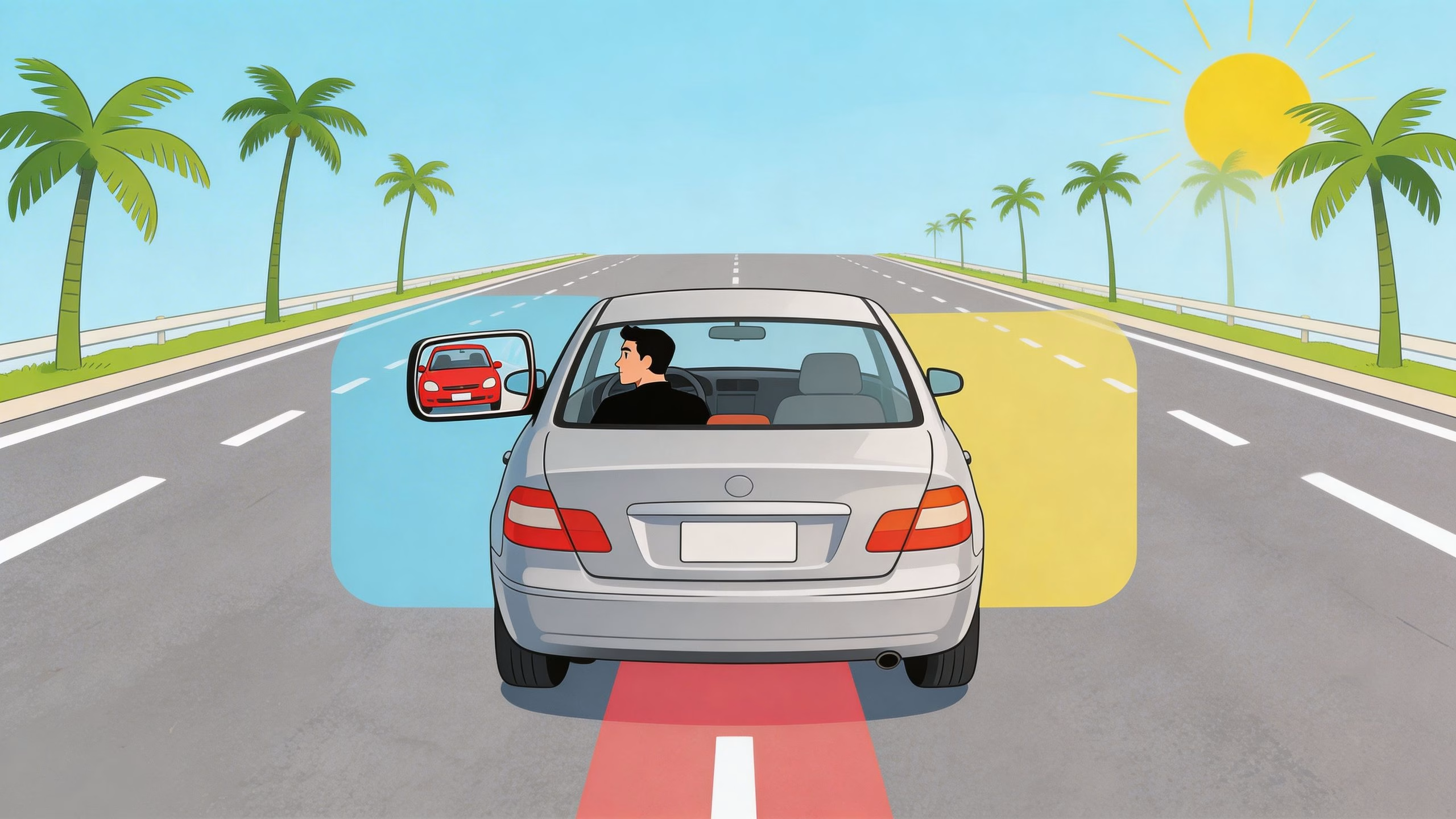
- Observation sequence: Mirrors, signal, blind spot, then move.
- Speed control: Don�t creep far below the flow unless the situation requires it.
These are simple actions, but under pressure students skip one piece of the chain. That�s why repetition matters.
When students fail the road test, it�s usually not because the maneuver was impossible. It�s because they rushed the setup.
Why Florida forbids shortcuts on certain maneuvers
Students sometimes ask why they can�t rely on the backup camera during the backing exercise. The reason is practical. The state wants to know whether you can physically orient yourself, judge path, and control the vehicle using your own observation.
The same logic applies to the three-point turn. The examiner isn�t asking whether your car has helpful features. The examiner is asking whether you understand spacing, steering, and control.
If you want a focused review before test day, this guide to the behind the wheel test is a useful place to rehearse the core habits.
Common Failures and How to Avoid Them
People often talk about failing like it�s random. It isn�t. Most failures come from predictable traps.
When you know the trap, you can practice the antidote.
Knowledge test traps
These mistakes show up again and again.
Memorizing answers instead of rules: Students remember one quiz question and get lost when the wording changes.
Antidote: After every missed question, explain the law in your own words.Mixing up right-of-way situations: Intersections, pedestrians, and turning decisions cause a lot of confusion.
Antidote: Practice scenario thinking. Ask, �Who must wait here, and why?�Rushing because the test feels intimidating: Nervous test takers click too quickly.
Antidote: Read the full question, then identify the topic before looking at the choices.Ignoring weak categories: Many people keep retaking full quizzes instead of drilling what they miss.
Antidote: Create a �trouble list� and review only those topics until they become easy.
Road test traps
The road test has its own repeat offenders.
| Trap | What it looks like | Antidote |
|---|---|---|
| Rolling stop | Car never fully settles | Count a calm full stop before moving |
| Poor observation | No clear blind spot check | Make your head movement obvious and timely |
| Turning too fast | Wide or sloppy turn path | Brake early and turn at a controlled speed |
| Backing with panic corrections | Vehicle drifts left and right | Keep your speed very slow and correct lightly |
| Not following instructions carefully | Moving before understanding | Listen first, then act |
The hidden problem is divided attention
Some applicants know how to drive but fall apart when they have to listen, steer, watch traffic, and remember the rule all at once. That�s a divided-attention issue, not a lack of intelligence.
You fix it by narrowing each practice session.
One day, focus only on stops and starts. Another day, practice only lane changes. Another day, repeat backing and three-point turns until the sequence feels ordinary.
The goal isn�t to avoid mistakes forever. The goal is to stop making the same mistake twice.
A student who identifies their repeated errors usually improves much faster than a student who just keeps �practicing driving� without a plan.
Navigating the New English-Only Test Policy in 2026
A major change is affecting many Florida applicants. The switch to English-only testing on February 6, 2026 has created an information gap for drivers who previously expected testing options in languages such as Spanish and Creole, as noted in this Florida permit test resource update.
For many students, this doesn�t mean they can�t pass. It means they need a different preparation strategy.
Comprehension first, English testing second
If English isn�t your first language, don�t begin by forcing yourself to memorize English test wording without understanding the traffic concept. That usually creates confusion.
A stronger path looks like this:
- Learn the traffic rule in your strongest language first
- Match that rule to the English words Florida uses
- Practice saying and recognizing those terms repeatedly
- Take English practice questions only after the concept is clear
That approach builds actual comprehension. It doesn�t just build fragile memorization.
Use language support wisely
Bilingual instruction isn�t a shortcut. It�s a bridge. A student who understands yielding, lane position, stopping distance, and sign meaning in Spanish or Portuguese can then connect those ideas to the English vocabulary on the test.
If you�re building your English for test situations, structured tools such as online ESL assignments can help reinforce reading accuracy, vocabulary, and confidence under timed conditions.
The key is to practice driving language, not just general English. Learn the words tied to signs, turns, lane changes, stopping, yielding, and examiner instructions. When those words become familiar, the test becomes less threatening and much more manageable.
Florida Driver's License Test FAQs
What happens if I fail one part of the test
You�ll usually need to retake the part you didn�t pass. Stay calm and find out exactly what caused the failure. A vague �I got nervous� doesn�t help much. A specific note like �I keep missing right-of-way questions� or �I rolled a stop on the road test� gives you something to fix.
Can I use my own vehicle for the road test
In many cases, yes, if the vehicle meets the testing requirements and is safe, legal, and ready to drive. Make sure basic equipment works and the car is clean and manageable. Don�t bring a vehicle you�re barely comfortable operating.
How should I schedule my appointment
Use your local licensing office or tax collector process and confirm the location, time, and required documents in advance. Double-check whether your area handles appointments differently, because confusion about location is common.
What should I do on test day if I feel panicked
Slow your body down first. Breathe, listen carefully, and do one task at a time. During the written test, answer the question in front of you. During the road test, complete the current action safely before worrying about the next one.
Is failing the first time the end of the road
Not at all. Many safe drivers needed a second attempt. What matters is how you respond. Review the exact reason, correct it, and come back better prepared.
If you want structured help before your exam, BDISchool offers Florida-focused driver education and traffic school resources designed for first-time drivers, returning drivers, and students who need flexible online study support in English, Spanish, or Portuguese.