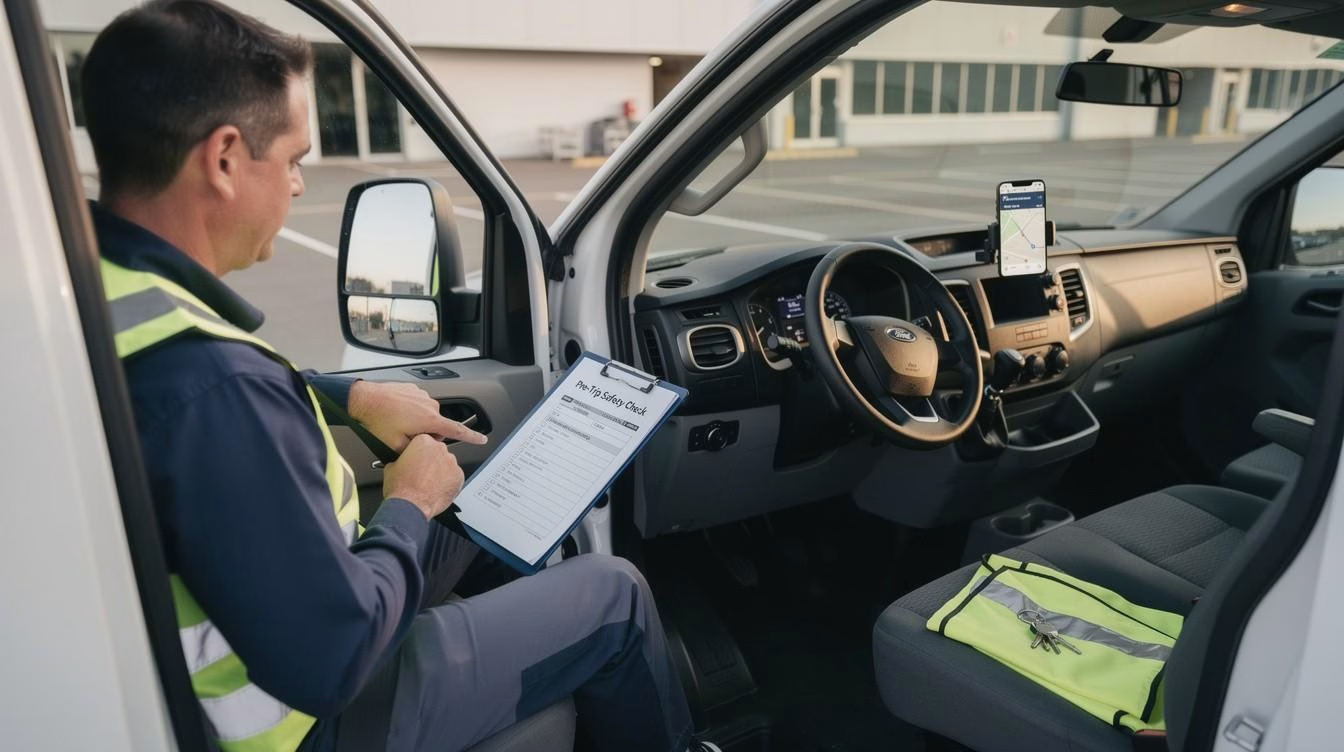

A Florida traffic citation is sitting on your kitchen counter right next to your keys, and you’re already doing the mental math. Paying the fine feels like the quickest way to put the ticket behind you, yet one careless payment can put points on your license and drive your car insurance up for years. The rules are stricter than most drivers expect, and waiting too long closes doors you can’t reopen.
Florida’s defensive driving course requirements aren’t one-size-fits-all. Your exact obligation depends on the type of ticket you received, your crash history, and how many points already sit on your record. Knowing whether you have a voluntary option or a state-mandated class determines what you need to file this week.
If you act inside the state’s short election window and finish the court-filing step properly, you stay in control of your driving record. Miss either step, and the state makes the next decision for you.
Which Florida Drivers Must Take a Defensive Driving Course
Most Florida drivers who receive a standard moving violation can choose whether to take a defensive driving course. Several high-risk situations strip that choice away. Florida doesn’t assign courses based on a general desire to sharpen your driving skills. Every requirement ties directly to measurable risk factors on your record: recent citations, crash frequency, injury, property damage, and specific serious offenses.
According to the FLHSMV Basic Driver Improvement provider guide, a driver with a qualifying moving-violation citation may voluntarily elect an approved Basic Driver Improvement (BDI) course within 30 days of the citation and before attending class, while drivers must pay the course cost themselves. That same state framework makes BDI mandatory after an at-fault crash where someone was transported to a hospital, after two crashes within two years causing more than $500 in property damage, or after convictions for reckless driving, racing, running a red light, or passing a stopped school bus.
For drivers dealing with repeated crashes, the rules escalate fast. Under the FLHSMV 3-crashes-in-3-years requirement published in 2025, drivers at fault in 3 crashes within 3 years must complete 12 hours of an approved Advanced Driver Improvement course, 4 hours of behind-the-wheel training, and an extended road test.
Florida Defensive Driving Requirements by Case
Use this breakdown to see immediately whether your situation is optional, mandatory, or escalated to an advanced program.
| Case | Course required | Course length | Deadline or trigger |
|---|---|---|---|
| Non-criminal moving violation, non-commercial driver | Voluntary BDI course | 4 hours | Elect within 30 days of the citation |
| At-fault crash with someone transported to a hospital | Mandatory BDI course | 4 hours | Triggered by the FLHSMV mandatory course notice |
| Two crashes within two years causing more than $500 property damage | Mandatory BDI course | 4 hours | Triggered by the second qualifying crash within two years |
| Conviction for reckless driving, racing, running a red light, or passing a stopped school bus | Mandatory BDI course | 4 hours | Triggered upon conviction for the offense |
| Third traffic offense causing a crash within 36 months | Advanced Driver Improvement (ADI) course | 12 hours plus 4 hours behind-the-wheel and extended road test | Complete within 90 days of conviction |
| Point-based license suspension, habitual offender classification, or court order | Advanced Driver Improvement (ADI) course | 12 hours | Triggered by the suspension notice, classification, or court order |
| Driver aged 55 or older seeking an insurance discount | Mature Driver Discount course | 6 hours | Not court-ordered; certificate goes to insurer |
Read the first row carefully if you hold a commercial credential. Voluntary BDI applies to non-commercial drivers with non-criminal moving violations, so CDL holders need to review whether CDL holders can take traffic school in Florida before trying to elect a class. Enrolling under the wrong license class wastes both your fee and your election window.
The deadline column matters as much as the course column. A voluntary election lives or dies inside that 30-day window, and a mandatory course carries its own completion clock once the state or court notifies you.
Advisor rule: Never guess your category based on what a friend did for their ticket. Your citation, your record, and your license class together decide whether traffic school is optional or required.
How Licensing Courses Differ From Citation Courses
Don’t confuse new-driver licensing classes with citation-driven defensive driving courses. As of 2025, the FLHSMV Driver Education Traffic Safety guide requires applicants under 18 who have never held a license elsewhere to complete a 6-hour Driver Education Traffic Safety course before applying. Similarly, in 2025, the FLHSMV TLSAE course listing required first-time applicants over 18 without an out-of-state license to finish a 4-hour Traffic Law and Substance Abuse Education course. Neither of these classes satisfies a citation requirement, and neither removes points. They exist purely for first-time license applicants.
For licensed drivers facing a recent moving violation, BDISchool’s Florida Basic Driver Improvement Course is the standard route. The four-hour course is aimed specifically at drivers who have recently received a moving violation, is state-approved, and is approved by the State of Florida for all courts and counties. Completing it keeps points off your license and prevents an insurance rate increase tied to that violation. If you’re weighing whether the effort pays off financially, Ticket Shield, PLLC breaks down how driving school affects insurance after a speeding ticket so you can see the long-term impact on your premiums.
How to Elect a Voluntary BDI Course Within 30 Days
Enrolling in a traffic school class doesn’t automatically tell the court you’re choosing traffic school. In Florida, your legal status and citation filing drive the process, not your course login. Follow these five steps in exact order so you don’t forfeit point avoidance on a technicality.
Five Steps to Lock In Point Avoidance
- Verify your citation and license type first. Check the ticket to confirm you’re dealing with a non-criminal moving violation and that you hold a non-commercial driver license. If you skip this check and enroll for an ineligible citation or a mandatory offense, your voluntary election won’t protect your record.
- File your election with the county clerk within 30 days. Per the FLHSMV traffic citations guidelines, you must elect an FLHSMV-approved BDI course through the appropriate county clerk within 30 days of the citation and before attending any course. Taking the class first and notifying the clerk afterward can void the entire point-avoidance benefit.
- Pay the full citation fine and court fees. Electing traffic school keeps points off your license, but it doesn’t erase your financial obligation to the county. You still owe the citation-related fine and fees, and leaving a balance unpaid can trigger a license suspension even if you finish the class.
- Complete your FLHSMV-approved course before the court’s deadline. Once the clerk records your election, the court gives you a specific completion window. Finish all course modules and assessments well ahead of that cutoff so technical hiccups or busy workweeks never push you past the due date.
- Submit proof of completion directly to the court. Don’t assume the school’s electronic report to the state closes your court file. You must ensure the court receives your completion documentation, because an unresolved court record can still result in points or administrative penalties.
Election Limits and the Court-Filing Trap
Florida puts strict caps on how often you can use voluntary BDI to shield your record. You can make this election only once in a 12-month period and eight times during your lifetime. If you’ve already used your annual slot, the clerk will reject a second election for a new ticket inside that rolling year.
Timing trips up more drivers than the coursework itself. Consider a driver ticketed on March 3 who puts the citation in the glovebox and waits until April 10 to call the clerk. Because more than 30 days passed, the voluntary election option is gone. Compare that with a driver ticketed on March 3 who elects with the county clerk on March 20 and finishes the online course in May inside the court’s completion window. That driver keeps the points off their record by honoring the initial election cutoff.
The other costly mistake is treating course completion as the finish line. Even when your provider reports your completion to FLHSMV, the county court handling your ticket still requires confirmation on its docket. Always verify that the clerk received and processed your certificate.
Never pay a ticket blindly online without checking the traffic school election box first. Once the clerk processes a standard payment as a guilty plea, you lose your chance to elect BDI.
Before you contact the county clerk or start your course registration, pull these three items together so you can finish in one sitting:
- Your citation number: Listed near the top of your Florida Uniform Traffic Citation so the clerk attaches your election to the right case.
- Your driver license number: Needed by both the county clerk and your traffic school to match your official FLHSMV record.
- An active email address: Used for clerk payment receipts and for your course registration form and certificate delivery.
Knowing how point thresholds accumulate makes it obvious why protecting that single election window matters so much.
Point Thresholds and When Crashes Require ADI
Ignoring one small ticket rarely suspends a license on its own, which is why so many drivers underestimate how fast Florida’s point system closes in. Points don’t reset on January 1. They sit on rolling time windows measured from each conviction date, meaning an old ticket from last autumn can combine with a fresh citation next month to put you off the road.
How Florida’s Rolling Point Windows Trigger Suspension
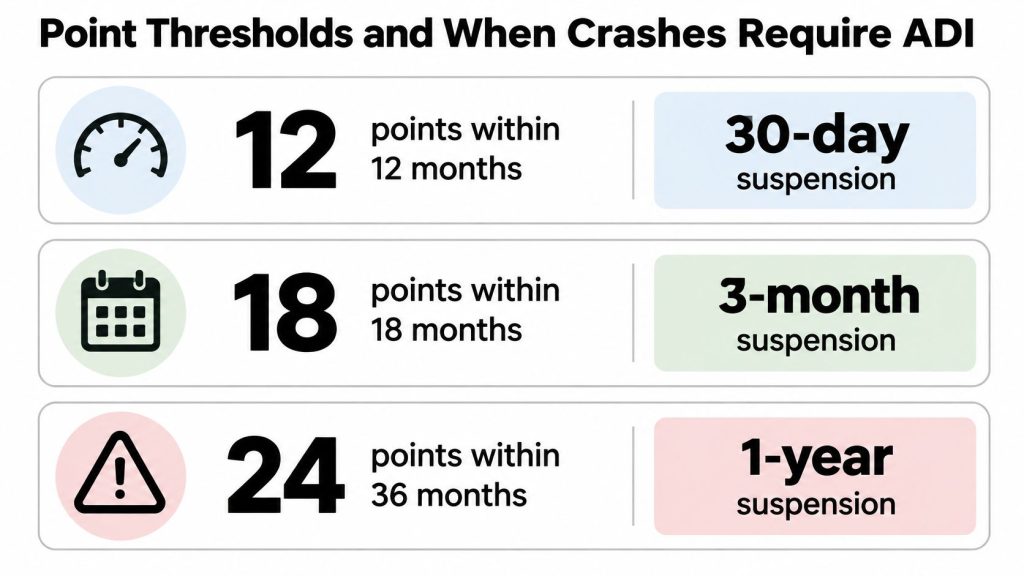
Under the FLHSMV driver improvement schools standards, three specific point totals trigger automatic license suspensions: 12 points within 12 months results in a 30-day suspension, 18 points within 18 months brings a 3-month suspension, and 24 points within 36 months causes a 1-year suspension.
| Points | Time window | Suspension length |
|---|---|---|
| 12 points | 12 months | 30 days |
| 18 points | 18 months | 3 months |
| 24 points | 36 months | 1 year |
Because these windows roll forward continuously, the exact same point total can be harmless for one driver and devastating for another. Imagine a driver who already carries 9 points from convictions over the past eight months and gets pulled over for a 3-point moving violation today. Paying that new ticket outright pushes the total to 12 points inside 12 months, triggering an automatic 30-day suspension. If that driver checks their dates immediately and elects BDI within the citation window, those 3 points stay off the record and the suspension never happens.
Pull your official driving record before a new ticket ever lands in your lap. Write down every conviction date from the last three years so you know exactly when older points age out of the 12-month, 18-month, and 36-month windows. Acting before you cross a threshold is always cheaper and simpler than fighting to reinstate a suspended license after the notice arrives in your mailbox.
When Crashes and Suspensions Escalate to ADI
Repeated crashes push you out of basic traffic school and into a much heavier graduated intervention. A driver convicted of, or pleading no contest to, a third traffic offense that caused a crash within 36 months faces three strict mandates:
- 12-hour ADI course: You must complete a 12-hour FLHSMV-approved Advanced Driver Improvement program rather than a standard basic course.
- 4 hours of behind-the-wheel training: Classroom or online study isn’t enough; you must log four hours of practical training with a Florida-licensed commercial driving school.
- Extended road test: You must pass an extended driving exam administered by a driver-license examiner or an authorized tax collector.
You get 90 days from the conviction to finish all three requirements. Miss that 90-day cutoff, and Florida cancels your driver license.
Crash history isn’t the only path into an advanced class. Florida also requires ADI if your license is suspended for point accumulation, if the state classifies you as a non-DUI habitual traffic offender, or if a judge orders it directly. Drivers facing any of these triggers should review Florida’s Advanced Driver Improvement course requirements right away so they don’t waste time enrolling in the wrong program.
Why a Standard BDI Certificate Never Satisfies ADI
One of the costliest mistakes suspended drivers make is assuming any Florida-approved traffic school certificate clears their record. It won’t. Completing a 4-hour basic class when your FLHSMV letter specifies a 12-hour advanced course leaves your suspension active and burns through your compliance clock.
Take a driver who opens a 12-point suspension notice on a Monday morning. Instead of signing up for the fastest class they find online, they need to treat that letter as their roadmap during week one:
- Read every line of the FLHSMV notice or court order. Look for the exact course title and reinstatement instructions printed on the document.
- Confirm whether ADI applies to your case. Verify that the program you choose explicitly carries state approval for Advanced Driver Improvement, not Basic Driver Improvement.
- Calendar your hard deadline immediately. If your requirement stems from three crashes in 36 months, mark day 90 from your conviction date and work backward to schedule your commercial behind-the-wheel hours and tax collector road test early.
A 4-hour BDI certificate can’t unlock a license suspended for points or repeated crashes. Match the exact course named on your notice before spending a dollar.
Once you confirm the exact program your record requires, registering accurately ensures your certificate reaches the state without delays.
Completing the Course and Getting Your Certificate
Finishing an online course is straightforward when you treat it like an official legal filing rather than background noise on your laptop. Every field you type during signup and every identity check along the way directly determines whether your completion certificate is valid.
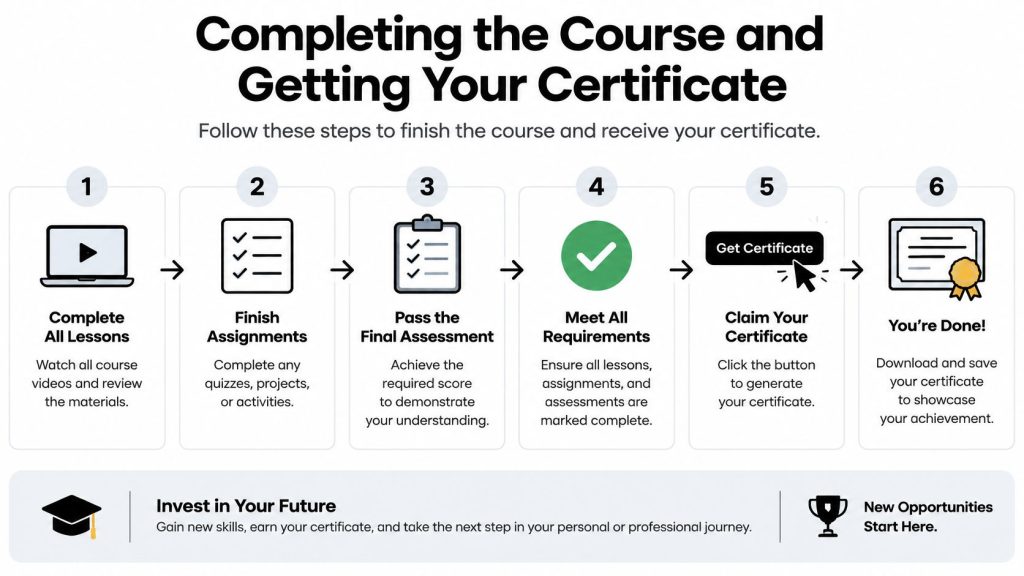
Here is the step-by-step path from initial enrollment to downloading your verified certificate.
Your Four-Part Completion Checklist
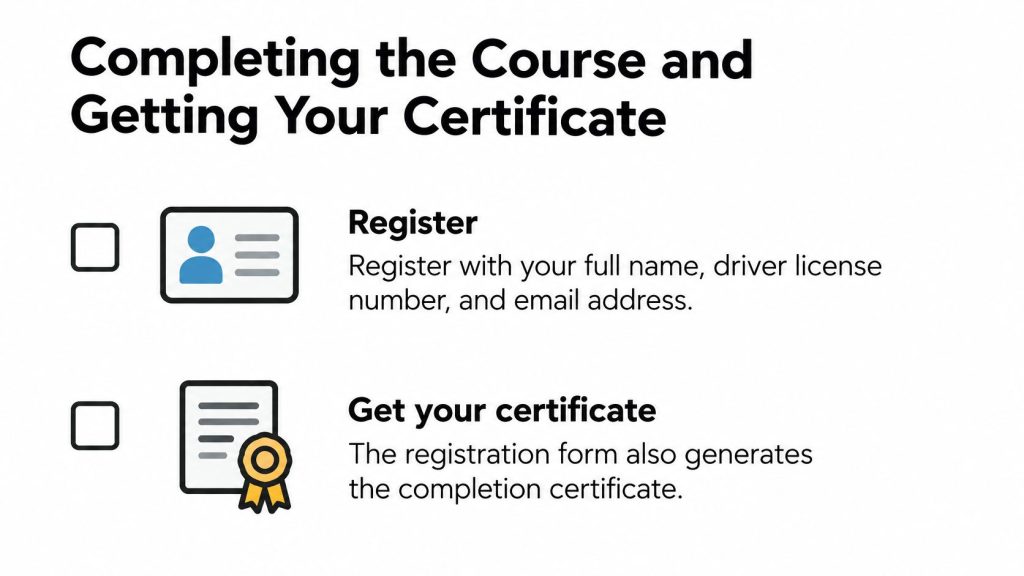
- Complete the registration form accurately: Before starting the lessons, we require a registration form with your full legal name, driver license number, and email address. Double-check every digit, because this exact information generates your official completion certificate at the end of the course.
- Pass every identity validation check: Throughout the course, you must clear identity validation requirements, which can include biometrics, security questions, or other required verification methods. Answer carefully and stay consistent, since Florida mandates these checks to verify the actual ticketed driver took the class.
- Finish all modules and pass assessments: Work through every lesson thoroughly and pass the final exam along with any other in-course assessment requirements set by course guidelines. Rushing through screens without reading Florida traffic law scenarios is the fastest way to trip over exam questions.
- Download and save your electronic certificate: Upon passing, we issue your certificate electronically and report your completion directly to FLHSMV. Because our course is approved by the State of Florida for all courts and counties, your certificate satisfies state standards statewide.
We are also required by Florida HSMV to retain pertinent student study and completion records for at least seven years, and we don’t sell or share your personal information with outside third parties except as necessary to fulfill a request like reporting completion. Still, don’t rely solely on electronic state reporting to clear your local court docket. Save a copy of your certificate right away and review our guide on how to submit your traffic school certificate in Florida so the county clerk closes your citation on time.
Refund Rules You Should Know Before Starting
Read the enrollment terms before you launch the first module so there are zero surprises. We issue a full refund if you cancel your enrollment contract by email within 30 calendar days of purchase (including weekends and holidays), provided you haven’t completed the course or obtained a certificate. Your cancellation email just needs your full name, address, signup date, and reason for canceling.
Once you engage with assessments or finish the curriculum, strict state-aligned rules kick in:
- Failed exams or assessments: No refunds are issued for failing the final exam or other in-course assessment requirements per course guidelines.
- Failed identity validation: No refunds are issued if you fail biometrics, security questions, or other required validation checks.
- Completed courses and reporting: No refunds are issued once you have completed all modules, once completion has been reported to FL HSMV, or due to course expiration.
Take your time with the study material and pay attention during security prompts. A prepared student avoids the most expensive mistake in online traffic school: failing an assessment or validation check they could have passed easily with five minutes of focus.
Mature Driver Discount Courses for Drivers 55 and Older
Not every Florida defensive driving course is tied to a traffic ticket or a crash. If you’re a clean-record driver looking to trim your annual auto insurance bill, Florida law builds a dedicated, low-effort pathway just for you.
Under the FLHSMV Mature Driver Discount course rules governed by section 627.0652 of the Florida Statutes, drivers aged 55 or older may complete an FLHSMV-approved Mature Driver Discount course and submit their completion certificate to their insurance carrier to request a discount. Your insurance company sets the exact discount amount, and the savings typically last three years, as long as you aren’t convicted of (and don’t plead guilty or no contest to) a moving violation during that period.
Mature Driver Course vs. Basic Driver Improvement
Don’t mix up a voluntary insurance refresher with a citation course. The Mature Driver program isn’t court-ordered, won’t dismiss a moving violation, and won’t prevent points from hitting your license after a ticket.
Consider a 58-year-old Tampa driver with a spotless record whose auto policy renews in June. Completing a 6-hour refresher course in April and emailing the certificate to their insurance agent locks in multi-year premium relief with minimal effort. Our Mature Driver Course is a 6-hour online refresher built specifically to sharpen safety awareness for drivers 55 and older.
Before you enroll, call your insurance agent to confirm how they apply the credit and how much you’ll save under your current policy. You can also explore how the Florida mature driver insurance discount works to prepare the right questions for your carrier. If you currently have an unpaid moving violation sitting on your desk, skip the Mature Driver course for now and compare it directly against the BDI route, because only BDI addresses your citation.
Confirm Your Deadline and Register This Week
Procrastination is the single biggest reason Florida drivers end up with preventable points and higher insurance bills. You now have the full map of Florida’s rules, so turn it into a concrete decision today.
Your Three-Step Decision Path
- Match your paperwork to the right course. Check your citation, court order, or FLHSMV notice to confirm whether you qualify for voluntary BDI, owe a mandatory BDI class, or need a 12-hour ADI program.
- Count the days on your calendar. If you’re still inside your election window for a non-criminal moving violation, file your election with the county clerk today and register for class immediately. If that window already closed, verify with the clerk whether a mandatory course or court-ordered option still applies.
- Never substitute the wrong level. If your suspension letter or court paperwork names ADI, enroll directly in an approved ADI program instead of hoping a shorter course will pass review.
Start Your Four-Hour Online Course Today
If you’re eligible for BDI, don’t wait for the deadline to creep up on a busy weekend. We offer Florida’s Basic Driver Improvement Course (also called Florida Four-Hour Traffic School), which you can register for and start right on our website. The course is four hours long, fully online, self-paced, and available in English, Spanish, and Portuguese so you can finish comfortably on your phone, tablet, or computer.
Completing this FLHSMV-approved program helps you avoid points on your driver license, maintain your Excellent Driver Safe Driver Status/Discount, and ensures no insurance rate increase due to the moving violation. Because our certificates are issued electronically and reported straight to FLHSMV, you stay fully compliant across every Florida court and county.
Every day you wait shrinks your margin for error with the county clerk. Register this week while you control the timeline, finish at your own pace, and keep your driving record clean.
Browse BDISchool’s Florida course catalog or explore DriverEducators’ online course lineup to pick your exact class and start your first module today. If you want help confirming which program matches your citation before signing up, call our team directly at 888-237-5669.
BDISchool provides FLHSMV-approved online courses meeting Florida’s defensive driving course requirements, including our four-hour Basic Driver Improvement course, eight-hour Intermediate and Aggressive Driver courses, and six-hour Mature Driver refresher in English, Spanish, and Portuguese. Protect your license from points, avoid moving-violation insurance rate hikes, and satisfy your Florida court deadline on your own schedule. Visit BDISchool right now to register and start your course today.