
Colorado adds points to your driving record only after a conviction, and the number depends on the violation: 1 point for speeding 5 to 9 mph over, 4 points for 10 to 19 mph over, and 12 points for a DUI. Adults 21 and older face a suspension at 12 points in 12 months or 18 points in 24 months. This guide gives you the full schedule, the limits by age, how long points count, and how to see your own total. It also explains how state-approved online courses fit in, so you can protect your record with the right information.
Key Takeaways
- Points are assessed after a conviction, not when an officer hands you the ticket. Colorado counts them by the date of the violation.
- Drivers 21 and older risk suspension at 12 points in 12 months or 18 points in 24 months. Younger drivers have much lower limits.
- Speeding 1 to 4 mph over adds 0 points, 5 to 9 adds 1, 10 to 19 adds 4, 20 to 39 adds 6, and 40 or more adds 12.
- Points stay on your record permanently but count toward your driving privileges for two years.
- Your total is not visible on the ticket or at the courthouse. You request your driving record from the Colorado DMV.
Table of Contents
- How Colorado assigns points
- Points for speeding in Colorado
- Points for other common violations
- How many points trigger a suspension
- How long points stay on your record
- How to check your points
- Can a driving course help with Colorado points or insurance?
- A practical plan after a Colorado ticket
- Our perspective
- Take the next step with Drivereducators
- FAQ
- Sources
How Colorado assigns points
Colorado drivers start at zero. Points are added to your record when convictions are reported to the DMV, and the schedule itself is set by C.R.S. �42-2-127. That detail matters in practice. A ticket you are contesting has not added anything yet. A ticket you pay without a fight is usually a conviction, and the points follow.
Two more rules shape how the points work:
- The violation date is what counts. Colorado uses the date you committed the violation, not the date of conviction, to decide whether points fall inside a suspension period. A ticket from eleven months ago can land in your 12-month window even if the conviction posts later.
- Courts do not keep your total. A Colorado judicial FAQ says courts do not maintain an individual driver�s point total and sends drivers to the state motor vehicle division, because age changes which rules apply.
Points for speeding in Colorado
Speeding is the violation most readers search for, and the schedule climbs fast. The Colorado General Assembly lists the following point values for speeding:
| Miles per hour over the limit | Points |
|---|---|
| 1 to 4 | 0 |
| 5 to 9 | 1 |
| 10 to 19 | 4 |
| 20 to 39 | 6 |
| 40 or more | 12 |
Driving at a speed that is not reasonable and prudent for the road conditions carries 3 points under the same schedule.
That answers a common question: can you drive 5 miles over the limit? A ticket at 5 to 9 mph over carries 1 point, so a single one is minor. The risk is the stack. A 1-point ticket plus a 4-point ticket plus a 6-point ticket is 11 points, one short of the adult suspension line.
The point total is only part of the cost. The General Assembly states that 1 to 24 mph over the limit is generally a Class A traffic infraction, while 25 mph or more over is a Class 2 misdemeanor traffic offense. Going 25 mph or more over in a construction zone is a Class 1 misdemeanor traffic offense. A misdemeanor means a court appearance and a heavier consequence than a fine.
Points for other common violations
The statute covers far more than speeding. These are the values for the violations that drivers are most often convicted of.
Serious offenses
- DUI or DUI per se, and leaving the scene of an accident: 12 points each.
- DWAI and reckless driving: 8 points each.
- Speed exhibition: 5 points.
- Underage drinking and driving: 4 points.
These values come from C.R.S. �42-2-127.
Everyday moving violations
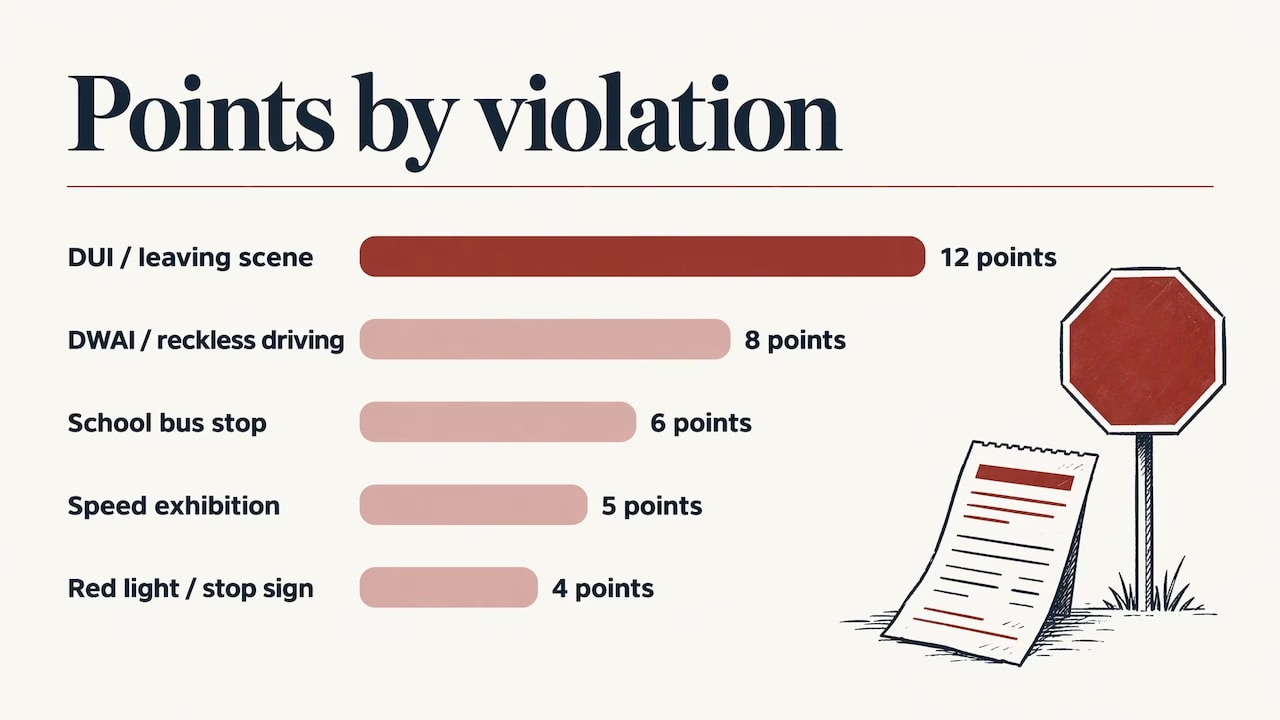
A published violation schedule from a Colorado traffic law firm lists 4 points for running a red light or stop sign, improper passing, and failure to obey a traffic-control device. Careless driving carries 4 or 12 points, depending on the circumstances. The same schedule lists 6 points for failing to stop for a school bus, 3 points for an improper turn or failure to yield, and 2 points for failure to signal.
A few quick comparisons show why a �small� ticket is not always small:
- A failure to signal (2 points) is cheap on its own, but two of them plus a stop sign (4 points) is 8 points.
- A school bus violation (6 points) is half of the adult suspension limit in one conviction.
- Reckless driving (8 points) plus one 4-point ticket reaches 12.
The statute is the final word on each value, and legislators can change it. Check the current text of C.R.S. �42-2-127 for any violation not listed here.
How many points trigger a suspension
The limit depends on your age and license type. The Colorado DMV publishes these thresholds in its suspension and reinstatement FAQs:
| Driver | Suspension risk |
|---|---|
| Age 21 and older | 12 points in 12 months, or 18 points in 24 months |
| Ages 18 to 20 | 9 points in 12 months, 12 points in 24 months, or 14 points before age 21 |
| Under 18 | 6 points in 12 months, or 7 points before turning 18 |
If you are under 21, the margin is thin. A single 6-point ticket can put an under-18 driver at the limit.
Professional drivers
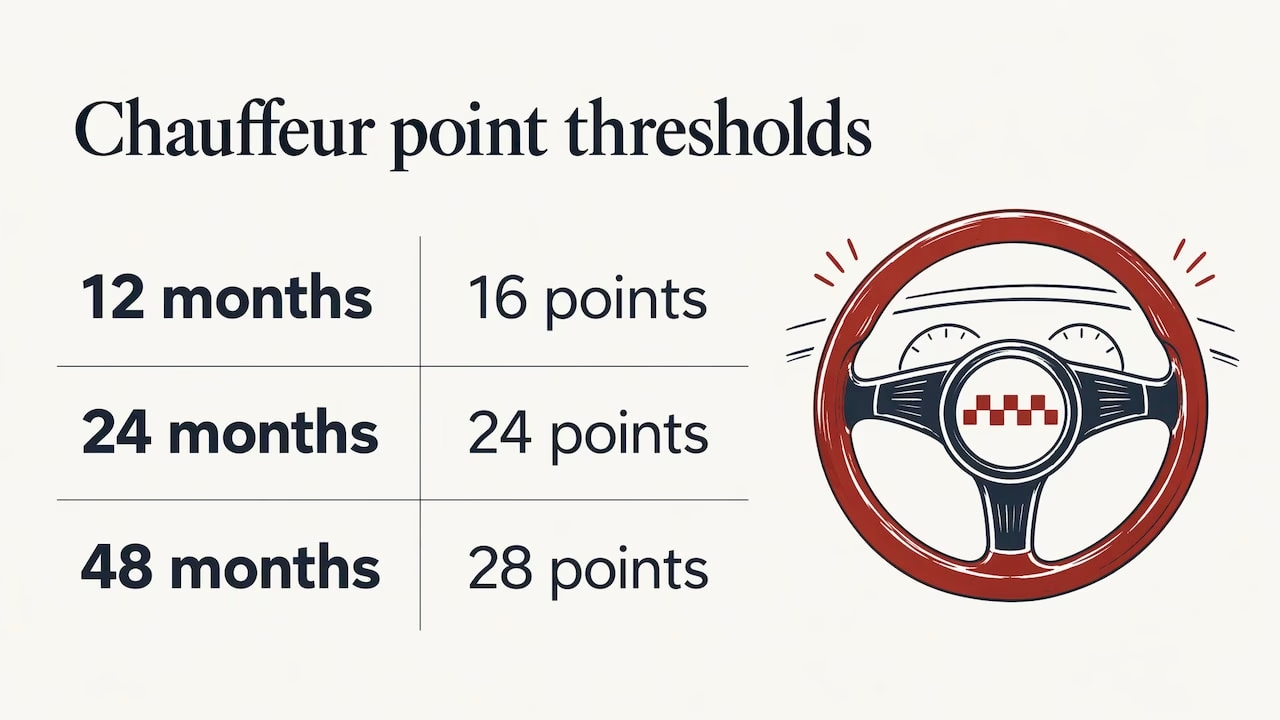
A chauffeur, such as a taxi driver, may qualify for higher thresholds of 16 points in 12 months, 24 in 24 months, or 28 in 48 months. This applies only if each ticket occurred in the course of employment, and the DMV advises bringing documentation to the hearing. If you drive for a living and want to understand how defensive driving training is structured for commercial drivers, the guide to a CDL defensive driving course covers what that training looks like.
What happens at a point suspension hearing
When you reach a threshold, the hearing officer must impose a point suspension. The officer may decide how long it lasts and whether to grant a probationary driver license. The maximum is one year, and the Department starts from a six-month base period. Arrive with your records in order, and with proof of any employment-related driving if it applies to you.
How long points stay on your record
There are two clocks, and people often mix them up.
- The record clock. Colorado State Patrol states that points remain on your license permanently, but affect your driving privileges for only two years. It also states that the driving record is retained for seven years and may be accessed by insurers and prospective employers.
- The suspension clock. Points count toward a suspension only inside the 12, 24, or 48 month windows above, measured from the violation date.
So a 4-point ticket will not push you toward a suspension two years from now. It can still show up when an insurer or an employer pulls your record for years after that. That is why avoiding the conviction in the first place is worth more than managing the points afterward.
How to check your points
The ticket does not show your running total, and neither does the court. The Douglas County Sheriff�s Office, for example, says it cannot see a driver�s point total and refers drivers to the Colorado Department of Revenue.
The DMV�s route is online. According to the myDMV help center, you create a myDMV account to verify your identity, choose Available Services, and select Request a Driving Record. Records bought online are uncertified and emailed to you. A certified record can only be purchased at a driver license office and is sent by U.S. mail.
A good habit: pull your record before you decide how to handle a new ticket. Count the points you already have within the last 12 and 24 months, add the new ticket�s value, and compare the result to your age band. That sum tells you whether the ticket is a nuisance or a threat to your license.
Can a driving course help with Colorado points or insurance?
The honest answer depends on what you want the course to do.
Insurance for drivers 55 and older. Colorado law requires insurers� filed rating materials to provide an appropriate premium reduction for a vehicle whose principal operator is at least 55 and who completes a qualifying, preapproved driver-education course. The reduction lasts three years. It does not apply to a course that a court or other governmental entity ordered after a moving violation.
Ticket handling. Whether a course affects a particular ticket is decided by the court that has your case, not by the course provider. Read your citation and the court�s instructions, and ask the court clerk before you pay for any course you hope will help.
Keeping a clean record in the long run. Points come from convictions, so the habits that prevent convictions are what protect your license. Our guides on how points are reduced and dismissed and seven ways to reduce points on your driving record explain the general options drivers weigh. Our Florida points system guide shows how a different state builds its schedule, which helps if you also drive or are licensed in Florida.
A practical plan after a Colorado ticket
- Read the citation. Note the violation, the date, and whether it is an infraction or a misdemeanor. A misdemeanor means a court appearance.
- Look up the point value. Match it against the schedules above.
- Request your driving record. Use myDMV to see what is already on it.
- Do the math for your age band. Count only points whose violation dates fall within the window.
- Talk to the court before paying. Paying is generally a conviction, and the conviction is what adds points.
- Keep records for a hearing. If you reach a threshold, bring documents, especially if you drive for work.
If a suspension is on the table, a Colorado attorney is the right person to advise you on contesting a ticket or a hearing. For the rest of your driving life, education that keeps you from the next ticket is the cheaper tool.
Our perspective
Most drivers meet the point system only after a ticket, when the stakes are already high. We think the better time to learn it is before.
The schedule rewards simple habits. The gap between 1 point at 5 to 9 mph over and 4 points at 10 to 19 mph over is a few seconds on the speedometer. Learning where those lines sit, and how quickly several small convictions add up, is the kind of knowledge that keeps a license clean.
That is why we build our courses in-house, with certified educators and safety specialists who keep the content current with statutory requirements. We design them to run on any phone, tablet or computer, with multilingual read-along features, so a busy driver can finish at their own pace. Our pricing is transparent, with no hidden fees, and we back our courses with a money-back guarantee.
A state-approved course is not a trick to get around the rules. It is a way to understand them and drive accordingly, and it is where we believe every driver should start.
the author
Take the next step with Drivereducators
Our state-approved online courses are built for drivers who need to meet a DMV, court or insurance requirement without rearranging their week. Our Florida catalog includes the Basic Driver Improvement course at $30, the Driver Education Traffic Safety course at $29.90, the Traffic Laws Substance Abuse Education course at $29.95, the Wireless Devices Distracted Driver course at $24.50, and the Mature Driver Insurance Discount course at $14.50. If you are licensed in Florida or take a Florida requirement, you can see every option on our course page.

If you manage drivers rather than drive yourself, our custom fleet safety course is built around your team�s driving. Your drivers� records matter to insurers and employers, and training is a practical way to protect them.
FAQ
How many points is a speeding ticket in Colorado?
It depends on how fast you were going. Speeding 1 to 4 mph over is 0 points, 5 to 9 is 1, 10 to 19 is 4, 20 to 39 is 6, and 40 or more is 12. Points are added after a conviction.
How many points will get my Colorado license suspended?
If you are 21 or older, 12 points in 12 months or 18 points in 24 months. Drivers 18 to 20 face 9 in 12 months, 12 in 24 months, or 14 before turning 21. Drivers under 18 face 6 in 12 months or 7 before turning 18.
How long do points stay on my Colorado license?
Colorado State Patrol states that points stay on your license permanently but affect your driving privileges for two years. The driving record itself is retained for seven years, and insurers and employers may be able to see it.
Can I look up my points on my license?
Yes, through the DMV. Create a myDMV account, then request a driving record. Courts and sheriff�s offices generally cannot give you your total, so the DMV is the place to go.
Sources
- Point Suspension, Colorado General Assembly
- Penalties for Speeding Violations, Colorado General Assembly
- Colorado Revised Statutes Section 42-2-127
- Colorado Revised Statutes Section 10-4-632
- Suspension and Reinstatement FAQs, Colorado DMV
- Point Suspensions, Colorado Department of Revenue
- Colorado State Patrol press release on driver points
- Colorado judicial district infraction FAQ
- Traffic Tickets, Douglas County Sheriff�s Office
- myDMV Online Services Help Center
- Drivers License Points Assessed, Colorado traffic law schedule
This article is provided for general information and is not a professional advice.