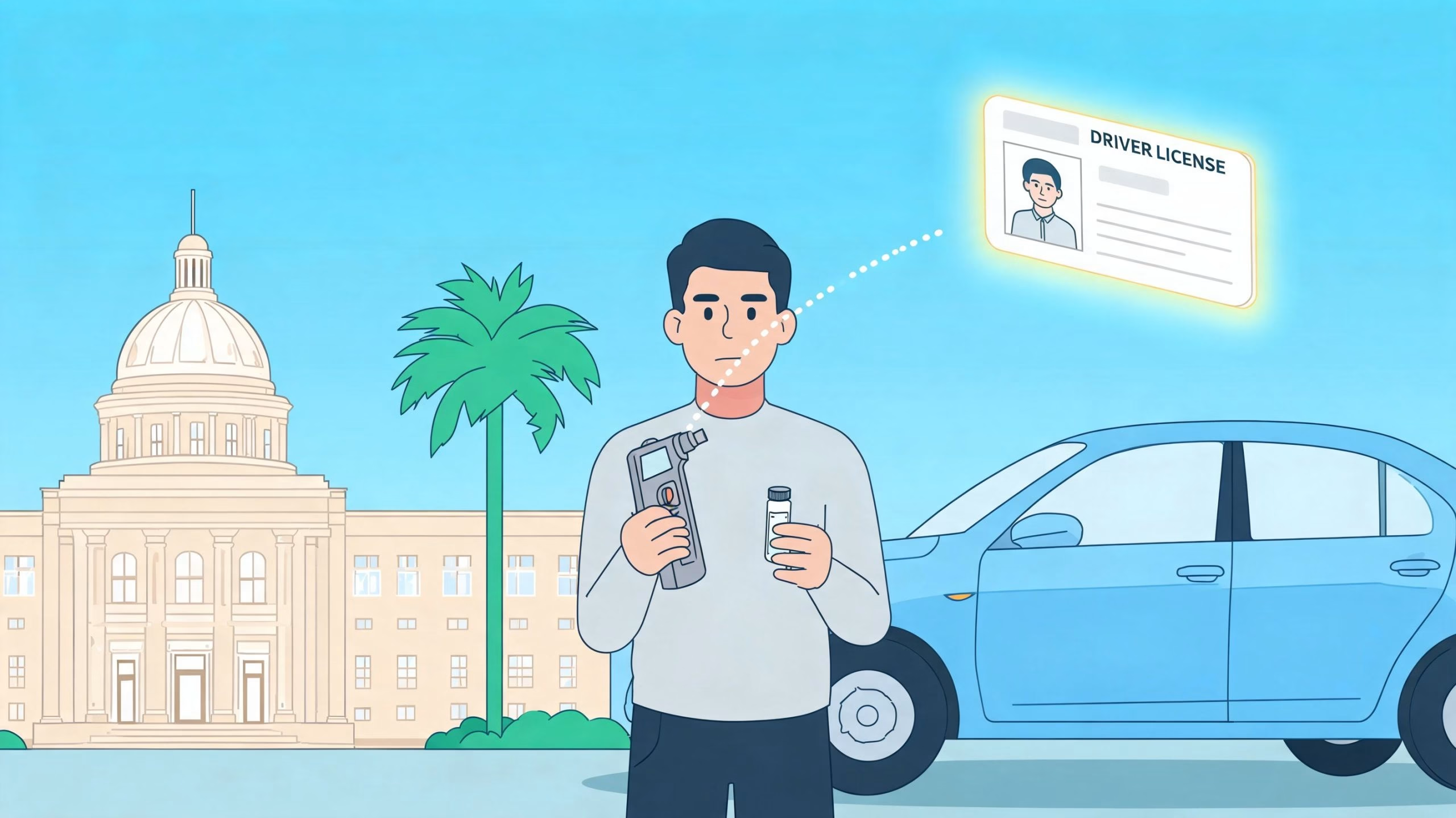
You open your mailbox, email, or FLHSMV account notice and see words that make your stomach drop. Alcohol test. Drug test. Suspension. Reinstatement. Most drivers don�t read those notices on a calm afternoon with plenty of time to think. They read them after an arrest, after a crash, or after learning their license has been flagged.
That�s why this topic feels so overwhelming.
If you�re trying to understand an alcohol and drug test dmv requirement in Florida, the first thing to know is that confusion is normal. The second thing to know is that the process is serious, but it�s also manageable when you break it into parts. You need to know what the notice means, why the state is asking for testing, what kind of test may be involved, how the result affects your driving privileges, and what steps help you move toward reinstatement.
A lot of drivers mix together the FLHSMV process, the court process, and traffic school. They are not the same thing. That misunderstanding causes missed deadlines and bad assumptions. If you’re starting from a suspended-license notice, this guide on common reasons for a suspended Florida license can also help you place your situation in context.
Understanding Your Notice from the Florida DMV
A Florida driver named Carlos gets pulled over after leaving a family gathering. He�s arrested on suspicion of impairment, released, and later receives paperwork tied to his driving privileges. One page talks about suspension. Another mentions compliance requirements. He isn�t sure whether the state wants a breath test, a treatment program, court paperwork, or all three.
That kind of confusion happens all the time.
What the notice is really telling you
An FLHSMV notice usually isn�t just �informational.� It tells you that your driving privilege has been affected or is about to be affected. The notice may relate to a DUI arrest, a refusal, a failed test, a required hearing, or conditions you must satisfy before reinstatement.
The most important first move is simple.
- Read every line slowly: Don�t skim for one date and toss the letter aside.
- Check for action words: Look for terms like suspension, revocation, disqualification, hearing, reinstatement, evaluation, or compliance.
- Match it to your recent event: Ask yourself whether this came after an arrest, crash, medical review, or court requirement.
- Keep every document together: Drivers often lose the page that explains the next step.
What drivers often misunderstand
Many people assume the DMV notice is the same thing as their criminal case. It isn�t. A judge may decide one part of your case, while the FLHSMV handles your license status on a separate track.
Practical rule: If the notice affects your license, treat it as urgent even if your court date is still weeks away.
The good news is that once you understand what agency is asking for what action, the process becomes much less mysterious. You don�t have to guess your way through it.
Why the FLHSMV Requires Alcohol and Drug Testing
Florida doesn�t require alcohol and drug testing to make drivers miserable. The state uses testing because impairment creates a real public safety risk, and licensing agencies are responsible for keeping unsafe drivers off the road.
The usual events that trigger testing
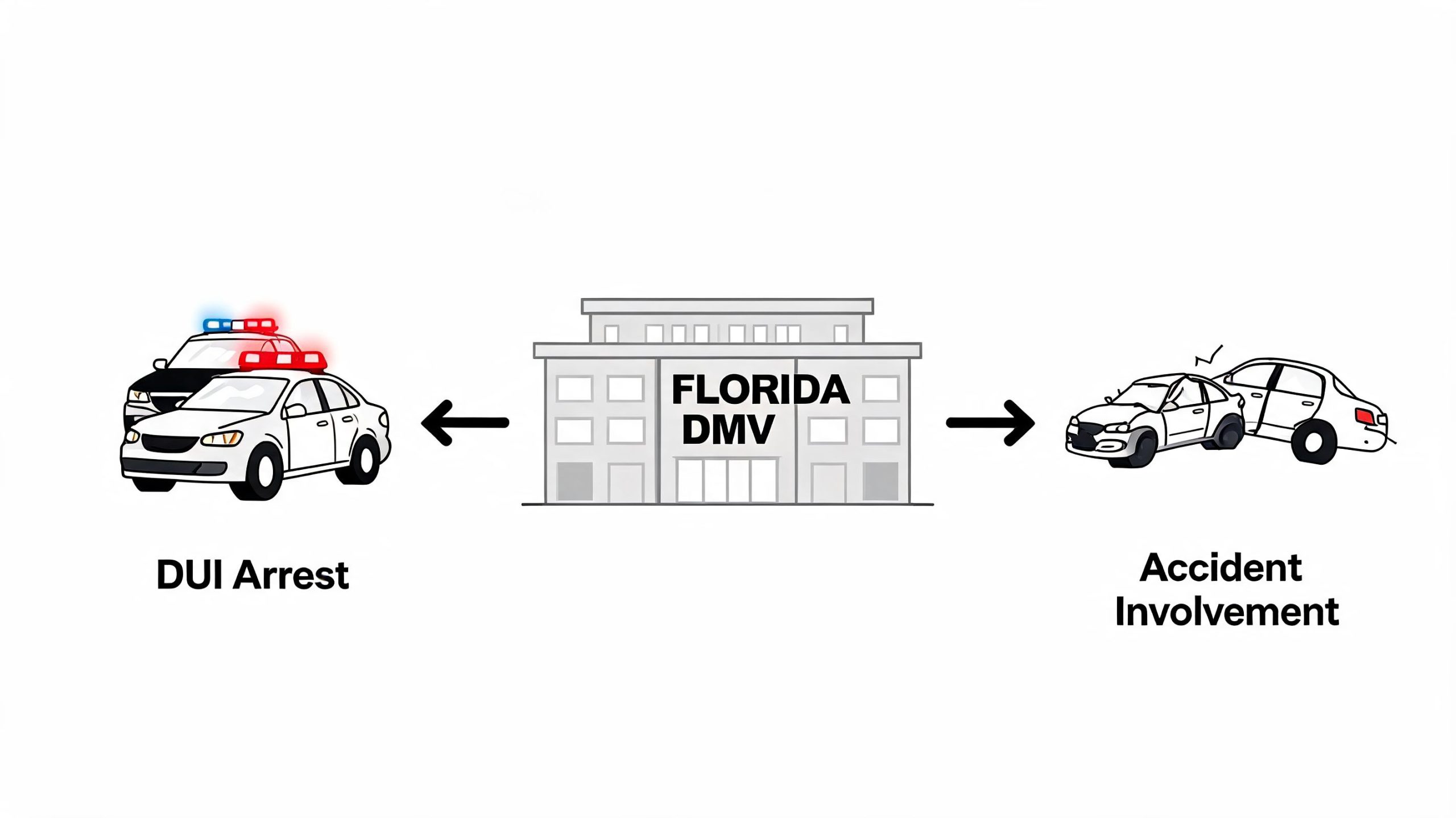
Testing usually enters the picture after one of a few situations:
- A DUI arrest: Law enforcement may request a breath, blood, or urine test depending on the situation.
- A serious crash: If impairment is suspected, chemical testing may become part of the investigation.
- A reinstatement requirement: Some drivers must prove compliance before getting their license back.
- A commercial driver issue: CDL holders face separate federal testing rules layered on top of state licensing rules.
Florida�s strict approach is tied to the consequences of impaired driving. In 2024, 11,904 people were killed in drunk-driving crashes involving drivers with BACs of 0.08 g/dL or higher, accounting for about 30 percent of all traffic fatalities, according to the IIHS alcohol and drugs research summary.
For a broader safety overview, this explanation of what counts as impaired driving in Florida helps many drivers understand why the state treats alcohol and drug issues differently from an ordinary speeding ticket.
The two tracks that confuse people
One of the biggest misunderstandings is this: the FLHSMV process and the criminal court process are separate.
The court deals with criminal charges. The FLHSMV deals with your license. Those two tracks can influence each other, but they aren�t identical. You can still face a licensing consequence even while your court case is unresolved.
A driver can feel �not convicted yet� and still lose driving privileges through an administrative process.
That separation is why deadlines matter so much. It also explains why drivers sometimes hear terms like �implied consent� before they fully understand them. If you want a plain-language example from another state, Georgia’s implied consent law gives a useful comparison for how refusal laws work in practice.
Why the state takes this so seriously
The state is trying to answer one practical question. Is this person safe to drive right now, and under what conditions? Testing helps officials make that decision.
That�s true for everyday drivers, and even more so for commercial drivers who operate larger vehicles and carry greater public risk. The testing system may feel harsh when you�re the one receiving the notice, but its purpose is road safety first.
Common Types of DMV Mandated Tests
Not every �alcohol and drug test dmv� situation means the same test. That�s where drivers get tripped up. A roadside breath test answers a different question than a monitored urine screen during a treatment program.
Breath testing
A breath test is most often used to measure alcohol concentration close to the time of driving. In the commercial setting, federal rules require evidential breath testing devices approved by NHTSA, and a screening result from 0.02% to 0.039% BAC removes a driver from safety-sensitive duties until a later test is below 0.02%, while 0.04% BAC or higher prohibits those duties and requires confirmation, as explained in the federal alcohol testing rules for motor carriers.
For everyday Florida drivers, the details of the machine may differ by context, but the idea is similar. Breath testing is aimed at current alcohol presence, not long-term behavior.
Blood testing
A blood test is often used when a crash is serious, when drug impairment is suspected, or when a more direct chemical sample is needed. It can identify alcohol and may also be used to screen for other substances depending on the case.
Blood tests often sound definitive to drivers, but the legal issue is still how the result is used in the investigation and licensing process.
Urine testing
Urine testing comes up frequently in monitored compliance settings. It�s also important in commercial drug testing. Federal protocols require urine specimens to be tested for five drug classes: marijuana (THC), cocaine, amphetamines, phencyclidine (PCP), and opiates, with positive screens confirmed using GC/MS at certified labs, followed by removal from safety-sensitive duties and referral to a Substance Abuse Professional, according to the DOT-style drug testing protocol summary.
For Florida drivers outside the CDL world, urine testing may be used in evaluation or monitoring programs, depending on the case requirements.
Hair testing and interlock data
A hair test is different from a roadside test. It�s usually discussed in longer-term monitoring settings because it�s not designed to answer �Were you impaired at the wheel five minutes ago?�
An Ignition Interlock Device, or IID, doesn�t test for drugs. It measures alcohol before the vehicle starts and may require rolling retests during use, depending on the program.
If you�re confused about why one test looks backward while another looks at the present moment, that confusion makes sense. They are built for different jobs.
Comparison of DMV-Related Alcohol and Drug Tests in Florida
| Test Type | What It Detects | Typical Detection Window | Common Florida Use Case |
|---|---|---|---|
| Breath | Alcohol in breath, used as a measure tied to current alcohol presence | Short-term, close to the time of testing | Traffic stops, DUI investigations, ignition interlock use |
| Blood | Alcohol and potentially drugs in a direct chemical sample | Context-specific | Serious crashes, suspected impairment investigations |
| Urine | Drug metabolites and sometimes alcohol-related monitoring | Longer than breath, varies by substance | Compliance programs, commercial-style testing, treatment monitoring |
| Hair | Long-term substance pattern rather than immediate driving impairment | Extended historical window | Some program or evaluation settings |
| IID data | Alcohol breath sample required to start or continue operating vehicle | Real-time device use | Reinstatement conditions after certain alcohol-related cases |
One hidden issue drivers rarely hear about
Some labs use stop-limit testing. That means drug screening may stop when a blood sample already shows a high alcohol level. An NIJ-funded study of 2,514 deidentified blood samples found this practice can hide drug involvement because it �precludes information of drug involvement in several cases,� as discussed in the National Institute of Justice article on drug-impaired driving and undertested drugs.
That matters because a case may look alcohol-only on paper even when multiple substances were involved.
How Test Results Affect Your Florida Driving Privileges
Once the test result arrives, most drivers ask one question. Can I still drive?
The answer depends on what happened, what was alleged, and whether you�re dealing with a suspension, revocation, refusal issue, or a commercial disqualification.
Suspension and revocation are not the same
A suspension is a temporary loss of driving privileges. A revocation cancels the license, and the driver must qualify again later under state rules.
That difference matters because drivers often use the words as if they mean the same thing. They don�t. A suspension points toward restoration after you satisfy conditions. A revocation usually means a more serious restart.
What results can trigger consequences
The FLHSMV can act on testing-related events such as:
- A reported alcohol violation
- A drug-positive result in a required setting
- A refusal to submit when implied consent applies
- Failure to complete required follow-up conditions
For commercial drivers, the stakes are especially high. Federal rules are strict because the license is tied to public safety duties. For noncommercial drivers, Florida still treats an alcohol or drug testing issue as a major compliance problem, not a routine traffic matter.
A hardship license may be possible
Some drivers may qualify for a hardship license, which allows limited driving for essential purposes such as work, school, or other approved needs. It�s not full freedom to drive whenever and wherever you want.
A hardship license is a narrow privilege, not a return to normal driving.
Eligibility depends on your record and the reason your license was affected. The key point is that many drivers assume �suspended� means �absolutely no path forward.� That isn�t always true.
Why people get blindsided
Drivers are often shocked when their license problem arrives before their criminal case is finished. That�s because the FLHSMV doesn�t have to wait for every court issue to wrap up before handling license status.
If you want a plain example of how someone can face an administrative suspension even without a conviction, these answers for suspended MN driving license show the same basic concept in another state system.
The practical takeaway is simple. Don�t measure your license status only by what happened in court that day. The FLHSMV uses its own process, deadlines, and standards.
Your Step-by-Step Guide to License Reinstatement
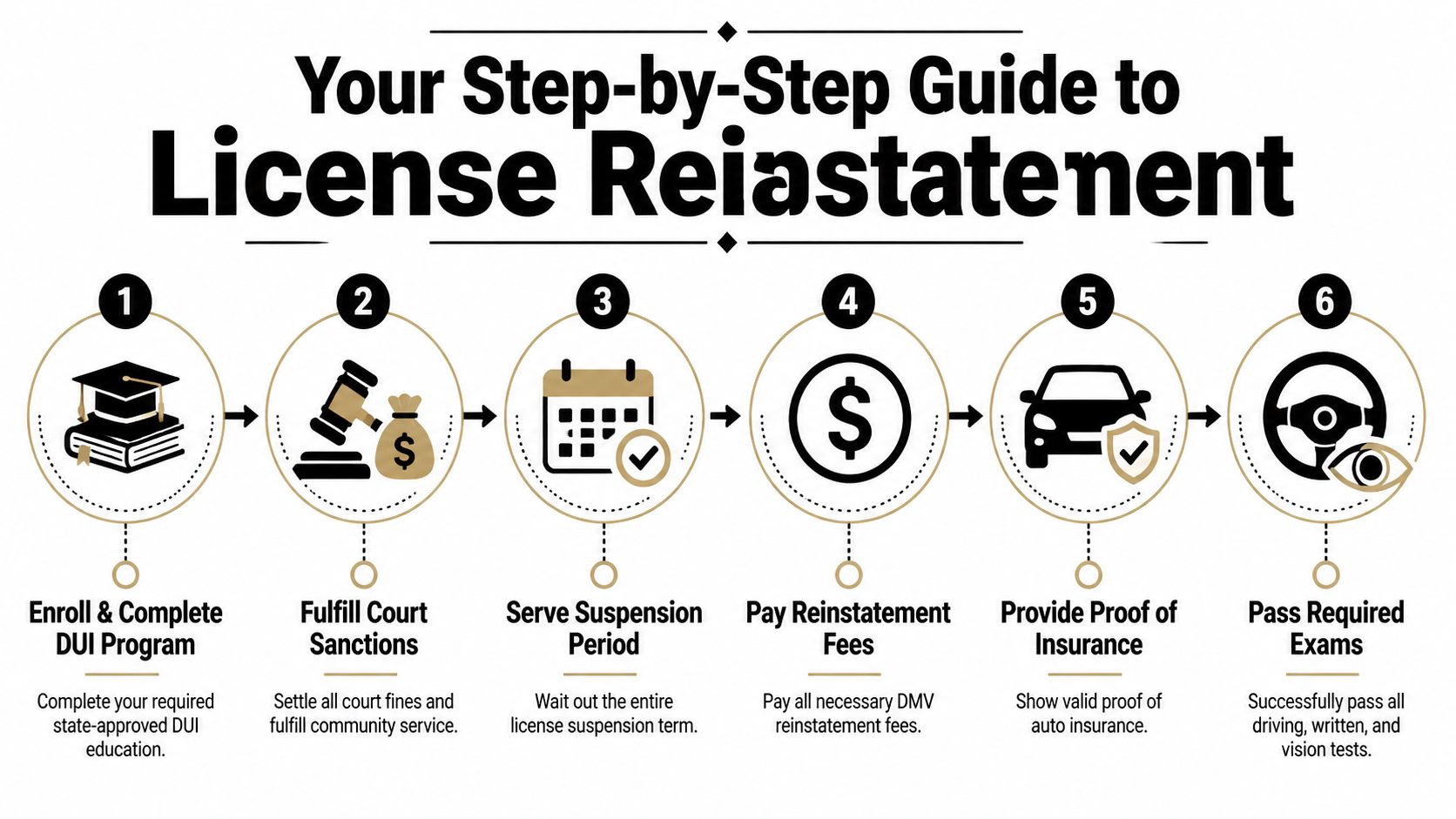
The reinstatement process feels easier once you stop seeing it as one giant problem and start seeing it as a checklist. Most drivers don�t fail because the steps are impossible. They fail because they miss one document, one class, or one condition.
Early in the process, many drivers benefit from reviewing a practical Florida license reinstatement checklist so they can track requirements in one place.
Here�s the roadmap.
Start with the required program and evaluation
If your case involves DUI-related reinstatement, the state may require a state-approved DUI program and a substance abuse evaluation. That evaluation is not the same thing as a basic traffic course for moving violations.
The evaluator looks at your history and may recommend education, treatment, or monitoring before the state restores driving privileges. If you�re unsure what that evaluation is supposed to involve, this overview of the first steps in addiction recovery gives a useful plain-language explanation of how substance abuse evaluations are generally structured.
Complete every follow-up requirement
This is the part drivers most want to negotiate around. They ask, �Can I just finish the class and skip the rest?�
Usually, no.
If the evaluation recommends treatment or follow-up, the FLHSMV may expect proof that you completed it. Partial compliance is still noncompliance. Keep copies of every completion record, discharge paper, and compliance report.
Important: A DUI program is separate from a standard point-reduction or driver-improvement course.
Handle insurance and interlock conditions
Many reinstatement cases require proof of insurance in a specific form. Some drivers also must install an Ignition Interlock Device before they can lawfully drive again.
An IID changes daily life more than people expect. You have to plan for startup tests, device maintenance, and careful compliance. Missed calibrations or device violations can create new problems.
A short explainer can help some drivers visualize the process before they start:
Gather paperwork before you go back to the state
Don�t show up or log in with half your file.
Bring or upload what applies to your case, such as:
- Completion proof: DUI school certificate, treatment records, or evaluation documents
- Insurance proof: Any required filing tied to reinstatement
- Identity documents: Your standard license-related identification paperwork
- Interlock compliance records: If installation was required
- Payment readiness: Reinstatement and related state fees
CDL drivers face a harder version of this
Commercial drivers need to be especially careful. The federal system is unforgiving. The FMCSA reports an alcohol violation rate for CDL drivers of about 0.05%, but a single positive test or refusal leads to a minimum one-year disqualification, according to the FMCSA drug and alcohol survey material-Drug_and_Alcohol_Survey_Results_FINAL-508C.pdf).
That low violation rate doesn�t mean the issue is minor. It means the system catches relatively few violations and punishes them severely.
One mistake to avoid
Don�t assume any course with �driver improvement� in the name will satisfy a DUI reinstatement requirement. Florida separates these pathways for a reason. A court-ordered or DUI-related requirement usually calls for a specific approved program, not a substitute you found online because it looked similar.
Preventing Violations with Proactive Driver Education
Most serious license problems don�t begin with the worst mistake a driver ever makes. They often begin with smaller patterns. Rushing. Following too closely. Driving upset. Using poor judgment about fatigue, alcohol, medication, or mixed substances.
That�s why proactive education matters.

Education fills the gaps drivers don�t know they have
Many drivers think they understand impairment because they know the phrase �don�t drink and drive.� But real-world risk is broader than that. It includes prescription medication, cannabis, combinations of substances, delayed effects, and bad decisions made before anyone feels �drunk.�
The hidden problem of stop-limit testing shows why broader education matters. Labs may stop drug screening after finding a high alcohol result, which means drug involvement can be underreported, as noted in the earlier NIJ discussion. In plain terms, people may leave a case believing alcohol was the whole story when it wasn�t.
Smaller violations can be early warning signs
A basic moving violation doesn�t make someone a dangerous driver. But repeated poor choices can create a pattern. That�s where education can help interrupt the cycle before it becomes a DUI, crash, or suspension problem.
Helpful topics include:
- Defensive driving habits: Better spacing, scanning, and speed control
- Risk awareness: Recognizing when you�re not fit to drive
- Behavior correction: Understanding how anger, distraction, and overconfidence affect judgment
- Impaired driving education: Learning how alcohol and drugs change reaction, attention, and decision-making
Drivers don�t need more shame. They need clearer judgment before the next bad decision happens.
If you want a Florida-focused course that addresses these issues in a preventive setting, this Florida drug and alcohol course is one example of structured education aimed at safer choices before a major violation occurs.
Frequently Asked Questions About Florida DMV Testing
What happens if I refuse a breathalyzer test in Florida
Refusal can trigger license consequences under Florida�s implied consent framework. The exact impact depends on your case history and circumstances, but the main lesson is simple. Refusal is not a free pass. It usually creates a separate problem for your driving privileges.
Can I take a BDI course to remove a DUI from my record
No. A Basic Driver Improvement course is not the same as a state-mandated DUI program. BDI is generally for eligible moving violations and point-related situations. It does not erase a DUI or replace DUI-specific requirements.
How long does a DUI affect my Florida driving record
A DUI can affect your record for a long time, and the practical effect may continue through insurance, employment, and licensing issues. The exact legal treatment can depend on the type of record being reviewed, so drivers should check both court and FLHSMV requirements rather than relying on hearsay.
What is the difference between an IDI course and a DUI program
An Intermediate Driver Improvement course is generally used for court-ordered traffic education or more serious non-DUI driving issues. A DUI program is a separate state-approved path tied to alcohol or drug-related driving cases and usually includes more specialized evaluation requirements.
Will the FLHSMV and the court always make the same decision
No. They�re separate systems. The court handles criminal charges. The FLHSMV handles licensing and driving privilege issues. A result in one process doesn�t automatically control the other.
If I already feel lost, what should I do first
Read your notice carefully, identify every deadline, keep all documents together, and confirm whether your issue is a DUI-program matter, a license-reinstatement matter, or a standard traffic-school matter. Drivers get into trouble when they assume those are interchangeable.
If you need a flexible Florida-approved traffic school option for eligible non-DUI situations, BDISchool offers online courses designed to help drivers handle points, court requirements, and insurance-related goals while building safer long-term habits.